Reduced vs Full Dose Direct Oral Anticoagulants in Extended Treatment of Venous Thromboembolism: A Systematic Review and Meta-Analysis
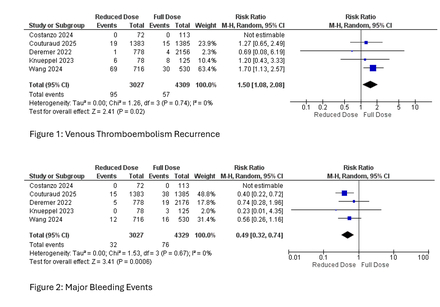
Abstract Body (Do not enter title and authors here): Background: Direct oral anticoagulants (DOACs) have been commonly used for extended treatment following an episode of Venous Thromboembolism (VTE) to reduce the recurrence rate. However, the benefit of recurrence prevention must be weighed against the increased risk of bleeding. Conflicting evidence exists regarding the comparative effectiveness and safety of reduced-dose versus full-dose DOACs in this setting. Hypothesis: Are reduced-dose DOACs as effective and safe as full-dose DOACs in the extended treatment of VTE? Aims: To compare the efficacy and safety of reduced versus full-dose DOACs for extended VTE treatment. Methods: We conducted a systematic search in PubMed, Google Scholar, ScienceDirect, Cochrane Library, and PLOS ONE from inception to May 10, 2025. We used RevMan 5.4.1 version to make statistical calculations and a random effects model to calculate the pooled relative risk (RR) values with their corresponding 95% confidence intervals (CI). Heterogeneity among the studies was assessed using the I2 statistic. A p-value of less than 0.05 was considered statistically significant. Results: A total of 7,356 patients (Reduced Dose: 3,027, Full Dose: 4,329) from four cohorts and one randomized controlled trial were included in the study. The mean age of participants was 66.81±14.97 years in the full-dose group and 64.87±14.23 years in the reduced-dose group, with 51.6% male overall. The VTE recurrence was higher in the reduced-dose group compared to the standard dose (RR, 1.50, CI: 1.08-2.08, I2=0%, p<0.05); however, bleeding events, such as major bleeding (RR, 0.49, CI: 0.32-0.74, I2=0%, p<0.05) and CRNMB (RR, 0.66, CI: 0.50-0.88, I2=18%, p<0.05), were significantly lower in the reduced group. The all-cause mortality events showed no significant difference (RR, 0.93, CI: 0.47-1.81, I2=85%, p=0.83) between the groups. Conclusions: Reduced-dose DOACs are associated with significantly lower rates of major and non-major bleeding compared to full-dose regimens in the extended treatment of VTE but carry a higher risk of VTE recurrence. Mortality rates were similar. Further randomized trials are warranted to determine the optimal long-term anticoagulation strategy.
Adhikari, Ashok
(
Universal College of Medical Sciences
, Bhairahawa , Nepal )
Shrestha, Apsha
(
Universal College of Medical Sciences
, Bhairahawa , Nepal )
Malapati, Sai Nikhitha
(
Kamineni Academy of Medical Science
, Hyderabad , India )
Baniya, Abinash
(
Chitwan Medical College
, Bharatpur , Nepal )
Makarla, Venkata Akhil
(
Mamata Medical College
, Khammam , India )
Ashok Adhikari:DO NOT have relevant financial relationships
| Apsha Shrestha:DO NOT have relevant financial relationships
| Sai Nikhitha Malapati:DO NOT have relevant financial relationships
| Abinash Baniya:DO NOT have relevant financial relationships
| Venkata Akhil Makarla:DO NOT have relevant financial relationships
| Dr. NEELAM JAISHWAL:DO NOT have relevant financial relationships
Bueno Claudia, Souza Barbara, Santos Aline, Da Silva Ferreira Laíse Jorrana, Varao Thawanny, Cunha Carneiro Maria Angelica, Gomes Laysa, Teixeira Costa Ana Carolina, Miranda Luana, Martin Joelma, Rocha Nathalia, Dias Adria