Logo

American Heart Association

  22
  0


Final ID: MP1577

Elevated Right Atrial to Pulmonary Capillary Wedge Pressure Ratio Within 1 Year From Unplanned Ventricular Tachycardia Ablation Predicts Periprocedural Acute Kidney Injury and Hemodynamic Instability

Abstract Body (Do not enter title and authors here): Background: Risk stratification for patients undergoing urgent ventricular tachycardia (VT) ablation remains limited, especially regarding right heart dysfunction. We investigated whether the right atrial pressure (RAP) to pulmonary capillary wedge pressure (PCWP) ratio or pulmonary artery pulsatility index (PAPi) predicts in-hospital outcomes following urgent VT ablation.
Methods: We retrospectively analyzed 102 consecutive patients who underwent unplanned (urgent or emergent) inpatient ventricular tachycardia (VT) ablation and had right heart catheterization (RHC) performed within the preceding 12 months. All patients were admitted with recurrent VT, of these 67 patients (66%) had VT storm. Patients were stratified by RAP: PCWP >0.6 versus ≤0.6 and PAPi <2 versus ≥2. Primary outcomes included post-procedural acute kidney injury (AKI, per kidney disease: Improving Global Outcomes [KDIGO] criteria) and intra-procedural hemodynamic instability. Multivariable logistic regression adjusted for age, sex, left ventricular ejection fraction (LVEF), New York Heart Association (NYHA) class, ischemic cardiomyopathy, context of RHC (outpatient vs inpatient) and moderate-to-severe mitral and tricuspid regurgitation (MR, TR).
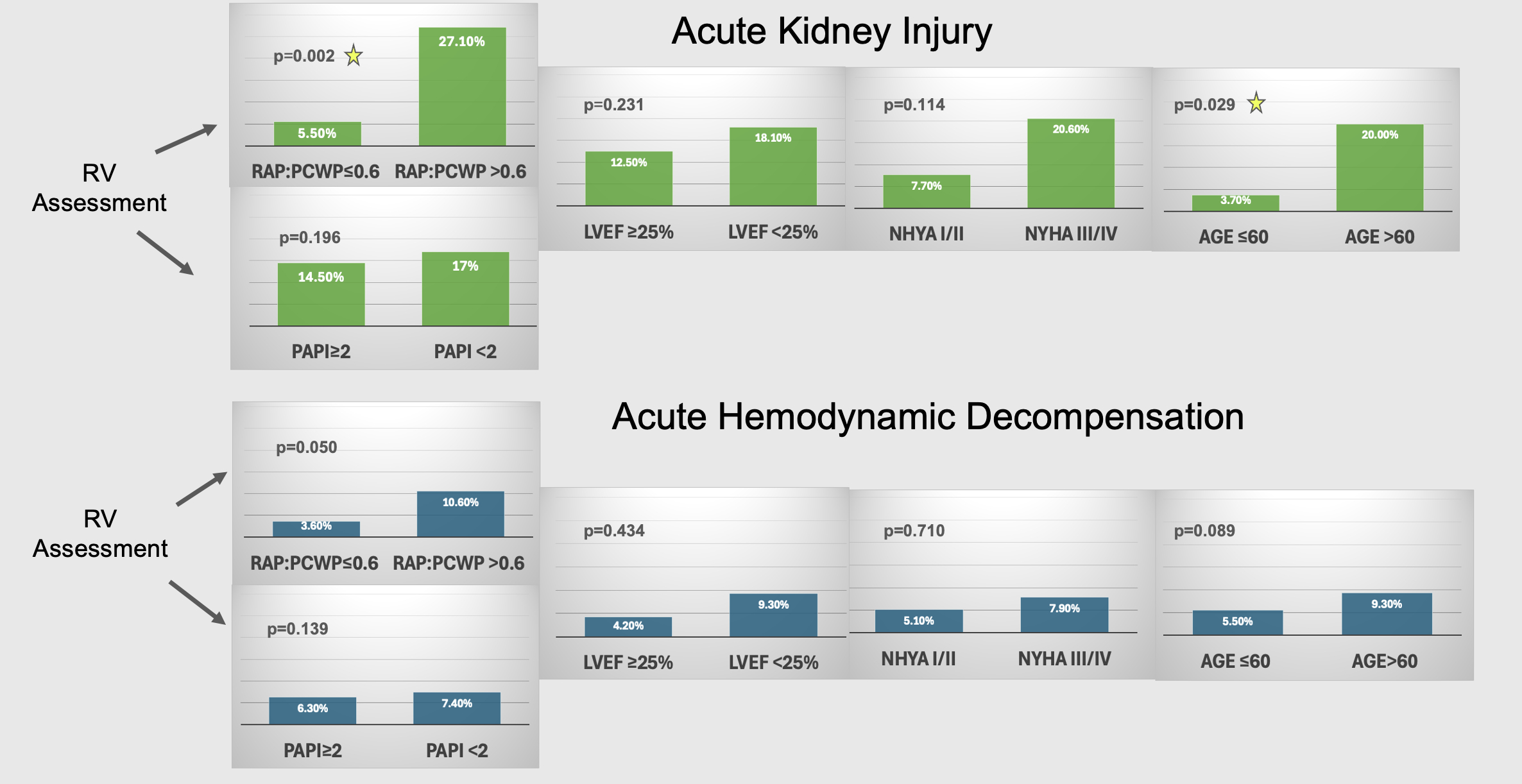
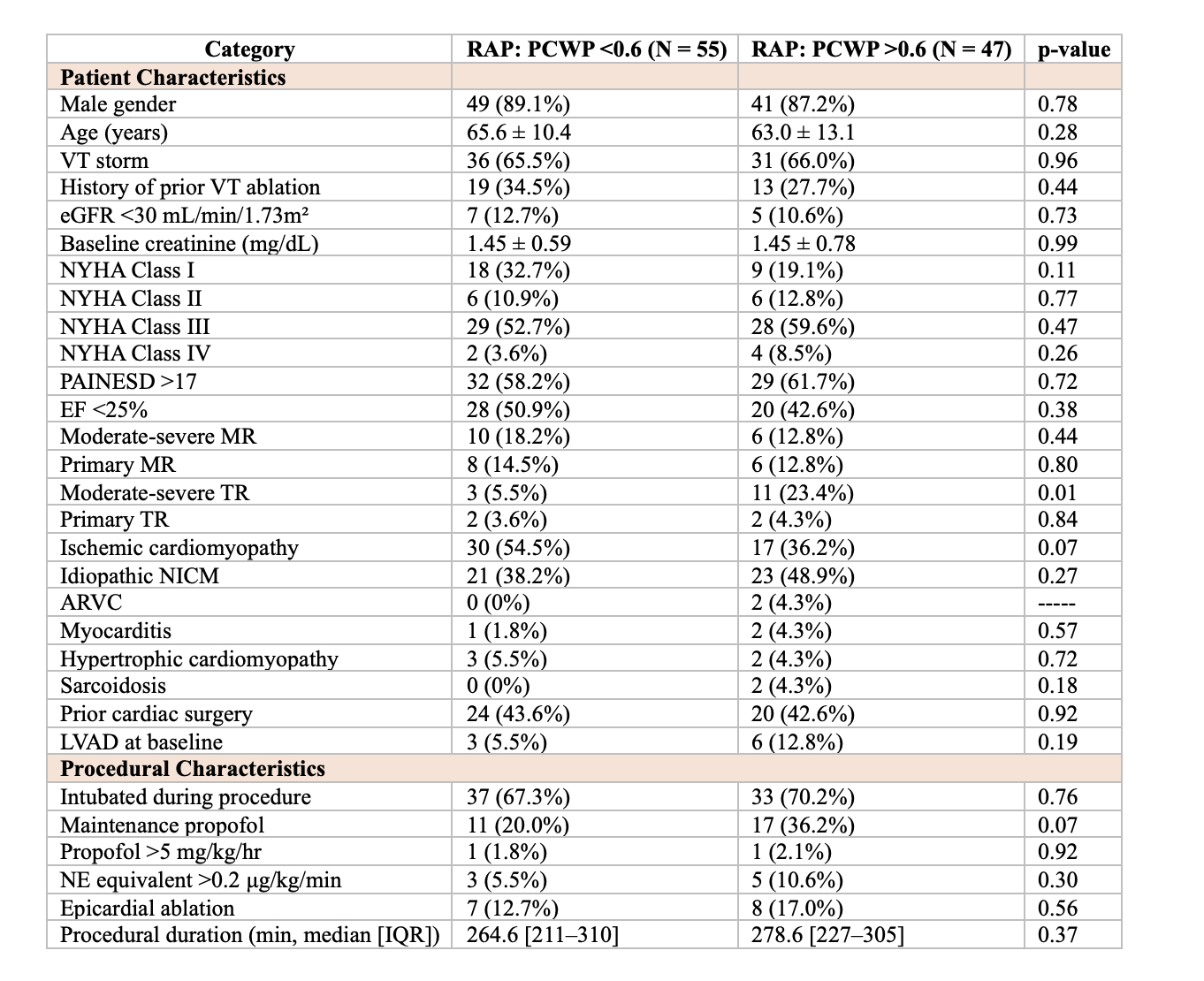
Results: We analyzed 102 consecutive inpatients admitted for urgent inpatient VT ablation, all of whom had right heart catheterization within the prior year. The overall cohort was predominantly male (88%), with a mean age of 64 years, and a high burden of advanced heart failure, including LVEF <25% in 47% and NYHA class III–IV symptoms in 58% (Table 1). After multivariable adjustment, RAP: PCWP >0.6 independently predicted AKI (odds ratio [OR] 10.4, 95% confidence interval [CI] 2.4–14.1, p=0.002) and hemodynamic instability (OR 6.1, 95% CI 1.5–16.3, p=0.050). AKI was also significantly more frequent in patients over 60 (OR 12.8, 95% CI 1.3-21.3). Notably, LVEF<25% and NYHA III-IV were not significantly associated with these outcomes (Figure 1). Furthermore, PAPi <2 was not significantly associated with adverse outcomes.
Conclusion: Among patients undergoing urgent inpatient VT ablation, an elevated RAP:PCWP ratio, but not PAPi, identifies individuals at heightened risk of AKI and intra-procedural hemodynamic instability. Incorporating RAP:PCWP into preprocedural assessment may improve risk stratification, perioperative planning, and patient selection.
  • Calcagno, Tess  ( Cleveland Clinic , Cleveland , Ohio , United States )
  • Dresing, Thomas  ( Cleveland Clinic Foundation , Cleveland , Ohio , United States )
  • Hussein, Ayman  ( Cleveland Clinic , Cleveland , Ohio , United States )
  • Kanj, Mohamed  ( Cleveland clinic , Cleveland , Ohio , United States )
  • Kochar, Arshneel  ( Cleveland Clinic , Cleveland , Ohio , United States )
  • Martin, David  ( Cleveland Clinic , Cleveland , Ohio , United States )
  • Saliba, Walid  ( CLEVELAND CLINIC , Cleveland , Ohio , United States )
  • Taigen, Tyler  ( Cleveland Clinic , Cleveland , Ohio , United States )
  • Varma, Niraj  ( Cleveland Clinic , Cleveland , Ohio , United States )
  • Higuchi, Koji  ( Cleveland Clinic , Cleveland , Ohio , United States )
  • Nakhla, Shady  ( Cleveland Clinic , Cleveland , Ohio , United States )
  • Karthik, V  ( Cleveland Clinic , Cleveland , Ohio , United States )
  • Lee, Justin  ( Cleveland Clinic , Cleveland , Ohio , United States )
  • Wazni, Oussama  ( Cleveland Clinic Foundation , Cleveland , Ohio , United States )
  • Santangeli, Pasquale  ( Cleveland Clinic , Cleveland , Ohio , United States )
  • Sroubek, Jakub  ( Cleveland Clinic , Cleveland , Ohio , United States )
  • Mendpara, Vaidehi  ( Cleveland Clinic , Cleveland , Ohio , United States )
  • Cesmat, Andrew  ( Cleveland Clinic , Cleveland , Ohio , United States )
  • Sipko, Joseph  ( Cleveland Clinic , Cleveland , Ohio , United States )
  • Baranowski, Bryan  ( Cleveland Clinic , Cleveland , Ohio , United States )
  • Bhargava, Mandeep  ( Cleveland Clinic , Cleveland , Ohio , United States )
  • Callahan, Thomas  ( CLEVELAND CLINIC FOUNDATION , Cleveland , Ohio , United States )
  • Chung, Mina  ( CLEVELAND CLINIC , Cleveland , Ohio , United States )
  • Author Disclosures:
    Tess Calcagno: DO NOT have relevant financial relationships | Thomas Dresing: DO NOT have relevant financial relationships | Ayman Hussein: No Answer | Mohamed Kanj: No Answer | Arshneel Kochar: DO NOT have relevant financial relationships | David Martin: No Answer | Walid Saliba: DO have relevant financial relationships ; Advisor:Boston Scientific:Active (exists now) | Tyler Taigen: DO have relevant financial relationships ; Consultant:Boston Scientific:Active (exists now) ; Consultant:Medtronic:Active (exists now) | Niraj Varma: DO have relevant financial relationships ; Consultant:Abbott:Active (exists now) ; Consultant:EBR:Active (exists now) ; Consultant:Impulse Dynamics:Active (exists now) | Koji Higuchi: DO NOT have relevant financial relationships | Shady Nakhla: No Answer | V Karthik: No Answer | Justin Lee: DO NOT have relevant financial relationships | Oussama Wazni: DO NOT have relevant financial relationships | Pasquale Santangeli: No Answer | Jakub Sroubek: DO have relevant financial relationships ; Speaker:Abbott:Active (exists now) ; Research Funding (PI or named investigator):Abbott:Active (exists now) | Vaidehi Mendpara: No Answer | Andrew Cesmat: DO NOT have relevant financial relationships | Joseph Sipko: DO NOT have relevant financial relationships | Bryan Baranowski: No Answer | Mandeep Bhargava: DO NOT have relevant financial relationships | Thomas Callahan: DO have relevant financial relationships ; Speaker:Medtronic:Active (exists now) ; Speaker:Boston Scientific:Active (exists now) ; Speaker:Abbott:Active (exists now) ; Speaker:Philips:Active (exists now) | Mina Chung: DO NOT have relevant financial relationships
Meeting Info:

Scientific Sessions 2025

2025

New Orleans, Louisiana

Session Info:

Advances in VT: Cutting-Edge Therapies, Techniques, and Risk Management

Sunday, 11/09/2025 , 11:50AM - 01:05PM

Moderated Digital Poster Session

More abstracts from these authors:
Cardiovascular, Kidney, and Metabolic (CKM) Syndrome is associated with increased risk for arrhythmia recurrence following atrial fibrillation (AF) ablation

Wass Sojin, Lee Justin, Martin David, Saliba Walid, Santangeli Pasquale, Sroubek Jakub, Taigen Tyler, Varma Niraj, Wazni Oussama, Chung Mina, Younis Arwa, Baranowski Bryan, Bhargava Mandeep, Callahan Thomas, Higuchi Koji, Hussein Ayman, Kanj Mohamed, Kochar Arshneel

Substrate Characterization and Outcomes of Catheter Ablation of Ventricular Tachycardia in Patients with Non-Ischemic Dilated Cardiomyopathy and Isolated Apical Scar

Liao Yi Wen Becky, Hussein Ayman, Kanj Mohamed, Kochar Arshneel, Koeth Robert, Lee Justin, Martin David, Mayuga Kenneth, Nakhla Shady, Rickard John, Saliba Walid, Baranowski Bryan, Sroubek Jakub, Taigen Tyler, Varma Niraj, Wazni Oussama, Santangeli Pasquale, Bhargava Mandeep, Callahan Thomas, Chung Mina, Courson Jeffery, Dresing Thomas, Higuchi Koji, Hight Nolan

You have to be authorized to contact abstract author. Please, Login
Not Available