
Impact of Early Reimplantation after Transvenous Lead Extraction of Infected Cardiac Implantable Electronic Device
Abstract Body (Do not enter title and authors here): ABSTRACT Background Transvenous lead extraction (TLE) is the standard of care for cardiac implantable electronic device (CIED) infections. Data regarding the optimal timing of CIED reimplantation after TLE are not well established.
Objective This study aims to assess the 5-year outcomes of early (≤7 days) versus non-early (>7 days) CIED reimplantation following TLE for CIED infection using a multi-national database.
Methods Using the TriNetX Analytics Research Network, we included patients aged ≥18 years who underwent TLE for CIED infection between 1/1/2014 and 1/1/2020. Patients were further categorized into two groups: early CIED reimplantation (≤7 days from TLE) and non-early CIED reimplantation. Propensity score matching (PSM) was performed by including patient demographics, LVEF, cardiac comorbidities and medications. The study outcomes included all-cause mortality and cardiac adverse events during a 5-year study period.
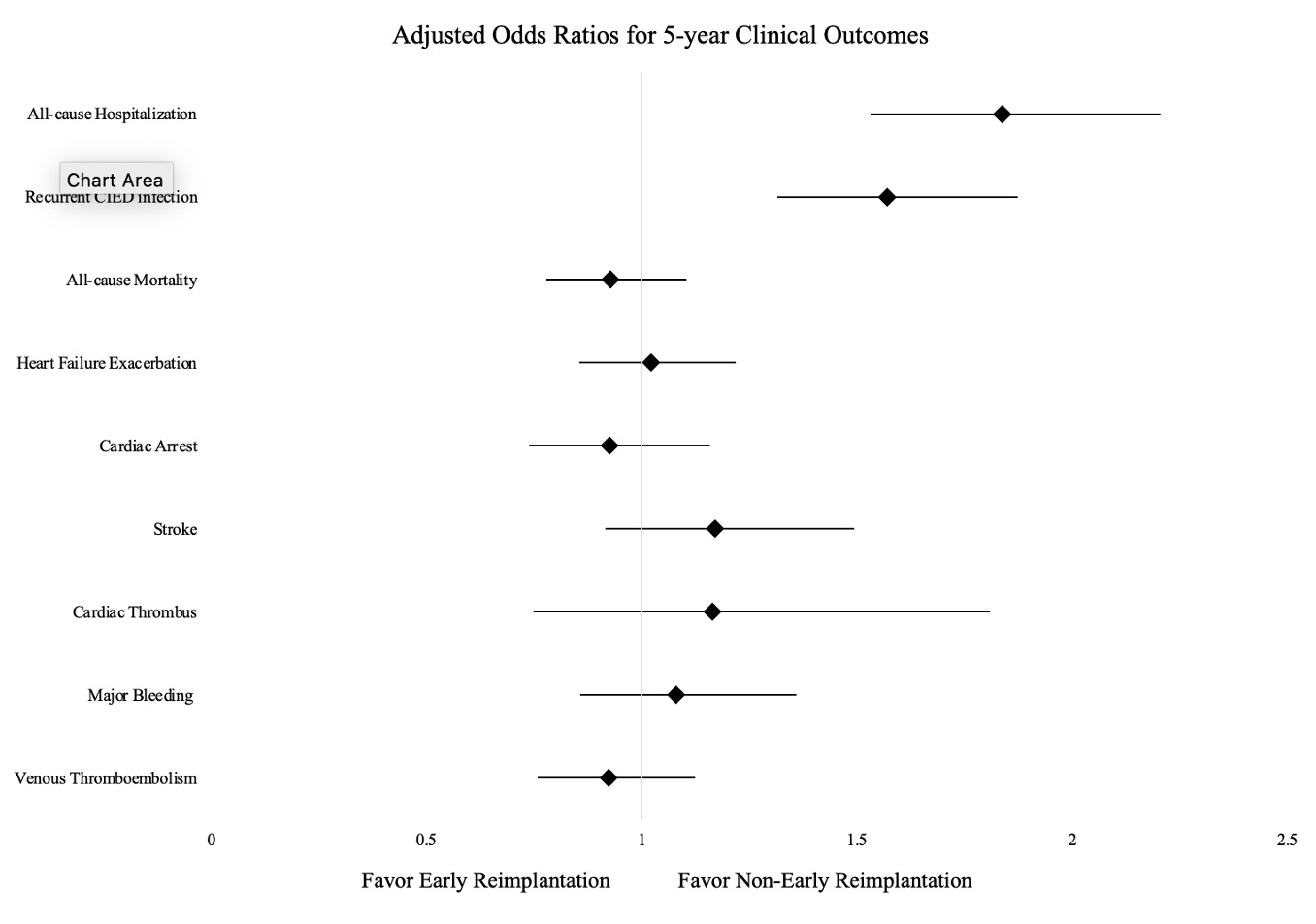
Results A total of 1668 patients in the early CIED reimplantation group and 1550 in the non-early group were identified. After PSM, 1327 patients in each group were analyzed. Compared to non-early group, early CIED reimplantation group was associated with significantly higher odds of all-cause hospitalization (odds ratio [OR]: 1.837, 95% confidence interval [CI]: 1.532-2.203) and repeated device infection (OR: 1.569, 95% CI: 1.314-1.873) at 5-year follow-up. However, no significant differences were observed in all-cause mortality (OR: 0.927, 95% CI: 0.778-1.104), HF exacerbation (OR: 1.021, 95% CI: 0.855-1.218), cardiac arrest (OR:0.924, 95% CI: 0.739-1.157), stroke (OR: 1.169, 95% CI: 0.915-1.494), cardiac thrombus (OR: 1.163, 95% CI: 0.749-1.808), major bleeding (OR: 1.079, 95% CI: 0.857-1.358) and venous thromboembolism (OR: 0.923, 95% CI: 0.759-1.123) between the two groups.
Conclusion Early reimplantation of CIED following TLE of infected devices was associated with worse outcomes in all-cause hospitalization and repeated device infection. Further large prospective studies are needed to define the optimal timing of device reimplantation.
Sin, Yuh Miin
( Mayo Clinic
, Phoenix
, Arizona
, United States
)
Tan, Min Choon
( Mayo Clinic AZ
, Kearny
, New Jersey
, United States
)
Vignarajah, Aravinthan
( Cleveland Clinic Fairview Hospital
, Fairview Park
, Ohio
, United States
)
Ibrahim, Ramzi
( Mayo Clinic
, Scottsdale
, Arizona
, United States
)
Tamirisa, Kamala
( Texas Cardiac Arrhythmia Institute
, Southlake
, Texas
, United States
)
Russo, Andrea
( Cooper University Health Care
, Moorestown
, New Jersey
, United States
)
Sorajja, Dan
( MAYO CLINIC
, Phoenix
, Arizona
, United States
)
El Masry, Hicham
( Mayo CLinic AZ
, Phoenix
, Arizona
, United States
)
Author Disclosures:
Yuh Miin Sin:DO NOT have relevant financial relationships
| Min Choon Tan:DO NOT have relevant financial relationships
| Aravinthan Vignarajah:DO NOT have relevant financial relationships
| Ramzi Ibrahim:DO NOT have relevant financial relationships
| Kamala Tamirisa:DO have relevant financial relationships
;
Speaker:abbott medical:Past (completed)
; Advisor:boston scientific:Active (exists now)
| Andrea Russo:DO have relevant financial relationships
;
Research Funding (PI or named investigator):Abbott, Bayer, Boston Scientific, Medtronic and Novartis:Active (exists now)
; Royalties/Patent Beneficiary:Royalties (writing/editing): UpToDate:Active (exists now)
; Other (please indicate in the box next to the company name):Fellowship support: Medtronic:Active (exists now)
; Consultant:Abbott, Atricure, Bayer, Sanofi:Past (completed)
; Consultant:Biosense Webster, Biotronik, Boston Scientific, Medtronic, Orchestra BioMed, PaceMate :Active (exists now)
| Dan Sorajja:DO NOT have relevant financial relationships
| Hicham El Masry:No Answer