
Logo

American Heart Association

  13
  0


Final ID: MP2168

Validation of Ring-Type Cuffless Blood Pressure (BP) Monitoring Device for Detecting Awake-Asleep BP Variations Compared to Ambulatory BP Monitoring Device

Abstract Body (Do not enter title and authors here): Introduction
Based on recommendations for validating cuffless BP devices by the European Society of Hypertension (ESH), this is the first validation study assessing the accuracy of CART BP, a ring-type cuffless blood pressure (BP) monitoring device, in detecting awake-asleep BP variations compared to conventional 24-hour ambulatory BP monitoring (ABPM). Unlike traditional cuff-based methods, the ESH validation criteria for cuffless devices emphasize assessing the device's capability to accurately track variations in BP, crucial for their clinical applicability.

Hypothesis
We hypothesized that the CART BP device would reliably detect awake-asleep BP variations compared to ABPM, demonstrating a high correlation (correlation coefficient ≥0.7) within an error margin of 5±8 mmHg (mean±standard deviation).

Methods
Participants were consecutively selected from initially recruited patients to ensure compliance with ESH recommendations: 30% with systolic BP (SBP) ≥130 mmHg and diastolic BP (DBP) ≥80 mmHg, and 30% with SBP <120 mmHg and DBP <70 mmHg, with the remaining 40% included sequentially based on recruitment order. Calibration of the CART BP device was performed at least 24 hours prior to monitoring. Participants simultaneously wore both the CART BP and ABPM devices on the non-dominant arm for 24 hours. Mean SBP/DBP values were calculated from ABPM and CART BP readings. The SBP/DBP changes between awake and asleep periods were compared.

Results
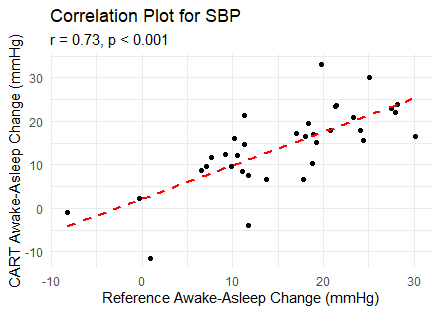
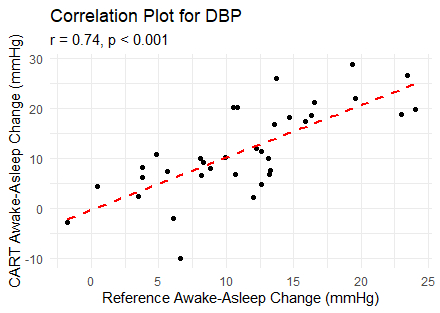
Of the 84 initially recruited participants, 35 were included in the final analysis: 30% (N=11) had SBP/DBP ≥130/80 mmHg, 30% (N=11) had SBP/DBP <120/70 mmHg, and the remaining 40% (N=13) were enrolled sequentially. The awake-asleep SBP/DBP changes were 15.61±8.74 / 11.35±6.22 mmHg with ABPM, and 14.15±9.18 / 11.61±8.85 mmHg with CART BP. Correlation coefficients were 0.73 for SBP and 0.74 for DBP (p<0.001 for both). Mean differences in awake-asleep BP changes between CART BP and ABPM were -1.46±6.57 mmHg for SBP and 0.26±5.98 mmHg for DBP, with no significant differences (p=0.197 and 0.798, respectively). The prevalence of dippers (74.3% VS 60%, p=0.131) was comparable between both devices.

Conclusion
CART BP demonstrated acceptable accuracy in detecting diurnal BP variations, aligning with ESH validation standards for cuffless BP monitoring devices.
  • Lee, Seung-mok  ( Seoul National University Hospital , Seoul , Korea (the Republic of) )
  • Koo, Bon-kwon  ( Seoul National University Hospital , Seoul , Korea (the Republic of) )
  • Lee, Hae-young  ( Seoul National University Hospital , Seoul , Korea (the Republic of) )
  • Author Disclosures:
    Seung-Mok Lee: DO NOT have relevant financial relationships | Bon-Kwon Koo: No Answer | Hae-Young Lee: DO NOT have relevant financial relationships
Meeting Info:

Scientific Sessions 2025

2025

New Orleans, Louisiana

Session Info:

Potpourri: Hypertension Emergencies, Hypertension in the Young, Hypertension Screening

Monday, 11/10/2025 , 01:45PM - 02:40PM

Moderated Digital Poster Session

More abstracts on this topic:
You have to be authorized to contact abstract author. Please, Login
Not Available