Patient Preferences for Antithrombotic Therapy for Stroke Prevention in Device-Detected Subclinical Atrial Fibrillation: A Probability Trade-Off Interview Study
Abstract Body (Do not enter title and authors here): Introduction Device-detected subclinical atrial fibrillation (AF) is common in patients with implanted cardiac rhythm devices. The ARTESiA trial demonstrated that in patients with subclinical AF, apixaban, as compared to aspirin, reduced stroke (0.98% versus 2.25% per year, 5 fewer strokes in 4 years with CHA2DS2-VASc > 4). However, apixaban also increased major bleeding (2.13% vs 1.45% per year, 2.72 more bleeds in 4 years with CHA2DS2-VASc > 4). Our objective was to estimate patient thresholds for stroke prevention and bleeding avoidance, as these factors may influence treatment decisions.
Methods Trained interviewers enrolled patients with a CHA2DS2-VASc score ≥ 4 (irrespective of AF history) from a tertiary care pacemaker/defibrillator clinic. Participants underwent a structured interview with a probability trade-off tool. We determined risk thresholds for the minimum 4-year reduction in stroke necessary to prefer apixaban compared to aspirin (minimal important difference, stroke MID) and the maximum tolerable number of major bleeds to prevent one stroke (maximum allowable difference, bleed MAD).
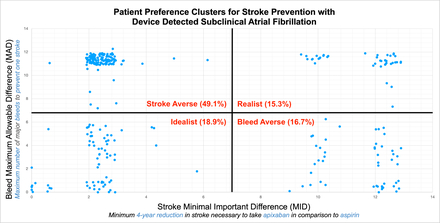
We grouped participants into one of four preference clusters: stroke averse (accepting of bleeds to prevent stroke), bleeding averse (accepting of stroke to prevent bleeds), realist (accepting of stroke or bleed) and idealist (unwilling to accept stroke or bleed).
Results Among 415 individuals approached, 300 participants consented and 275 completed the full interview. Mean age was 81.5 ± 6.9 years, 55.3% were female, median CHA2DS2-VASc score was 4 (IQR 4-5), and 148 (53.8%) had a history of AF.
The overall mean stroke MID was 5.0 ± 4.5, meaning that on average, patients require a 5% reduction in stroke over 4 years of follow up to justify apixaban over aspirin. The overall bleed MAD was 8.0 ± 4.0, meaning that on average, patients were willing to endure 8 additional major bleeds to prevent one stroke. The highest proportion of participants were stroke averse (49.1%); a minority were bleeding averse (16.7%), realist (15.3%) and idealist (18.9%) [Figure].
Conclusions
Among patients with a cardiac rhythm device and CHA2DS2-VASc ≥ 4, the mean stroke risk reduction to justify the increased bleeding risk on apixaban, as compared to aspirin, is in line with the reduction in stroke seen for patients with subclinical AF in ARTESiA. Patients will accept a mean 8 additional bleeds to prevent one stroke. Patients are 3 times more likely to be stroke averse than bleeding averse.
Suri, Rubani
( McMaster University
, Hamilton
, Ontario
, Canada
)
Devereaux, Pj
( Population Health Research Institute
, Hamilton
, Ontario
, Canada
)
Lopes, Renato
( DUKE CLINICAL RESEARCH
, Durham
, North Carolina
, United States
)
Mcintyre, William
( Population Health Research Institute
, Hamilton
, Ontario
, Canada
)
Xie, Feng
( McMaster University
, Hamilton
, Ontario
, Canada
)
Healey, Jeff
( Population Health Research Institute
, Hamilton
, Ontario
, Canada
)
Hills, Mellanie
( StopAfib.org
, Greenwood
, Texas
, United States
)
Lobban, Trudie
( Arrhythmia Alliance AF Assoc
, Hilton Head Island
, South Carolina
, United States
)
Diao, Melzee
( McMaster University
, Hamilton
, Ontario
, Canada
)
Ribas, Catalina
( McMaster University
, Hamilton
, Ontario
, Canada
)
Siegal, Deborah
( University of Ottawa
, Ottawa
, Ontario
, Canada
)
Benz, Alexander
( Population Health Research Institute
, Hamilton
, Ontario
, Canada
)
Author Disclosures:
Rubani Suri:DO NOT have relevant financial relationships
| PJ Devereaux:DO have relevant financial relationships
;
Research Funding (PI or named investigator):Abbott Diagnostics:Past (completed)
; Other (please indicate in the box next to the company name):Bayer - Advisory Board Member:Active (exists now)
; Consultant:Trimedic:Active (exists now)
; Consultant:Roche Canada:Active (exists now)
; Consultant:Astra Zeneca:Active (exists now)
; Consultant:Abbott Diagnostics:Active (exists now)
; Other (please indicate in the box next to the company name):CloudDX - medical devices:Active (exists now)
; Research Funding (PI or named investigator):Siemens:Past (completed)
; Research Funding (PI or named investigator):Roche Diagnostics:Active (exists now)
; Research Funding (PI or named investigator):AOP Pharma:Past (completed)
| Renato Lopes:DO have relevant financial relationships
;
Consultant:Pfizer:Active (exists now)
; Consultant:Medtronic:Past (completed)
; Research Funding (PI or named investigator):Pfizer:Past (completed)
; Research Funding (PI or named investigator):Bristol Myers Squibb:Past (completed)
; Consultant:Bristol Myers Squibb:Active (exists now)
; Consultant:Boehringer Ingelheim:Past (completed)
; Consultant:Bayer:Past (completed)
; Consultant:Novo Nordisk:Active (exists now)
; Consultant:Daiichi Sankyo:Past (completed)
| William McIntyre:DO have relevant financial relationships
;
Consultant:AtriCure:Active (exists now)
; Speaker:iRhythm:Past (completed)
| Feng Xie:No Answer
| Jeff Healey:DO have relevant financial relationships
;
Research Funding (PI or named investigator):BMS/Pfizer:Past (completed)
; Research Funding (PI or named investigator):Medtronic:Active (exists now)
; Research Funding (PI or named investigator):Boston Scientific:Active (exists now)
| Mellanie Hills:DO have relevant financial relationships
;
Employee:American Foundation for Women's Health:Active (exists now)
; Employee:True Hills, Inc:Active (exists now)
| Trudie Lobban:No Answer
| Melzee Diao:DO NOT have relevant financial relationships
| Catalina Ribas:No Answer
| Deborah Siegal:DO have relevant financial relationships
;
Independent Contractor:Astra Zeneca:Past (completed)
; Independent Contractor:Servier:Past (completed)
; Independent Contractor:BMS-Pfizer:Past (completed)
| Alexander Benz:DO have relevant financial relationships
;
Speaker:Bristol-Myers Squibb:Past (completed)
; Speaker:Bristol-Myers Squibb:Expected (by end of conference)
; Other (please indicate in the box next to the company name):Boston Scientific (participation in an educational program - Fellowship Herzrhythmus):Active (exists now)
; Speaker:AstraZeneca:Past (completed)
Johnson Neil, Kelly David, Oehrlein Elisabeth, Vandigo Joe, De Carvalho Fernanda, Gorre Celina, Hall Tanya, Hennessy Susan, Kazi Dhruv, Kotseva Kornelia, Petrie Patsy