
Logo

American Heart Association

  15
  0


Final ID: MP438

Time Since Menopause Shapes Women's Metabolome and Cardiovascular Risk

Abstract Body (Do not enter title and authors here): Introduction
The risk of cardiovascular disease (CVD) increases significantly after menopause in women. However, the metabolic mechanisms underlying this association remain insufficiently understood. Metabolomic profiling offers a novel approach to elucidate the biological pathways linking time since menopause (TSM) to CVD risk.
Hypothesis
We hypothesized that TSM is associated with specific metabolomic changes in postmenopausal women, and that these metabolomic alterations mediate the increased risk of CVD associated with longer TSM.
Methods
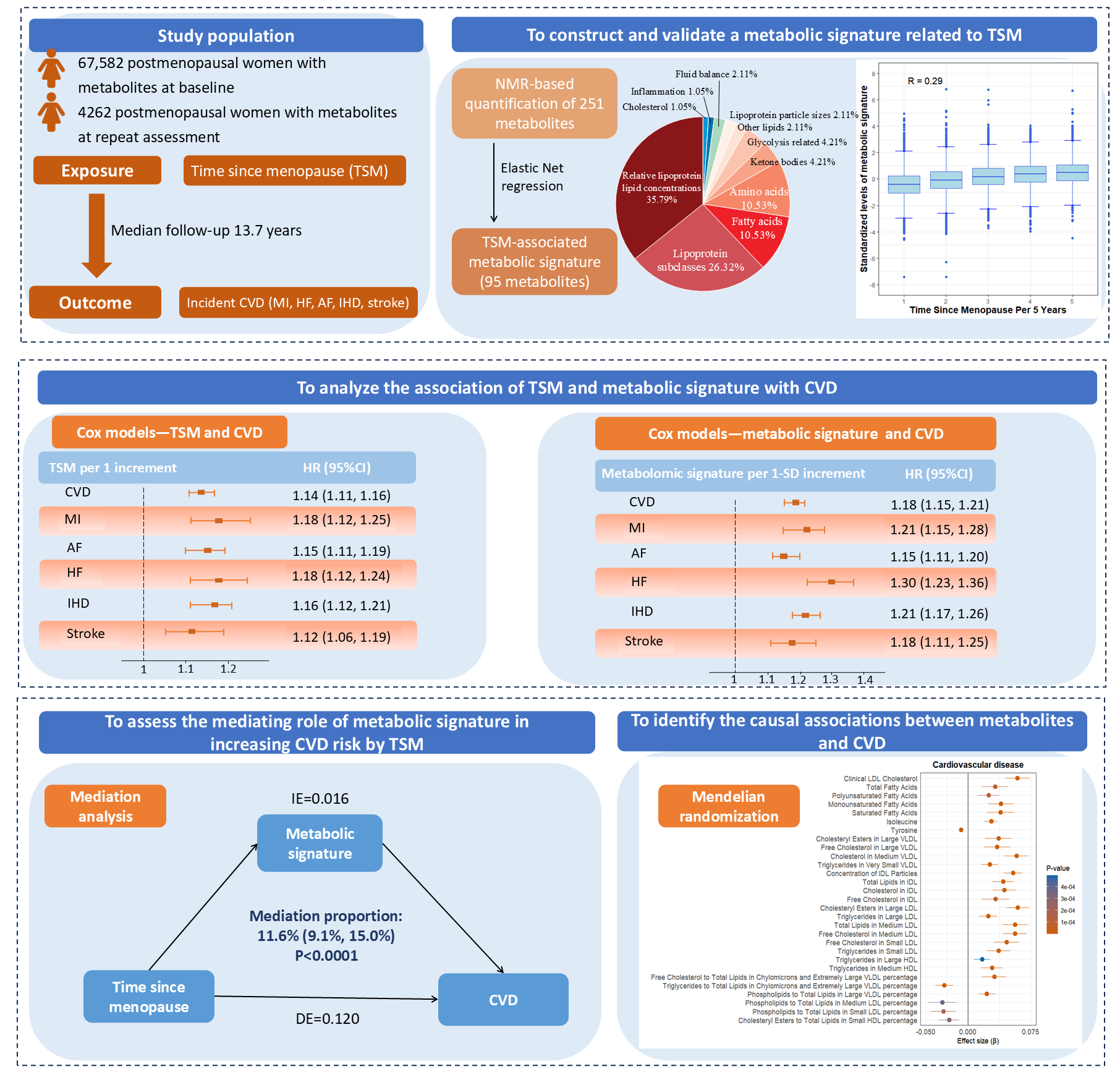
We used data from 67,582 postmenopausal women in the UK Biobank, all free of CVD at baseline. TSM was calculated as the duration from natural menopause to baseline age. Plasma metabolomic profiling quantified 251 metabolites using nuclear magnetic resonance. Elastic net regression was applied to identify a metabolomic signature associated with TSM. Cox proportional hazards models were used to estimate hazard ratios (HR) and 95% confidence intervals (CI) for the associations of TSM and the metabolomic signature with incident CVD, adjusting for demographic, socioeconomic, and lifestyle factors. Mediation analysis was conducted to assess the indirect effect of the metabolomic signature on TSM–CVD association. Mendelian randomization (MR) was performed to evaluate causal relationships between identified metabolites and CVD.
Results
During a median follow-up of 13.7 years, 8,313 women developed CVD. Ninety-five metabolites were identified as components of the TSM-related metabolomic signature. Each one-unit (5-year) increase in TSM (HR 1.14, 95% CI 1.11–1.16) and each 1-SD increase in the metabolomic signature (HR 1.18, 95% CI 1.15–1.21) were independently associated with elevated CVD risk after adjustment for confounders. Mediation analysis indicated that 11.6% of the association between TSM and CVD was mediated by the metabolomic signature. MR analyses confirmed causal roles for 29 metabolites in CVD development. Sensitivity and subgroup analyses showed robust and consistent results.
Conclusions
Longer time since menopause is associated with adverse metabolomic changes that increase CVD risk in postmenopausal women. The identified metabolomic signature mediates a significant proportion of this risk and may serve as a biomarker for CVD prevention. These findings underscore the importance of considering both TSM and metabolic profiles in CVD risk assessment and management among postmenopausal women.
  • Zhu, Dongshan  ( School of Public Health, Cheeloo College of Medicine, Shandong University , Jinan , China )
  • Wang, Qi  ( School of Public Health, Cheeloo College of Medicine, Shandong University , Jinan , China )
  • Xie, Bo  ( School of Public Health, Cheeloo College of Medicine, Shandong University , Jinan , China )
  • Author Disclosures:
    Dongshan Zhu: DO NOT have relevant financial relationships | Qi Wang: No Answer | Bo Xie: No Answer
Meeting Info:

Scientific Sessions 2025

2025

New Orleans, Louisiana

Session Info:

CKM Syndrome Care and Outcomes Among Women and Young Adults

Saturday, 11/08/2025 , 12:15PM - 01:30PM

Moderated Digital Poster Session

More abstracts on this topic:
A Community Outreach Program Focused on Hypertension Awareness Reaches 600+ People in Rural Georgia and Works to Build the Next Generation of Biomedical Scientists

Dent Elena, Ilatovskaya Daria, Pinkerton Brittany, Crider Emily, Ryan Michael, Sullivan Jennifer

Adverse Pregnancy Outcomes Are Associated with Incident Peripheral Artery Disease, Results from the Women’s Health Initiative.

Jackson Elizabeth, Leblanc Erin, Haring Bernhard, Harrington Laura, Allison Matthew, Eaton Charles, Lamonte Michael, Hovey Kathleen, Andrews Chris, Wells Gretchen, Manson Joann, Levitan Emily, Spracklen Cassandra, Wild Robert

You have to be authorized to contact abstract author. Please, Login
Not Available