Prevalence of Masked Hypertension Assessed by Home Blood Pressure Monitoring According to AHA PREVENT Risk Estimation Among Japanese Outpatients
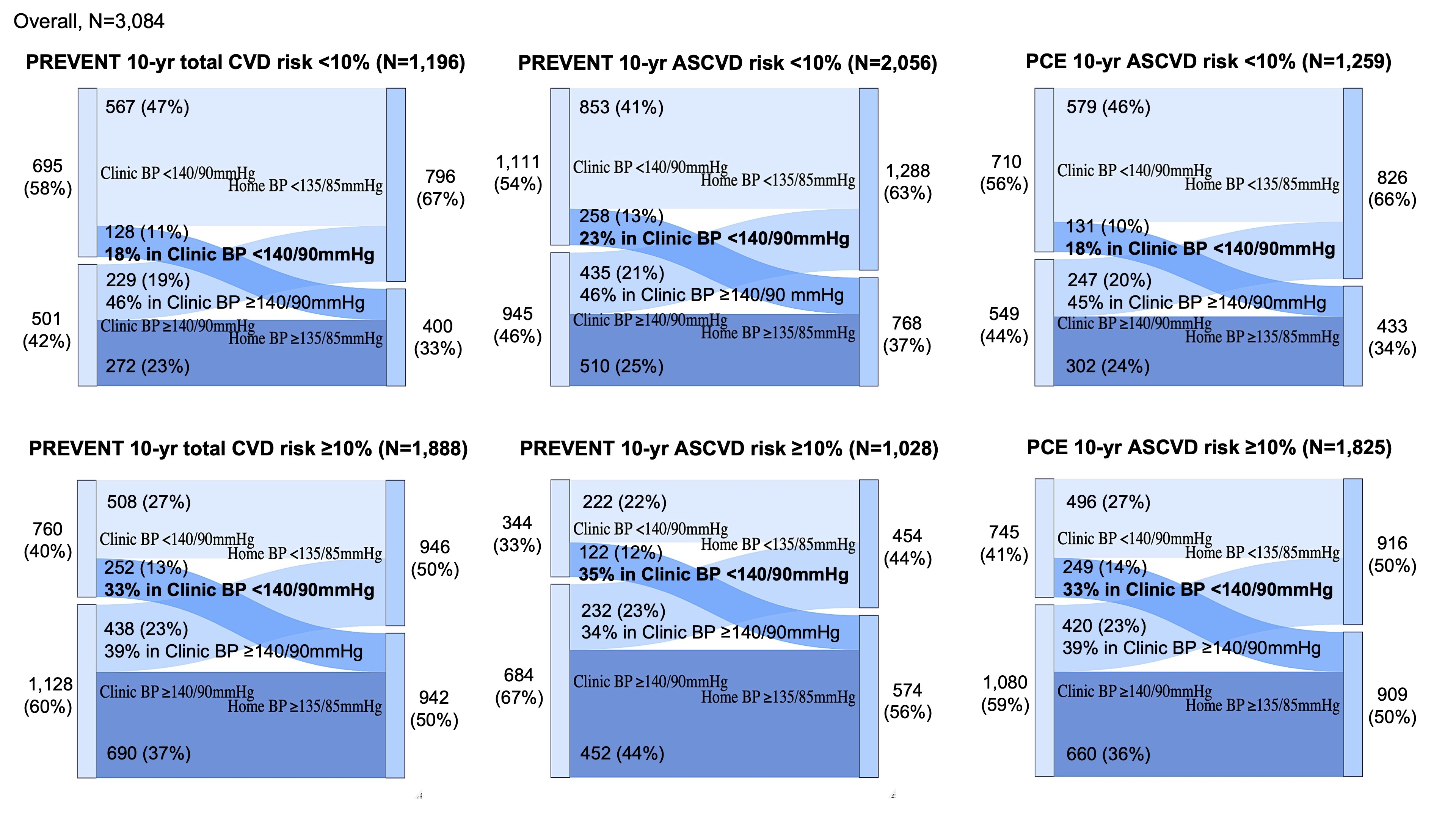
Abstract Body (Do not enter title and authors here): BACKGROUND: Masked hypertension (MHT) is defined as high out-of-office blood pressure (BP) despite non-high office BP and is associated with incident cardiovascular disease (CVD). The 2017 ACC/AHA hypertension guideline recommends assessing CVD risk using the 2013 Pooled Cohort Equations (PCE). In 2023, the AHA released a newer model, the Predicting Risk of CVD EVENTs (PREVENT). If these prediction models can help identify MHT, they may improve patient selection for out-of-office BP assessment. HYPOTHESIS: A higher estimated CVD risk according to PREVENT or PCE is associated with a higher prevalence of MHT than a lower estimated risk. METHODS: This cross-sectional analysis used data from a nationwide cohort designed to evaluate home BP for CVD prediction among 4,310 Japanese outpatients. Home BP was measured with a validated oscillometric device twice daily (morning and evening) for 14 days. MHT was defined as high home BP (systolic BP [SBP] ≥135 mmHg and/or diastolic BP [DBP] ≥85 mmHg) despite non-high clinic BP (SBP <140 mmHg and DBP <90 mmHg). Participants with prior atherosclerotic CVD (ASCVD), heart failure, or ineligibility for the PREVENT and PCE models were excluded. Estimated risks were calculated using the PREVENT 10-year total CVD (PREVENTtotal CVD) and ASCVD (PREVENTASCVD) models and the PCE 10-year ASCVD (PCEASCVD) model. RESULTS: Among 3,084 participants (mean age, 63.5 years; 44% male; 77% use antihypertensive medication), 61%, 33%, and 59% had an estimated risk ≥10% according to the PREVENTtotalCVD, PREVENTASCVD, and PCEASCVD, respectively. Figure shows clinic and home BP status stratified by an estimated risk of <10% or ≥10% according to each model. Of 1,445 participants with non-high clinic BP, the prevalence of MHT was 33% versus 18% in those with an estimated risk ≥10% versus <10% by PREVENTtotal CVD. In adjusted logistic models, the odds ratios (ORs) for MHT in participants with ≥10% by PREVENTtotalCVD (OR 1.71, 95%CI 1.17-2.49), by PREVENTASCVD (OR 1.05, 95%CI 0.73-1.53), and by PCEASCVD (OR 2.09, 95%CI 1.42-3.09) compared with those with <10%. The C-statistics for discriminating MHT were not different between models including each estimated risk as a continuous variable (C-statistics: PREVENTtotal CVD, 0.661; PREVENTASCVD, 0.663; and PCEASCVD, 0.662). CONCLUSIONS: In the present study, estimated CVD risk according to the both PREVENT and PCE models was associated with the prevalence of MHT.
Narita, Keisuke
( Columbia University Irving Medical Center
, New York
, New York
, United States
)
Hoshide, Satoshi
( Jichi Medical University School of Medicine
, Shimotsuke
, Japan
)
Fujiwara, Takeshi
( Jichi Medical University School of Medicine
, Shimotsuke
, Japan
)
Tomitani, Naoko
( Jichi Medical University School of Medicine
, Shimotsuke
, Japan
)
Kario, Kazuomi
( Jichi Medical University School of Medicine
, Shimotsuke
, Japan
)
Author Disclosures:
Keisuke Narita:DO NOT have relevant financial relationships
| Satoshi Hoshide:DO NOT have relevant financial relationships
| Takeshi Fujiwara:DO NOT have relevant financial relationships
| Naoko Tomitani:No Answer
| Kazuomi Kario:DO have relevant financial relationships
;
Research Funding (PI or named investigator):Omron Healthcare:Active (exists now)
; Advisor:Daiich Sankyo:Active (exists now)
; Advisor:Medtronic:Active (exists now)
; Research Funding (PI or named investigator):Fukuda Denshi:Active (exists now)
; Research Funding (PI or named investigator):A&D:Active (exists now)