Logo

American Heart Association

  15
  0


Final ID: Sa2052

Prevalence of cardiometabolic conditions across body mass index categories—the distinct burden of severe (class III) obesity

Abstract Body (Do not enter title and authors here): Background: Cardiometabolic (CM) conditions are a recognized complication of obesity, although their comparative burden among patients with severe (class III) obesity is less well known.

Objective: To characterize the prevalence of CM conditions among US adults as a function of body mass index (BMI, kg/m2).

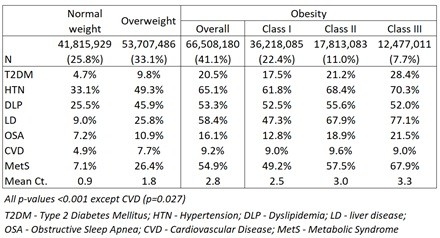
Methods: Nationally representative, cross-sectional data from the 2017–2020 National Health and Nutrition Examination Survey (NHANES), the most recent survey with comprehensive condition coverage, were evaluated to determine the prevalence of CM conditions as a function of BMI. Seven CM conditions were evaluated: type 2 diabetes (T2DM), cardiovascular disease (atherosclerotic disease or heart failure) (CVD), hypertension (HTN), dyslipidemia (DLP), metabolic syndrome (MetS), metabolic dysfunction-associated steatotic liver disease (LD, including metabolic dysfunction-associated steatohepatitis, fibrosis, and cirrhosis), and obstructive sleep apnea (OSA). Patients were categorized by BMI as normal weight (18.5–24.9), overweight (25.0–29.9), obesity class I (30.0–34.9), obesity class II (35.0–39.9), and obesity class III (40.0 and higher). Population-representative prevalence estimates were derived using NHANES sampling weights and distributions were evaluated with χ2 tests.

Results: In the NHANES weighted sample (n=162,031,595) mean age was 47.7 years, with 50.3% male and 35.1% non-white or Hispanic. The burden of CM conditions was greatest among patients with class III obesity (Table). The prevalence of CM conditions increased in a near-linear fashion across BMI groups, ranging from 0.9 mean total conditions among normal weight adults to 3.3 among those with class III obesity.

Conclusion: The burden of CM conditions increases with severity of obesity and is greatest among patients with class III obesity, with patients experiencing an average of 3.3 conditions. Lowering BMI via obesity reduction efforts including anti-obesity medications may attenuate the CM burden associated with obesity.
  • Rathore, Saif  ( Sandbar Life Sciences , Kankakee , Illinois , United States )
  • Chung, Karen  ( Viking Therapeutics, Inc. , San Diego , California , United States )
  • Akkas, Yilmaz  ( Medicus Economics , Milton , Massachusetts , United States )
  • Epstein, Andrew  ( Medicus Economics , Milton , Massachusetts , United States )
  • Lian, Brian  ( Viking Therapeutics, Inc. , San Diego , California , United States )
  • Author Disclosures:
    Saif Rathore: DO have relevant financial relationships ; Consultant:McKinsey & Company:Active (exists now) ; Consultant:Medicus Economics:Active (exists now) | Karen Chung: DO have relevant financial relationships ; Employee:GRAIL:Past (completed) ; Individual Stocks/Stock Options:Viking Therapeutics:Active (exists now) ; Employee:Viking Therapeutics, Inc.:Active (exists now) | Yilmaz Akkas: No Answer | Andrew Epstein: No Answer | Brian Lian: No Answer
Meeting Info:

Scientific Sessions 2025

2025

New Orleans, Louisiana

Session Info:

Outcomes Linked to Obesity and Related Comorbidities

Saturday, 11/08/2025 , 02:30PM - 03:30PM

Abstract Poster Board Session

More abstracts on this topic:
Albuminuria Drives Type 2 Diabetes-Related Atrial Fibrillation: an ACCORD substudy

Siqueira Amanda, Everett Brendan

A Quarter Century of Mortality Trends in Hypertension and Sick Sinus Syndrome Among Elderly in the United States

Eltawansy Sherif, Khan Muhammad, Iqbal Asad, Sharif Aleena, Hossain Mohammad, Ali Muhammad Faizan, Ahmad Husnain, Faizan Muhammad, Ahmed Ashraf, Abdul Malik Mohammad Hamza Bin, Pahwani Ritesh, Patel Rahul, Mehdi Hassan

You have to be authorized to contact abstract author. Please, Login
Not Available