
Feasibility, Acceptability, and Perspectives Towards Wearable Devices to Assess Life’s Essential 8 Among Home Health Aides
Abstract Body (Do not enter title and authors here): Background: Home health aides (HHAs) provide essential care to the growing population of older adults with cardiovascular (CV) disease who want to age in place. Despite their vital role in patient care, HHAs are a vulnerable population of healthcare professionals who often experience poor CV health. Activity tracking devices offer a promising way to improve HHAs’ CV health awareness and promote health behavior change, particularly with respect to physical activity (PA) and sleep quality, two areas of the AHA’s Life’s Essential 8.
Objective: This study aimed to understand how feasible it is for HHAs to use activity tracking devices and assess their perceptions toward such devices with respect to improving their CV health.
Methods: We partnered with the labor and management fund of the largest healthcare union in the US to conduct a field study with HHAs working in New York, NY. Participants wore activity tracking devices for four weeks. HHAs were subsequently interviewed on their experiences and attitudes towards the devices and asked to reflect on personalized visualizations of their data.
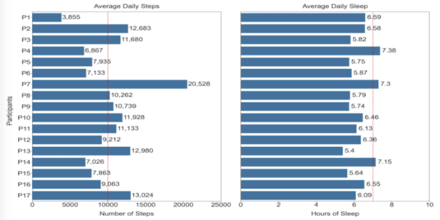
Results: A total of 17 HHAs participated; they had a mean age of 48.7 (SD 12.2) years, 15 were female (88%), 11 identified as Black (65%), 5 identified as Hispanic or Latinx, and they worked as HHAs for a mean of 11.7 years (SD 7.5). Sixteen out of 17 HHAs (94%) wore their activity trackers for the full 28-day study period. Participants took a mean of 10,230 (SD 3,586) steps and slept for a mean of 6.27 (SD 0.58) hours per night. Overall, 4 key themes emerged: (1) Activity tracking devices enhanced participants' health awareness by providing empirical data for self-reflection; (2) This increased awareness led to positive behavioral changes, including setting and achieving health-related goals; (3) HHAs believed these devices could potentially improve not only their own health but also that of their patients ; and (4) Despite this optimism, participants emphasized that their ability to modify sleep and activity patterns was constrained by social and occupational determinants, with sleep improvements being particularly challenging.
Conclusions: Our findings suggest that appropriately designed personal tracking interventions could offer a promising approach to supporting positive health-related changes in this historically overlooked workforce, potentially improving both their wellbeing and, by extension, the quality of care they provide to their patients.
Dicpinigaitis, Michael
( Weill Cornell Medicine
, New York
, New York
, United States
)
Reading Turchioe, Meghan
( Columbia University SON
, New York
, New York
, United States
)
Avgar, Ariel
( Cornell University
, Ithaca
, New York
, United States
)
Vashistha, Aditya
( Cornell University
, Ithaca
, New York
, United States
)
Dell, Nicola
( Cornell Tech
, New York
, New York
, United States
)
Sterling, Madeline
( Weill Cornell Medicine
, New York
, New York
, United States
)
Solano-kamaiko, Ian
( Cornell Tech
, New York
, New York
, United States
)
Tan, Melissa
( Cornell Tech
, New York
, New York
, United States
)
Yang, Irene
( Cornell Tech
, New York
, New York
, United States
)
Cheng, Kexin
( Cornell Tech
, New York
, New York
, United States
)
Peramsetty, Ronica
( Weill Cornell Medicine
, New York
, New York
, United States
)
Shum, Michelle
( Weill Cornell Medicine
, New York
, New York
, United States
)
Escamilla, Yanira
( 1199SEIU Training and Employment Funds
, New York
, New York
, United States
)
Bayly, Jennifer
( Weill Cornell Medicine
, New York
, New York
, United States
)
Author Disclosures:
Michael Dicpinigaitis:DO NOT have relevant financial relationships
| Meghan Reading Turchioe:DO have relevant financial relationships
;
Ownership Interest:Iris OB Health:Active (exists now)
; Research Funding (PI or named investigator):NIH:Active (exists now)
; Consultant:Boston Scientific:Past (completed)
| Ariel Avgar:No Answer
| Aditya Vashistha:No Answer
| Nicola Dell:No Answer
| Madeline Sterling:DO NOT have relevant financial relationships
| Ian Solano-Kamaiko:DO NOT have relevant financial relationships
| Melissa Tan:No Answer
| Irene Yang:No Answer
| Kexin Cheng:No Answer
| Ronica Peramsetty:DO NOT have relevant financial relationships
| Michelle Shum:No Answer
| Yanira Escamilla:No Answer
| Jennifer Bayly:No Answer