
Logo

American Heart Association

  16
  0


Final ID: MP2373

Severe Hypertriglyceridemia in Pregnancy: A Case Highlighting Therapeutic Challenges

Abstract Body (Do not enter title and authors here): Introduction
Severe hypertriglyceridemia (HTG) in pregnancy increases the risk of acute pancreatitis and preeclampsia, carrying a high maternal and fetal mortality rate. Management of severe HTG during pregnancy is challenging, as pharmacologic options are limited due to potential fetal risks.

Description of Case
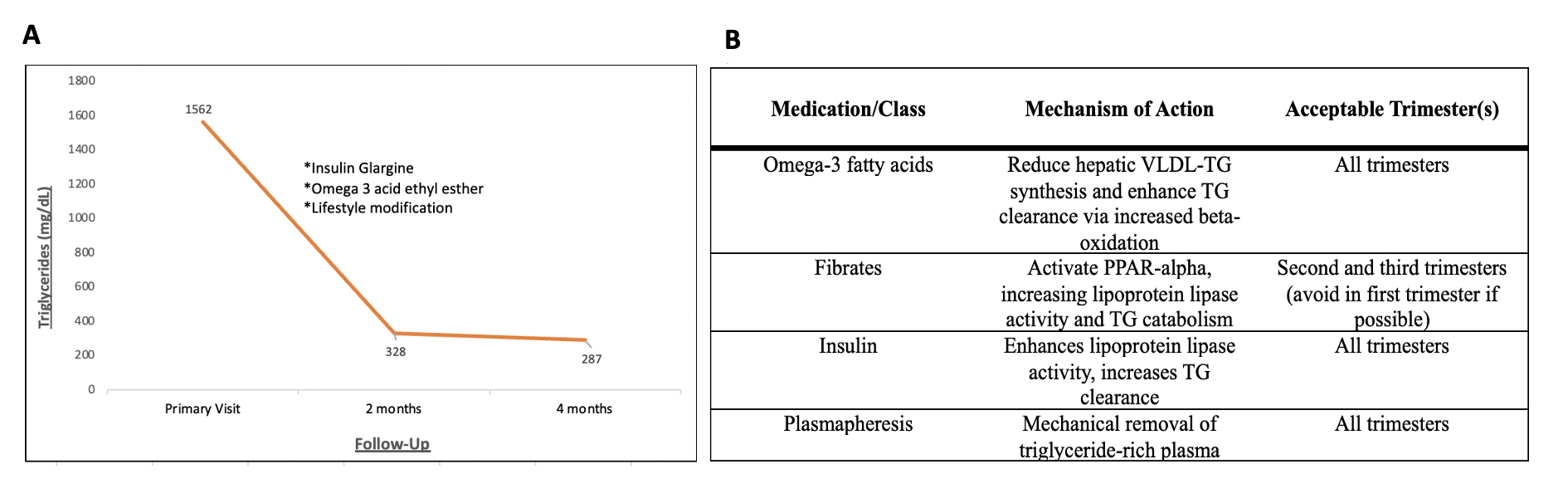
A 34-year-old G1P000 woman with type 2 diabetes mellitus and HTG was referred to cardio-obstetrics clinic at 16 weeks of gestation with a triglyceride (TG) level of 1,562 mg/dL. Prior to conception, she had been treated with a biguanide for diabetes and a combination of fish oil, fenofibrate, and a statin for HTG, which were discontinued for fetal safety. Given the markedly elevated TG level, a multidisciplinary decision was made to urgently reinitiate lipid-lowering therapy with omega-3 acid ethyl esters 4g daily (Lovaza) and subcutaneous insulin glargine. In addition, she received counseling on lifestyle modification, including a low-fat, low-carbohydrate diet and a goal of 150 minutes of moderate physical activity per week. At two-month follow-up, her TG level had significantly improved to 328 mg/dL, with a further decrease to 287 mg/dL by four months without maternal or fetal complications.

Discussion
This case highlights the complexities involved in managing HTG during pregnancy. While total cholesterol and TG levels naturally increase throughout pregnancy, levels typically remain below 250 mg/dL. Traditional lipid-lowering agents, including statins, PCSK9 inhibitors, ezetimibe, bempedoic acid, and lomitapide, are generally avoided during pregnancy due to limited fetal safety data. In high-risk women with dyslipidemia, an individualized treatment approach can include insulin and omega 3 fatty ethyl esters or even LDL apheresis to prevent life-threatening complications. Lifestyle modification with a low-fat diet and omega-3 fatty acids must be balanced with both maternal and fetal nutritional needs to prevent abnormal fetal development. Thus, cardio-obstetric management of high-risk women with metabolic disorders should center around preconception risk assessment, multidisciplinary care, intensive lifestyle modification, selective use of non-statin agents or apheresis, and vigilant monitoring throughout pregnancy. There remains a significant gap in evidence regarding the safety and efficacy of lipid-lowering therapies during pregnancy, underscoring the urgent need for further research to guide management of severe HTG in pregnancy.
  • Roy, Rukmini  ( University of Chicago , Chicago , Illinois , United States )
  • Altenburg, Marie  ( University of Chicago , Chicago , Illinois , United States )
  • Horan, Mary  ( The University of Chicago , Chicago , Illinois , United States )
  • Davidson, Michael  ( UNIVERSITY OF CHICAGO , Highland Park , Illinois , United States )
  • Patel, Hena  ( Hena Patel , Chicago , Illinois , United States )
  • Author Disclosures:
    Rukmini Roy: DO NOT have relevant financial relationships | marie Altenburg: DO NOT have relevant financial relationships | Mary Horan: No Answer | Michael Davidson: No Answer | Hena Patel: DO NOT have relevant financial relationships
Meeting Info:

Scientific Sessions 2025

2025

New Orleans, Louisiana

Session Info:

Dangerous Rhythms and Silent Threats: Cardiac Curveballs in Pregnancy and Postpartum

Monday, 11/10/2025 , 12:15PM - 01:30PM

Moderated Digital Poster Session

More abstracts on this topic:
Efficacy of Icosapent Ethyl for Cardiovascular Risk Reduction by Aspirin Use in REDUCE-IT

Aggarwal Rahul, Steg Philippe, Bhatt Deepak, Ballantyne Christie, Miller Michael, Brinton Eliot, Jacobson Terry, Ketchum Steven, Doyle Ralph, Tardif Jean-claude

DENND5B Plays a Role in Triglyceride-Rich Lipoprotein Secretion from Human Enterocytes and Hepatocytes

Hage Olivia, Neupane Khaga, Voy Clairity, Karakashian Alexander, Gordon Scott

More abstracts from these authors:
Association of Preeclampsia with Long-Term Coronary Microvascular Dysfunction Utilizing Cardiac Stress Magnetic Resonance Imaging

Roy Rukmini, Rana Sarosh, Lang Roberto, Patel Amit, Shahul Sajid, Patel Hena, Wang Haonan, Huang Sherry, Minga Iva, Wang Shuo, O'hara Meaghan, Tang Maxine, Slivnick Jeremy, Polonsky Tamar

Long-Term Myocardial Tissue Characterization in Women with Preeclampsia

Roy Rukmini, Rana Sarosh, Lang Roberto, Shahul Sajid, Patel Hena, Wang Haonan, Huang Sherry, Minga Iva, O'hara Meaghan, Tang Maxine, Wang Shuo, Slivnick Jeremy, Polonsky Tamar

You have to be authorized to contact abstract author. Please, Login
Not Available