
MADIT-ICD Benefit Score – Assessing Utility in SCD-HeFT
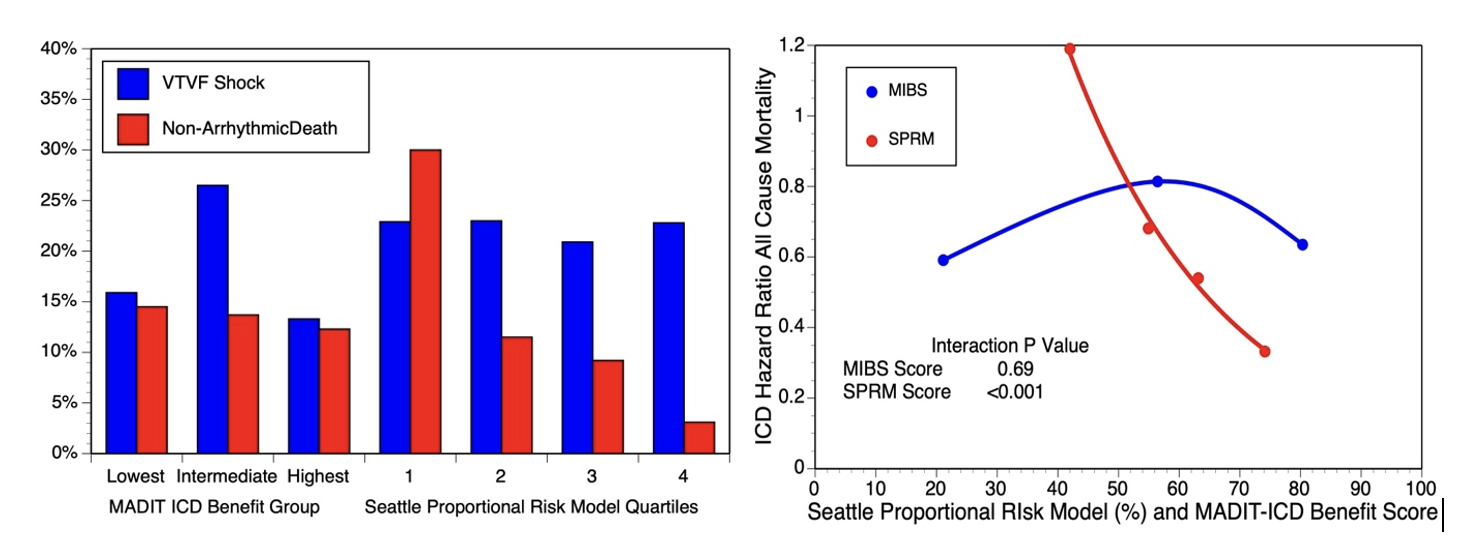
Abstract Body (Do not enter title and authors here): Background: The MADIT-ICD Benefit Score (MIBS) predicts ICD VT/VF shocks vs. non-arrhythmic death and divides patients into three predicted ICD benefit groups. Objective: The actual utility of the MIBS in primary prevention ICDs clinical trial with a control has not been evaluated. Methods: MIBS continuous score and categories (lowest, intermediate and highest ICD benefit) were derived for patients in SCD-HeFT in ICD and control arms. VT/VF therapy (Shock) vs. non-arrhythmic death (NAD) was compared across risk categories. The observed ICD hazard ratio for all-cause mortality was calculated for categories. SCD-HeFT ICD programming was 18 of 24 beats with a single rate zone of 188 bpm. Comparison was made with the Seattle Proportional Risk Model (SPRM) quartiles (predicts proportion of sudden vs. non-sudden death). Results: MIBS ranged from 2-91 with mean of 54±18 with lowest (<25), intermediate (25-75), and highest (>75) ICD benefit categories of 17%, 68% and 15%. The first event was a Shock (62%) vs. NAD (38%). The MIBS Category with highest ratio of Shock/NAD was the intermediate group with 2-fold difference due to higher Shock rates. Shock vs. NAD was similar in the lowest and highest ICD benefit groups. SPRM had a 10-fold difference in the Shock/NAD, due 90% lower NAD. The ICD benefit was least in the Intermediate MIBS group (interaction P=0.69) and the lowest quartile of the SPRM (interaction P<0.001). The ICD hazard ratio was similar for MIBS <50 (n=503, 0.72) vs. >50 (n=1173, 0.76) with a nonsignificant interaction p value (0.78). Conclusion: The MADIT-ICD Benefit Score did not validate for VT/VF Shock and Non-arrhythmic death or predict a variable ICD benefit for all-cause mortality in SCD-HeFT. The SPRM had a 10-fold difference in the ratio of Shock/NAD and a significant difference in ICD benefit. Reasons for this difference may be due to different patient populations, therapies (CRT or not), ICD programming, or background medications. Application: MADIT-ICD Benefit Score should be validated in other ICD trials to ascertain the utility of the risk model in predicting ICD benefit.
Levy, Wayne
( UNIVERSITY WASHINGTON
, Seattle
, Washington
, United States
)
Poole, Jeanne
( UNIVERSITY WASHINGTON
, Seattle
, Washington
, United States
)
Mark, Daniel
( DUKE UNIV MEDICAL CTR
, Chapel Hill
, North Carolina
, United States
)
Fishbein, Daniel
( UNIVERSITY WASHINGTON
, Seattle
, Washington
, United States
)
Bardy, Gust
( SEATTLE INST CARDIAC RESEARCH
, Seattle
, Washington
, United States
)
Author Disclosures:
Wayne Levy:DO have relevant financial relationships
;
Consultant:Medtronic:Active (exists now)
; Other (please indicate in the box next to the company name):Zoll/Respircardia -Steering Committee:Active (exists now)
; Other (please indicate in the box next to the company name):NAMSCA/Ochestra Biomed:Active (exists now)
; Other (please indicate in the box next to the company name):Cardiac Dimensions:Active (exists now)
; Consultant:Kestra:Active (exists now)
; Other (please indicate in the box next to the company name):LivaNova - CEC:Past (completed)
; Other (please indicate in the box next to the company name):WhiteSewell - CEC:Active (exists now)
; Other (please indicate in the box next to the company name):Abbott/St Jude/CardioMems - CEC:Active (exists now)
; Other (please indicate in the box next to the company name):EBR Systems Inc - CEC:Active (exists now)
; Other (please indicate in the box next to the company name):Baim Institute/Janssen - CEC:Active (exists now)
; Consultant:Impulse Dynamics:Active (exists now)
| Jeanne Poole:DO have relevant financial relationships
;
Researcher:Biotronik:Active (exists now)
; Researcher:Kestra Medical:Active (exists now)
; Researcher:AtriCure:Active (exists now)
; Researcher:Boston Scientific:Active (exists now)
| Daniel Mark:DO NOT have relevant financial relationships
| Daniel Fishbein:No Answer
| Gust Bardy:No Answer