Intensive Versus Standard Blood Pressure Control in Patients with Type 2 Diabetes Mellitus: An Updated Systematic Review and Meta-analysis
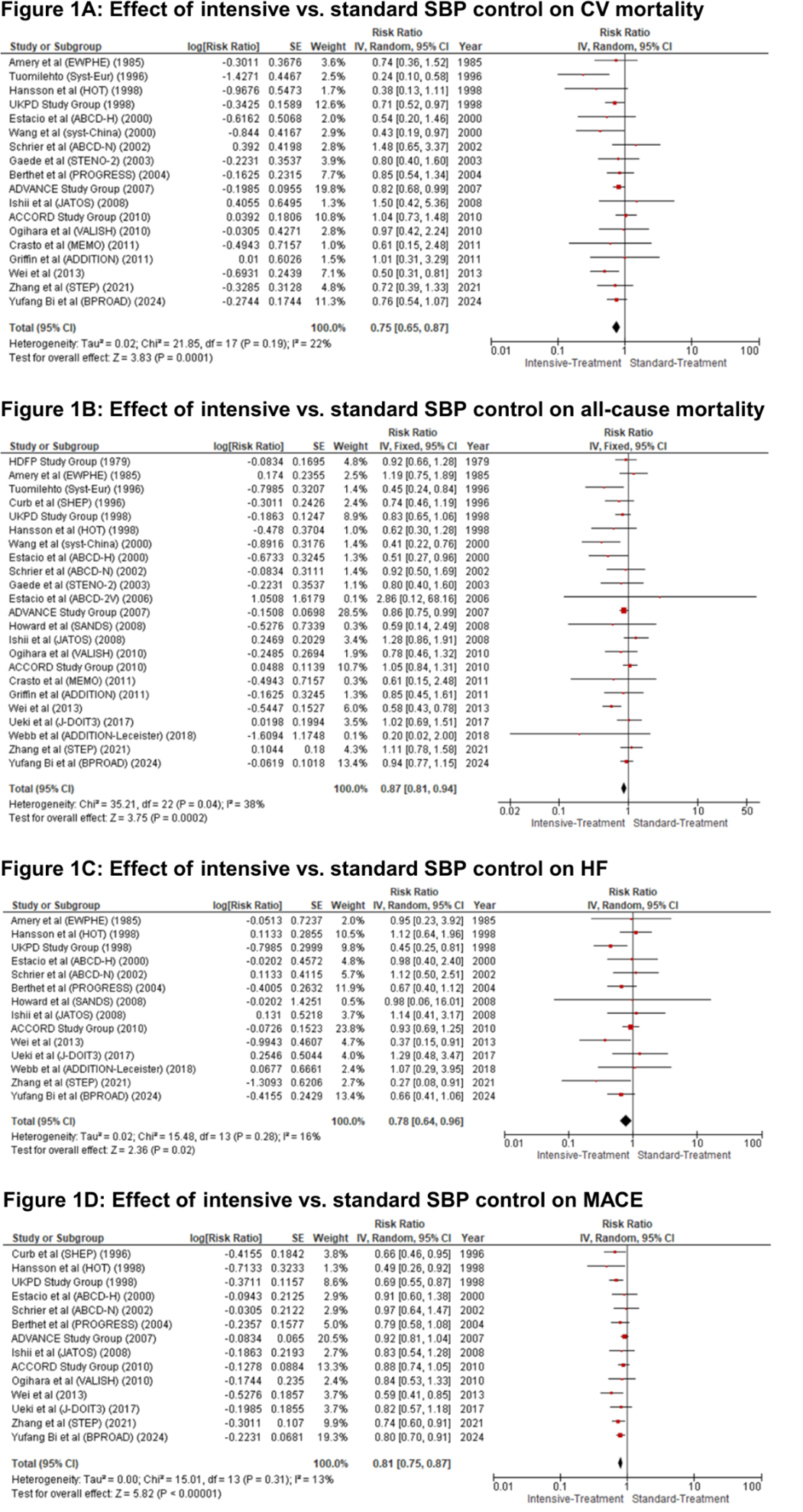
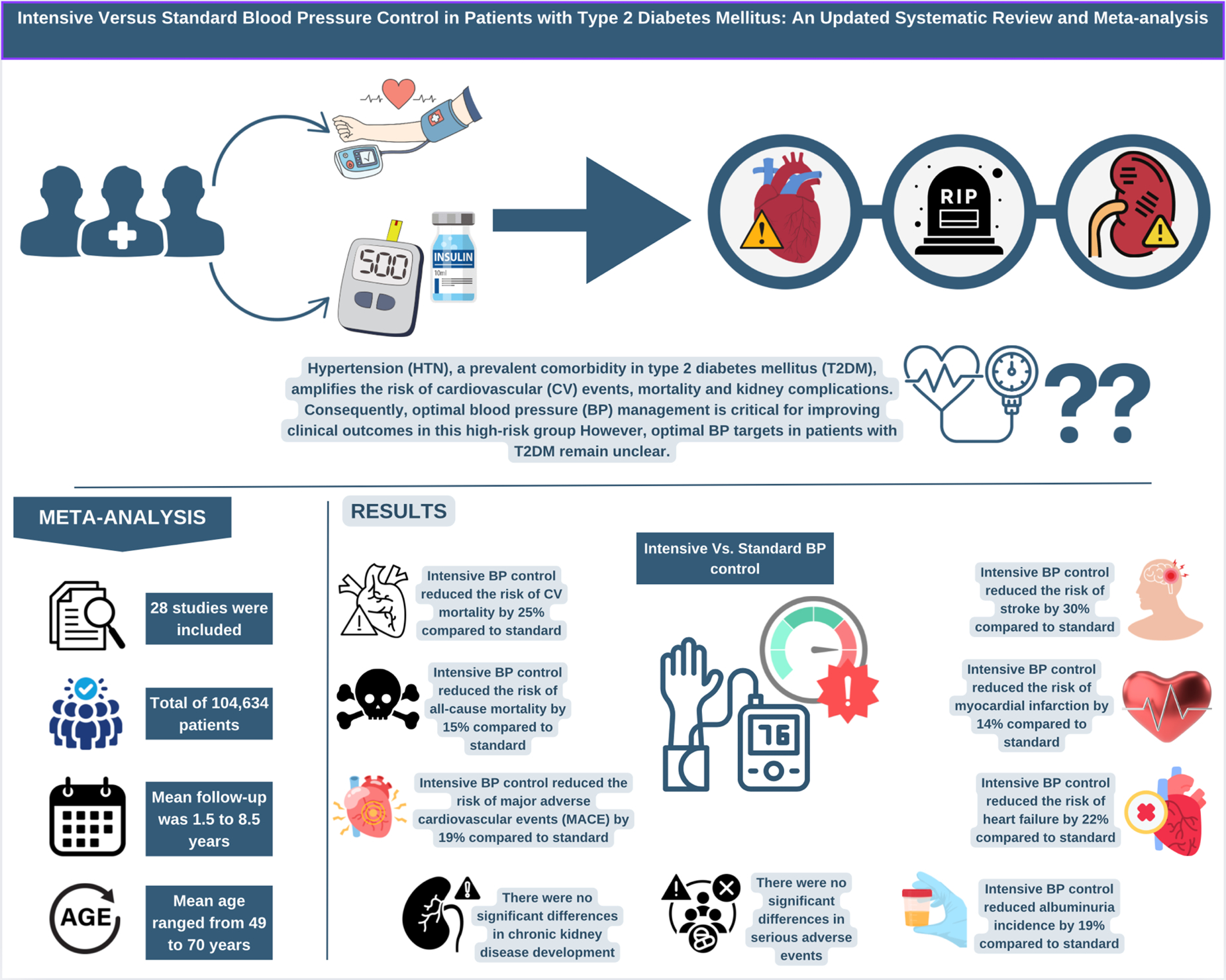
Abstract Body (Do not enter title and authors here): Background: Hypertension (HTN), a prevalent comorbidity in type 2 diabetes mellitus (T2DM), increases the risk of cardiovascular (CV) events, mortality, and kidney complications. However, optimal blood pressure (BP) targets in patients with T2DM remain unclear. Research Question: Does intensive BP control, compared to standard targets, reduce CV, renal, and mortality outcomes in patients with T2DM? Aims: We aim to conduct an updated meta-analysis to evaluate the effects of intensive vs. standard BP control on CV and kidney outcomes and mortality in T2DM patients. Methods: A comprehensive search of PubMed, Cochrane Library, and Scopus was conducted through December 2024 for trials comparing intensive vs. standard BP control in patients with T2DM. Outcomes assessed included all-cause mortality, CV mortality, major adverse CV events (MACE), stroke, myocardial infarction (MI), incident heart failure (HF), chronic kidney disease (CKD) development, albuminuria, and serious adverse events (SAEs). Risk ratios (RRs) with 95% confidence intervals (CIs) were calculated using a random effects model. Results: 28 trials encompassing 104,634 patients were included. Intensive BP control significantly reduced the risk of CV mortality (RR: 0.75, 95% CI: 0.65–0.87, P = 0.0001), all-cause mortality (RR: 0.85, 95% CI: 0.76–0.95, P = 0.004), MACE (RR: 0.81, 95% CI: 0.75–0.87, P < 0.00001), stroke (RR: 0.70, 95% CI: 0.61–0.80, P < 0.00001), MI (RR: 0.86, 95% CI: 0.79–0.94, P = 0.001), HF (RR: 0.78, 95% CI: 0.64–0.96, P = 0.02), and albuminuria (RR: 0.89, 95% CI: 0.82–0.97, P = 0.005). There were no significant differences in CKD development (RR: 1.08, 95% CI: 0.92–1.26, P = 0.36) or SAEs (RR: 1.16, 95% CI: 0.97–1.40, P = 0.10). Conclusions: Intensive BP control in patients with T2DM was associated with a lower risk of all-cause mortality, CV mortality, MACE, stroke, MI, HF, and albuminuria as compared to standard control, without an increased risk of serious adverse events.
Siddiqi, Ahmed Kamal
(
Emory University
, Atlanta , Georgia , United States )
Maniya, Muhammad Talha
(
Ziauddin University
, Karachi , Pakistan )
Ali, Kumail Mustafa
(
Jinnah Sindh Medical University
, Karachi , Pakistan )
Chew, Nicholas
(
National University of Singapore
, Kent Ridge , Singapore )
Rana, Jamal
(
KAISER PERMANENTE
, Oakland , California , United States )
Agarwala, Anandita
(
Baylor Scott and White Health
, Plano , Texas , United States )
Khan, Mohammad
(
Baylor Scott and White Health
, Plano , Texas , United States )
Author Disclosures:
Ahmed Kamal Siddiqi:DO NOT have relevant financial relationships
| Muhammad Talha Maniya:DO NOT have relevant financial relationships
| Kumail Mustafa Ali:DO NOT have relevant financial relationships
| Nicholas Chew:No Answer
| Jamal Rana:DO NOT have relevant financial relationships
| Anandita Agarwala:DO NOT have relevant financial relationships
| Mohammad Khan:DO have relevant financial relationships
;
Consultant:Bayer:Active (exists now)
; Research Funding (PI or named investigator):Merck:Active (exists now)
; Consultant:Novartis:Active (exists now)
; Consultant:Boehringer Ingelheim:Active (exists now)