Implementation of a Multicomponent Intervention Increases Acute Myocardial Infarction Diagnosis and Evidence-Based Treatment in a Tanzanian Emergency Department
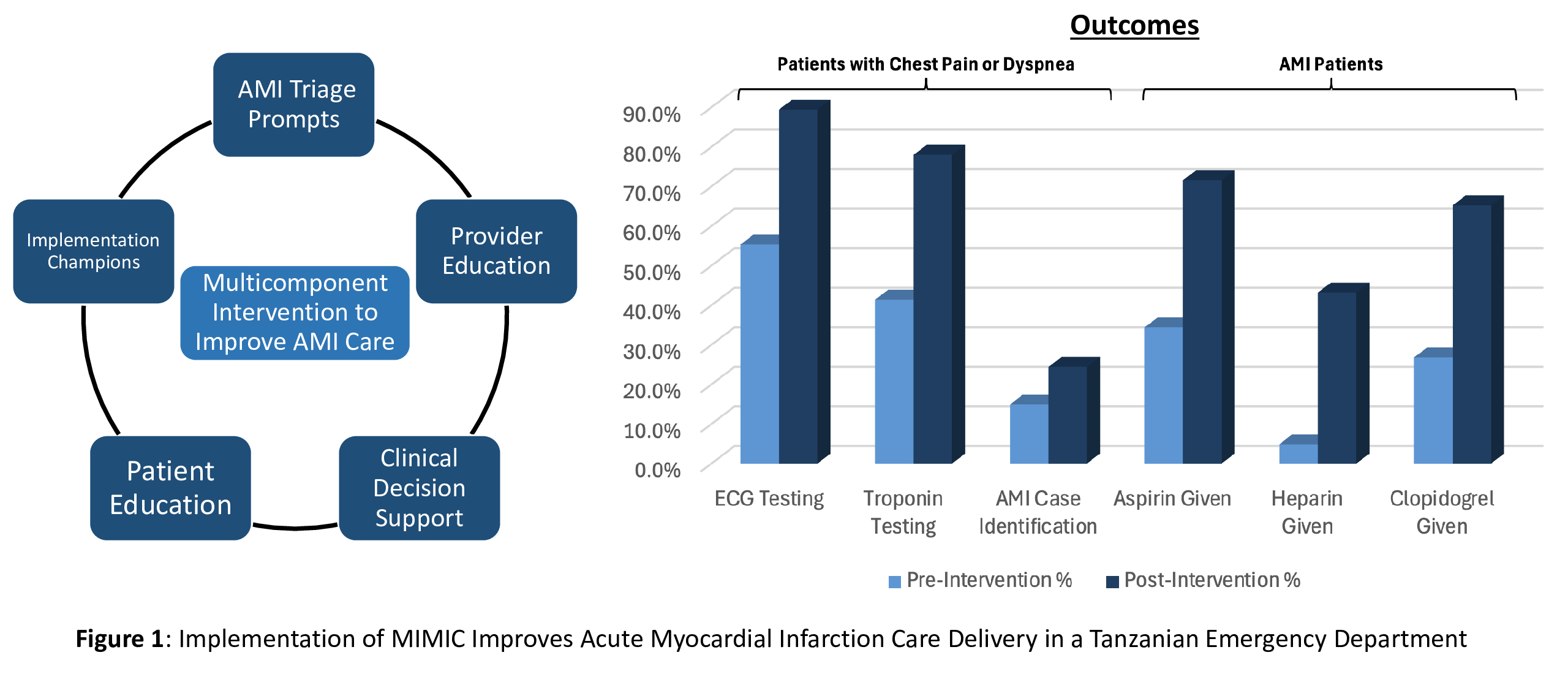
Abstract Body (Do not enter title and authors here): Introduction: The burden of acute myocardial infarction (AMI) is growing in Tanzania, but AMI is frequently misdiagnosed, and uptake of evidence-based AMI care is suboptimal, leading to high rates of short-term mortality among patients. To address these gaps, we used implementation mapping and participatory co-design to develop the Multicomponent Intervention for Improving Myocardial Infarction Care (MIMIC)—the first contextually tailored intervention for improving AMI care in sub-Saharan Africa. MIMIC includes 5 key components: triage prompts, provider education, clinical decision support, patient education, and implementation champions.
Hypothesis: We hypothesized that implementing MIMIC in a Tanzanian emergency department (ED) would enhance evidence-based AMI care by increasing ECG and troponin testing rates and improving the administration of antiplatelet therapy.
Methods: We conducted a single-arm, pre-post implementation trial in an ED in northern Tanzania. Adults presenting with chest pain and/or dyspnea were prospectively enrolled in the pre-intervention phase (Feb–Aug 2023) and post-intervention phase (Sept 2023–Aug 2024). AMI was defined using Fourth Universal Definition criteria. Thirty-day mortality was assessed via telephone follow-up. Clinical care before and after MIMIC implementation was directly observed and compared using Pearson’s chi-squared test.
Results: A total of 275 patients (41 with AMI) were enrolled pre-intervention and 577 (141 with AMI) were enrolled post-intervention. Following MIMIC implementation, there were significant increases in ECG testing (89.4% vs 55.3%; OR 6.82, 95% CI: 4.79–9.79; p < 0.001), troponin testing (78.0% vs 41.4%; OR 4.99, 95% CI: 3.67–6.83; p < 0.001), and AMI case identification (24.4% vs 14.9%; OR 1.84, 95% CI: 1.26–2.73; p = 0.002) among ED patients with chest pain/dyspnea. Among AMI patients, significant increases were observed in evidence-based treatment, including aspirin (71.6% vs 34.4%; OR 4.80, 95% CI: 2.31–10.37; p < 0.001), heparin (43.2% vs 4.9%; OR 13.76, 95% CI: 3.99–93.79; p < 0.001), and clopidogrel (65.2% vs 26.8%; OR 5.03, 95% CI: 2.37–11.39; p < 0.001).
Conclusion: MIMIC improved AMI recognition and evidence-based treatment at a single site in northern Tanzania. These findings support adaptation and scale-up of MIMIC to improve the delivery of AMI care in Tanzania and similar settings in sub-Saharan Africa.
Rahim, Faraan
(
Harvard Medical School
, Export , Pennsylvania , United States )
Sakita, Francis
(
Kilimanjaro Christian Medical Centre
, Moshi , Tanzania, United Republic of )
Sumner, Spencer
(
Duke University School of Medicine
, Durham , North Carolina , United States )
Shayo, Dr Frida
(
Kilimanjaro Christian Medical Centre
, Moshi , Tanzania, United Republic of )
Galson, Sophie
(
Duke University School of Medicine
, Durham , North Carolina , United States )
Coaxum, Lauren
(
Duke University School of Medicine
, Durham , North Carolina , United States )
Pyne, Abigail
(
Duke University School of Medicine
, Durham , North Carolina , United States )
Vaidyanathan, Arthi
(
Duke University School of Medicine
, Durham , North Carolina , United States )
Akrabi, Ally
(
Bugando Medical Centre
, Mwanza , Tanzania, United Republic of )
Manyangu, Gloria
(
Bugando Medical Centre
, Mwanza , Tanzania, United Republic of )
Thielman, Nathan
(
Duke University School of Medicine
, Durham , North Carolina , United States )
Bloomfield, Gerald
(
Duke University School of Medicine
, Durham , North Carolina , United States )
Hertz, Julian
(
Duke University School of Medicine
, Durham , North Carolina , United States )
Author Disclosures:
Faraan Rahim:DO NOT have relevant financial relationships
| Gloria Manyangu:No Answer
| Nathan Thielman:DO NOT have relevant financial relationships
| Gerald Bloomfield:DO NOT have relevant financial relationships
| Julian Hertz:No Answer
| Francis Sakita:No Answer
| Spencer Sumner:No Answer
| Dr Frida Shayo:No Answer
| Sophie Galson:No Answer
| Lauren Coaxum:No Answer
| Abigail Pyne:No Answer
| Arthi Vaidyanathan:No Answer
| Ally Akrabi:No Answer