Logo

American Heart Association

  16
  0


Final ID: MP157

Evaluation of Retinal Ischemic Perivascular Lesions as a Potential Biomarker for Cardiovascular Disease Risk- A Systematic Review and Meta-Analysis

Abstract Body (Do not enter title and authors here): Introduction
Cardiovascular disease (CVD) is a leading global cause of mortality, often remaining undiagnosed until critical events occur. Retinal ischemic perivascular lesions (RIPLs), detectable via optical coherence tomography (OCT), have been proposed as non-invasive indicators of subclinical ischemia. Given the accessibility and low cost of OCT imaging, RIPLs may offer a practical tool for early CVD risk identification.
Research Question/Hypothesis:
We hypothesized that the presence of RIPLs is significantly associated with increased risk of all-cause cardiovascular mortality and that their detection may serve as an effective, low-cost method for identifying individuals at elevated risk of CVD.
Methods
A systematic review and meta-analysis were conducted in accordance with PRISMA guidelines. A comprehensive search of MEDLINE, Scopus, and Cochrane CENTRAL from 2015 to May 2025 identified observational studies evaluating the relationship between RIPLs and CVD. Studies involving adult populations and using OCT imaging for RIPL detection were included. Odds ratios (ORs) and 95% confidence intervals (CIs) were pooled using a random-effects model. Heterogeneity was assessed using the heterogeneity statistic.
Results
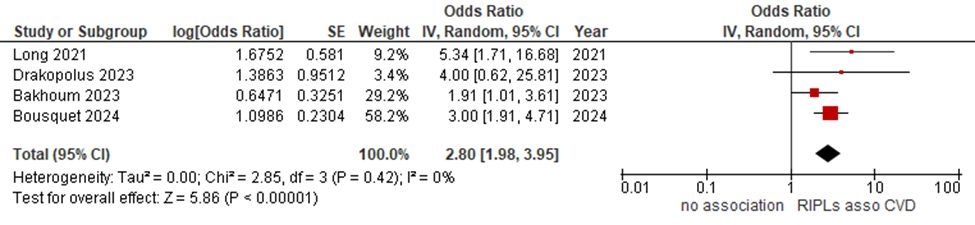
Out of 100 studies screened, six met inclusion criteria, and four were eligible for meta-analysis, involving a total of 710 participants. The pooled OR for the association between RIPLs and CVD-related mortality was 2.8 (95% CI: 1.98–3.95), indicating that individuals with RIPLs had over twofold increased risk compared to those without. Heterogeneity was minimal (zero), supporting the robustness and consistency of findings across studies.
Conclusions
RIPLs identified on OCT are associated with elevated cardiovascular risk. Given the non-invasive, widely available, and cost-effective nature of OCT, RIPLs may serve as potential biomarker used as valuable screening tool for early CVD detection. Incorporation of RIPL assessment into routine care could facilitate timely intervention, reduce reliance on invasive diagnostics, minimize patient burden and help prevent expensive treatments. It will also be very useful in the future to consider incorporating this biomarker in artificial intelligence tools that detect risk factors for CVD.
  • Zahra, Fatima  ( Aga Khan University Hospital , Karachi , Pakistan )
  • Malik, Manahil  ( Aga Khan University Hospital , Karachi , Pakistan )
  • Abid, Khadijah  ( Aga Khan University Hospital , Karachi , Pakistan )
  • Ismail, Haji  ( Aga Khan University Hospital , Karachi , Pakistan )
  • Damji, Karim  ( Aga Khan University Hospital , Karachi , Pakistan )
  • Tayyab, Haroon  ( Aga Khan University Hospital , Karachi , Pakistan )
  • Author Disclosures:
    Fatima Zahra: DO NOT have relevant financial relationships | Manahil Malik: No Answer | Khadijah Abid: No Answer | Haji ismail siddiq: DO NOT have relevant financial relationships | Karim Damji: No Answer | Haroon Tayyab: No Answer
Meeting Info:

Scientific Sessions 2025

2025

New Orleans, Louisiana

Session Info:

Silent Signals: Detecting Risk Early Using Innovative Imaging and Biomarkers

Saturday, 11/08/2025 , 03:15PM - 04:25PM

Moderated Digital Poster Session

More abstracts on this topic:
3D spheroids composed by induced Skeletal Muscle Progenitor Cells and Mesenchymal Stem Cells derived from human Pluripotent Stem Cells can recapitulate embryonic niches in hindlimb ischemia model

Kim Jinju, Park Jae-hyun, Choi Yeon-jik, Park Hun

A Measure of Residential Segregation and Thrombo-inflammation in Black and White Americans

Manogaran Erin, Cushman Mary, Kamin Mukaz Debora, Sparks Andrew, Packer Ryan, Brochu Paige, Judd Suzanne, Howard Virginia, Plante Timothy, Long Leann, Cheung Katherine

You have to be authorized to contact abstract author. Please, Login
Not Available