Behaviorally-Designed Gamification Increases Physical Activity Among Breast and Prostate Cancer Survivors: The ALLSTAR Randomized Clinical Trial
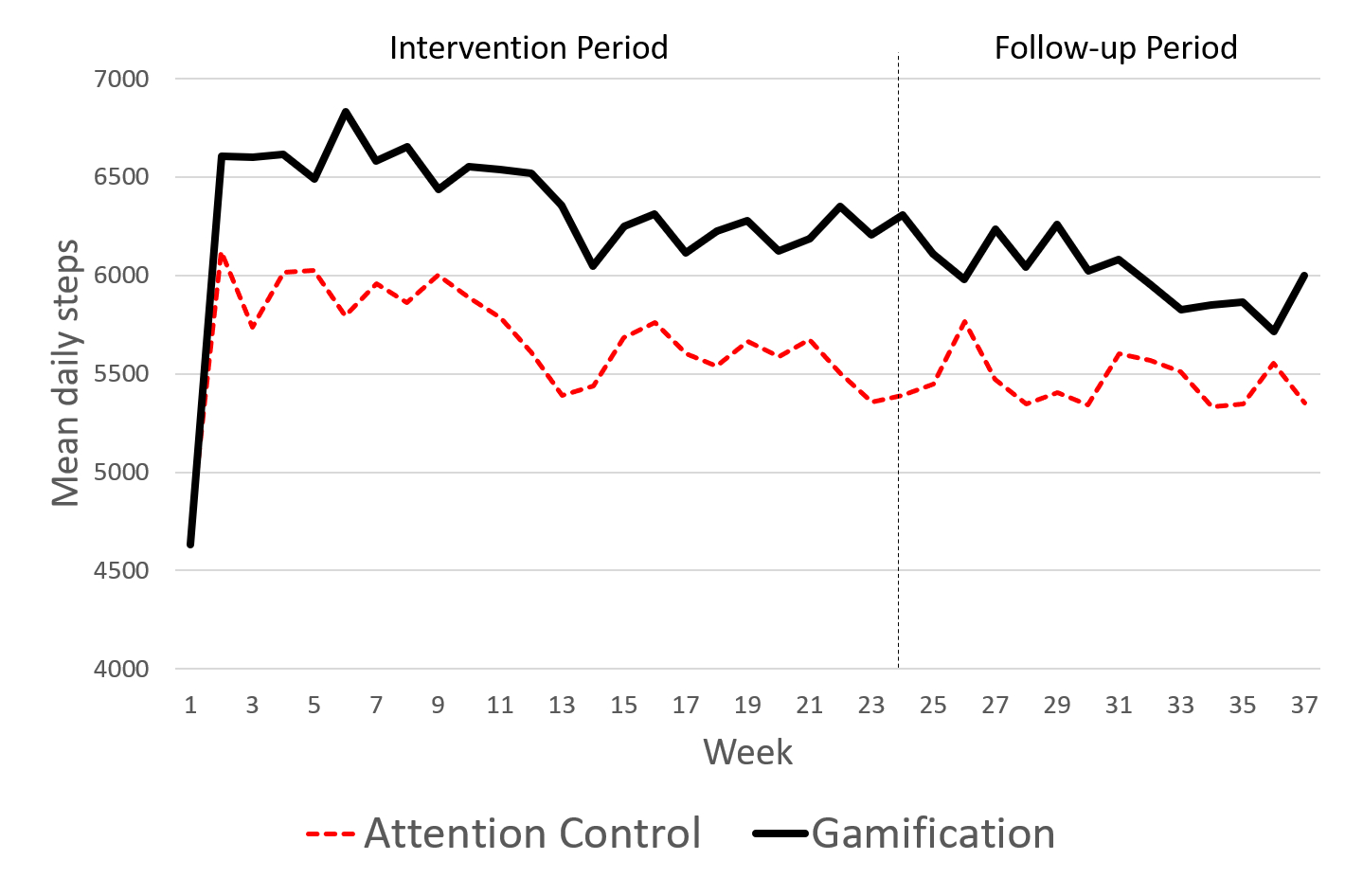
Abstract Body (Do not enter title and authors here): Background: Breast and prostate cancer survivors are at high risk of cardiovascular events due to cardiotoxic therapies. Physical activity is associated with better outcomes in these patients, but most do not meet targets. Black and Hispanic cancer survivors are at higher risk for cardiovascular events and are less active than non-Hispanic White survivors. Methods: This was a pragmatic randomized controlled trial evaluating the effectiveness of a remotely delivered gamification intervention to increase daily physical activity in Black and Hispanic breast and prostate cancer survivors who had received cardiotoxic therapy and had at least 1 additional cardiovascular risk factor. Patients were mailed a wearable device to track daily steps, established a baseline daily step count, set a goal to increase daily step count by 1500-3000/day, and were randomized to control (n=76) or gamification (n=74). The gamification group was entered into a 24-week game designed using insights from behavioral economics with points and levels for achieving step goals. The intervention included a 12-week follow-up period to evaluate sustainability of behavior. The control group received feedback from the wearable device but no other interventions for 36 weeks. The primary outcome was change from baseline in daily steps through the end of the 24-week intervention period. Results: A total of 150 patients (mean age, 64 years; 81% female, 64% Black, 35% Hispanic, 60% hypertension, 51% hyperlipidemia, 44% obesity, 28% diabetes; mean time since cancer diagnosis, 7.8 years) were enrolled from 2 health systems. Mean±SD daily step count increase from baseline through the end of the intervention period was 983±1539 in the control arm and 1757±1921 in the gamification arm (Figure). Compared with controls, gamification participants had a significantly greater increase from baseline in mean daily steps during the intervention period (+770, 95% CI 217 to 1323, P = 0.006), which persisted during follow-up (+596, 95% CI -30 to 1223, P = 0.06). Gamification also increased weekly minutes of moderate to vigorous physical activity more than control (intervention period: +16, 95% CI 4 to 29, P=0.01; follow-up: +11, 95% CI 0 to 21, P = 0.05). Conclusion: Remotely delivered gamification increased daily physical activity from baseline more than control in breast and prostate cancer survivors, and may represent a scalable intervention to reduce cardiovascular risk in this high-risk population.
Fanaroff, Alexander
(
University of Pennsylvania
, Philadelphia , Pennsylvania , United States )
Orr, Jennifer
(
University of Pennsylvania
, Philadelphia , Pennsylvania , United States )
Anucha, Chinyere
(
University of Pennsylvania
, Philadelphia , Pennsylvania , United States )
Kim, Emily
(
University of Pennsylvania
, Philadelphia , Pennsylvania , United States )
Rareshide, Charles
(
University of Pennsylvania
, Philadelphia , Pennsylvania , United States )
Zhu, Jingsan
(
University of Pennsylvania
, Philadelphia , Pennsylvania , United States )
Echevarria, Meagan
(
City of Hope Comprehensive Cancer Center
, Duarte , California , United States )
Rodarte, Stephanie
(
City of Hope Comprehensive Cancer Center
, Duarte , California , United States )
Balasian, Elina
(
City of Hope Comprehensive Cancer Center
, Duarte , California , United States )
Kassabian, Mareen
(
City of Hope Comprehensive Cancer Center
, Duarte , California , United States )
Ky, Bonnie
(
University of Pennsylvania
, Philadelphia , Pennsylvania , United States )
Volpp, Kevin
(
University of Pennsylvania
, Philadelphia , Pennsylvania , United States )
Armenian, Saro
(
City of Hope Comprehensive Cancer Center
, Duarte , California , United States )
Author Disclosures:
Alexander Fanaroff:DO have relevant financial relationships
;
Research Funding (PI or named investigator):Prolocor:Past (completed)
; Consultant:JNJ/BMS:Expected (by end of conference)
; Research Funding (PI or named investigator):Optum:Active (exists now)
; Consultant:Abbott:Past (completed)
; Consultant:Novartis:Past (completed)
| Mareen Kassabian:No Answer
| Bonnie Ky:No Answer
| Kevin Volpp:DO have relevant financial relationships
;
Advisor:Thrive Global:Active (exists now)
; Researcher:Independence Blue Cross:Active (exists now)
; Ownership Interest:VAL Health :Active (exists now)
| Saro Armenian:DO NOT have relevant financial relationships
| Jennifer Orr:DO NOT have relevant financial relationships
| Chinyere Anucha:DO NOT have relevant financial relationships
| Emily Kim:DO NOT have relevant financial relationships
| Charles Rareshide:DO NOT have relevant financial relationships
| Jingsan Zhu:No Answer
| Meagan Echevarria:DO NOT have relevant financial relationships
| Stephanie Rodarte:DO NOT have relevant financial relationships
| Elina Balasian:DO NOT have relevant financial relationships