Clinical characteristics and management of patients with hypertension and
cardiovascular-renal-metabolic diseases in routine care: Insights from iCaReMe Global Registry
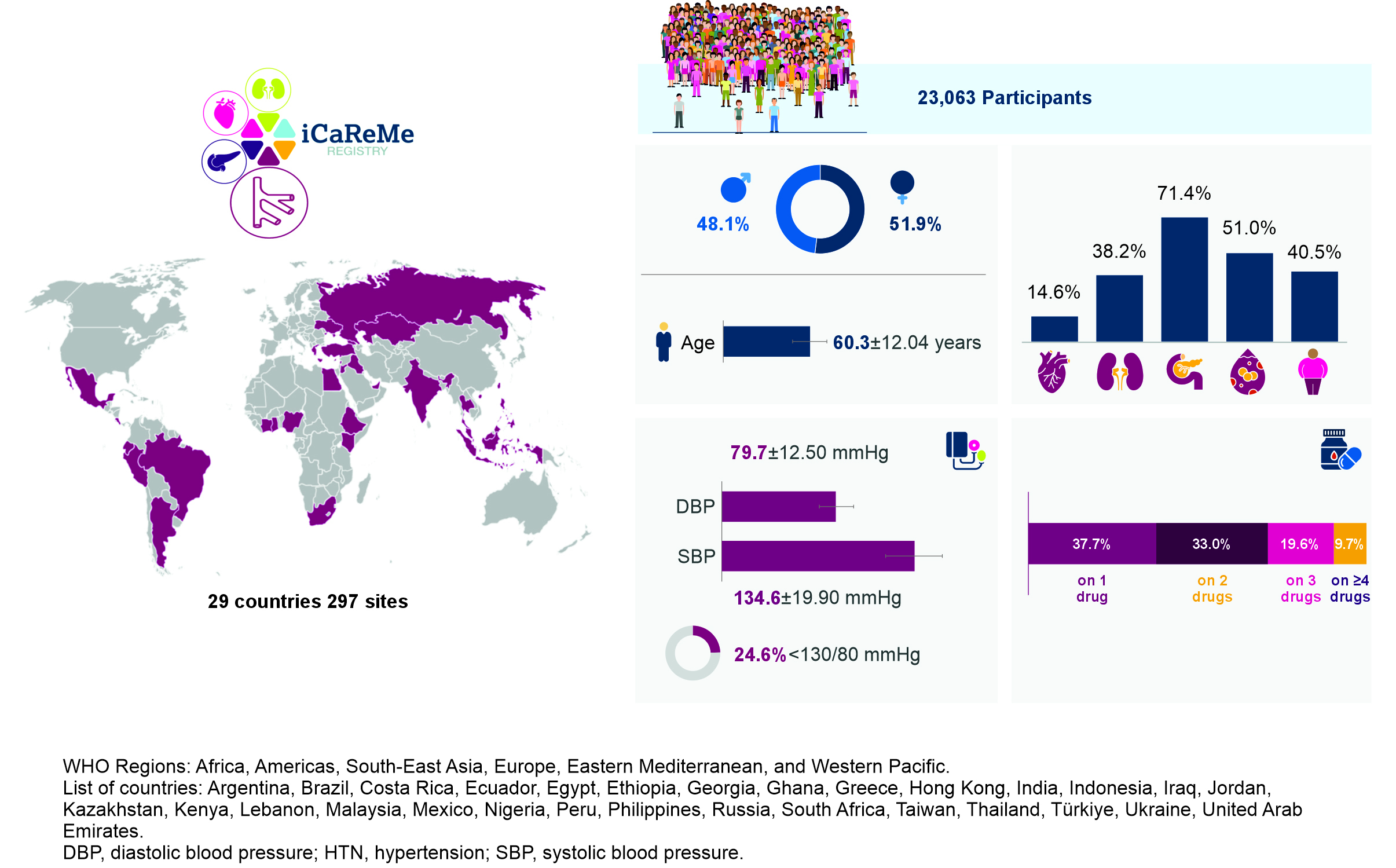
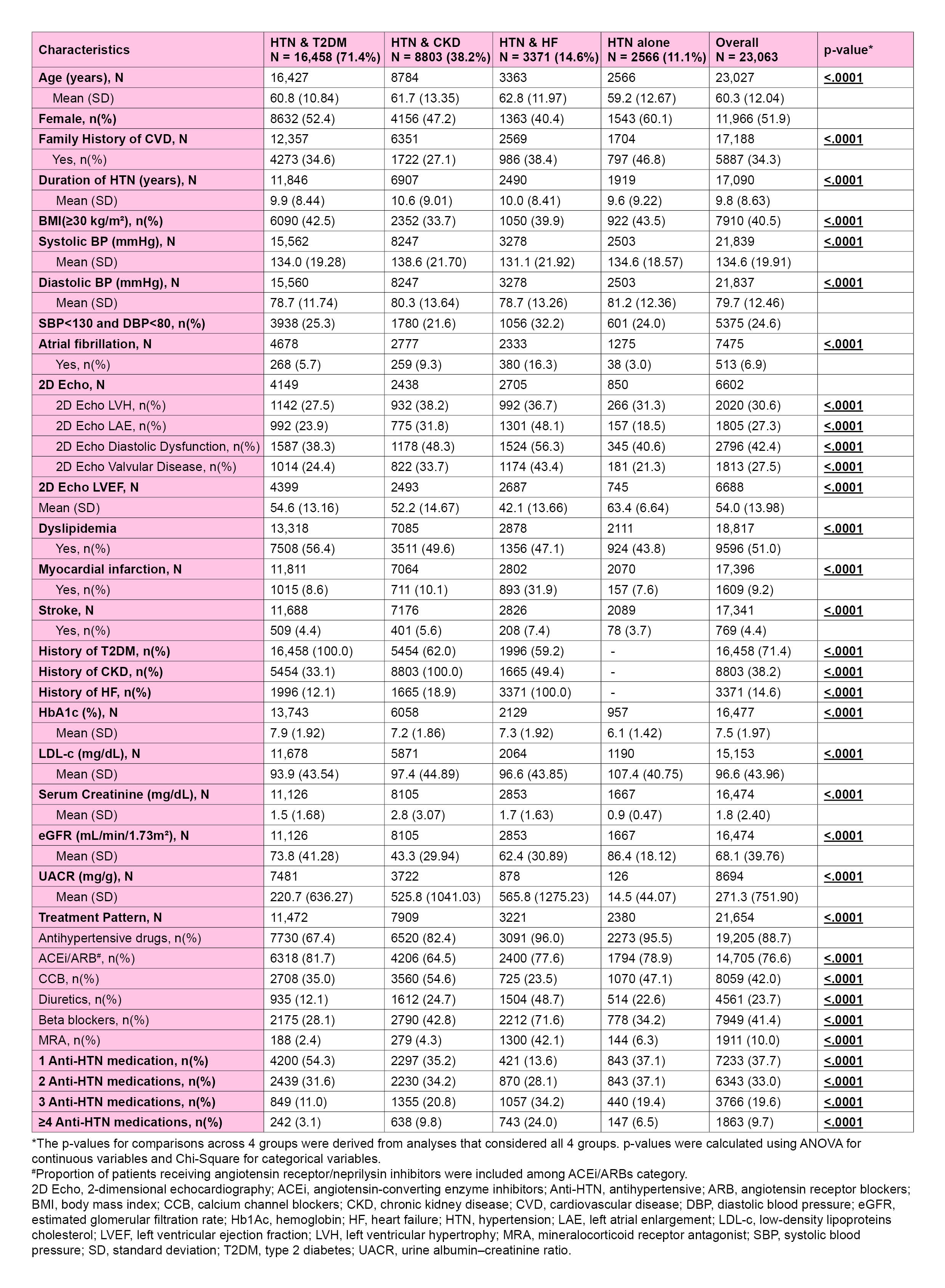
Abstract Body (Do not enter title and authors here): Background Hypertension (HTN) is the leading modifiable risk factor for the global burden of cardiovascular renal metabolic diseases (CVRM). It’s a major precursor and comorbidity for type 2 diabetes (T2DM), heart failure (HF) and chronic kidney disease (CKD) thus a holistic view of HTN management may help in designing effective strategies for better outcomes. iCaReMe Global Registry provides real world data on characteristics and management patterns of hypertensive patients in conjunction with CVRM diseases. Research Questions To describe the clinical characteristics and management patterns of patients with HTN and comorbid CVRM diseases. Methods iCaReMe Global Registry (NCT03549754) is a multinational, prospective, observational study assessing the management and quality of care in over 50,000 subjects with either HTN, T2DM, CKD, and/or HF. Baseline data of HTN patients enrolled from 29 countries across the six WHO regions in 2018–2024 were used for a cross-sectional descriptive analysis of demographic, clinical characteristics and treatment patterns. Results The study involved 23,063 participants (mean age 60.3±12.0 years, 51.9% female). Comorbidities included T2DM in 71% (mean HbA1c=7.9±1.9), CKD in 38% (mean eGFR=43.3±29.9 mL/min/1.73 m2), HF in 15% (mean LVEF=42.1%±13.7%), dyslipidemia in 51% and obesity in 40.5% (Figure 1). 2D Echo results showed LVH in 31%, left atrial enlargement in 27%, and diastolic dysfunction in 42% of patients. Mean office SBP/DBP were 134.6±19.9/79.7±12.5 mmHg with only 25% achieving BP target of <130/80 mmHg. Anti-HTN medications were prescribed to 89% of patients. Most prescribed classes were ACEi/ARB in 77%, CCB in 42%, beta blockers in 41% and diuretics in 24%. Overall, 62% of the participants were prescribed two or more antihypertensive drugs. CKD patients presented the highest BP levels and the lowest BP control rate, those with HF had the highest use of combination therapy and highest HTN control rate whereas T2DM patients showed the lowest rate of prescribed anti-HTN medications and combinations use (Table 1). Conclusion Our analysis provides a unique perspective on HTN management among patients with comorbid CVRM diseases. The observed substantial burden of risk factors, target organ damage, and low rates of BP control reveal significant gaps in current treatment practices. These findings highlight the urgent need for enhanced HTN management strategies to improve patient outcomes across this high-risk population.
Khunti, Kamlesh
(
Diabetes Research Centre, University of Leicester
, Leicester , United Kingdom )
Arici, Mustafa
(
Hacettepe University Faculty of Medicine
, Ankara , Turkey )
Pollock, Carol
(
University of Sydney
, Sydney , New South Wales , Australia )
Huang, Chien-ning
(
Chung Shan Medical University Hospital
, Taichung , Taiwan )
Tinoco-silva, Ruben Oswaldo
(
Clinic Specialized in Diabetes Management in Mexico City IMSS-Bienestar Public Health Services
, Mexico , Mexico )
El Sayed, Adel
(
Sohag Faculty of Medicine, Sohag
, Cairo , Egypt )
Coto, Esteban
(
Global Medical Affairs, BioPharmaceuticals Medical, AstraZeneca
, Gaithersburg , Maryland , United States )
Kosiborod, Mikhail
(
Late-Stage Development (CVRM), BioPharmaceuticals R&D, AstraZeneca
, Boston , Massachusetts , United States )
Farouk, Hisham
(
Medical Affairs, AstraZeneca International
, Dubai , United Arab Emirates )
Salama, Karim
(
Medical Affairs, AstraZeneca International
, Dubai , United Arab Emirates )
Vasnawala, Hardik
(
Medical Affairs, AstraZeneca International, AstraZeneca India
, Bangalore , India )
Hadaoui, Ahmed
(
Medical Affairs, AstraZeneca International, AstraZeneca Algeria
, Algiers , Algeria )
Author Disclosures:
Kamlesh Khunti:No Answer
| Karim Salama:DO have relevant financial relationships
;
Employee:AstraZeneca International :Active (exists now)
| Hardik Vasnawala:DO have relevant financial relationships
;
Employee:AstraZeneca:Active (exists now)
| Ahmed HADAOUI:DO have relevant financial relationships
;
Employee:AstraZeneca:Active (exists now)
| Mustafa ARICI:No Answer
| Carol Pollock:DO have relevant financial relationships
;
Speaker:Astra Zeneca:Past (completed)
; Advisor:Astra Zeneca:Active (exists now)
; Advisor:Boehringer Ingelheim:Past (completed)
; Research Funding (PI or named investigator):Astra Zeneca:Expected (by end of conference)
; Advisor:Bayer:Active (exists now)
; Advisor:Novartis:Active (exists now)
; Speaker:Novartis:Past (completed)
; Speaker:Novo Nordisk:Past (completed)
| Chien-Ning Huang:DO NOT have relevant financial relationships
| Ruben Oswaldo Tinoco-Silva:No Answer
| Adel El Sayed:No Answer
| Esteban Coto:No Answer
| Mikhail Kosiborod:No Answer
| Hisham Farouk:No Answer