Logo

American Heart Association

  18
  0


Final ID: MP376

Elevated Lipoprotein(a) Is Independently Associated With Greater Infarct Size, Especially in Premature Atherosclerosis

Abstract Body (Do not enter title and authors here): Background: Elevated lipoprotein(a) (Lp[a]) is an independent, causal, genetic risk factor for CVD. While increasing infarct size corresponds with poor outcomes, it is unknown whether Lp(a) is associated with infarct size.
Objective: To understand if elevated Lp(a), including intermediate risk (30–50 mg/dL) is associated with increasing infarct size, especially in patients (pts) with premature atherosclerosis (<55 and <65 years in men and women, respectively).
Methods: Data from pts referred for coronary computed tomography angiography (CCTA) and enrolled in the Lp(a) subanalysis of the Genetic Loci and the Burden of Atherosclerotic Lesions (GLOBAL) study (NCT01738828) were analyzed. Lp(a) was measured at the time of CCTA between 2012–2014; Lp(a) data were later validated. Cases were defined by history of myocardial infarction. Infarct size was measured by contrast-enhanced CT and analyzed in a core laboratory. The left ventricle was analyzed visually based on a 17-segment model; infarct size was determined as the number of segments with discernible infarct. Lp(a) (mg/dL) was measured by latex-enhanced immunoturbidimetric assay; apolipoprotein B (apoB; mg/dL) was measured by antigen–antibody turbidimetric assay. The association between Lp(a) and infarct size was determined by Spearman’s correlation, and the independent association of Lp(a) measurements across the apoB range was determined by generalized covariance. Data were adjusted for age, sex, and apoB.
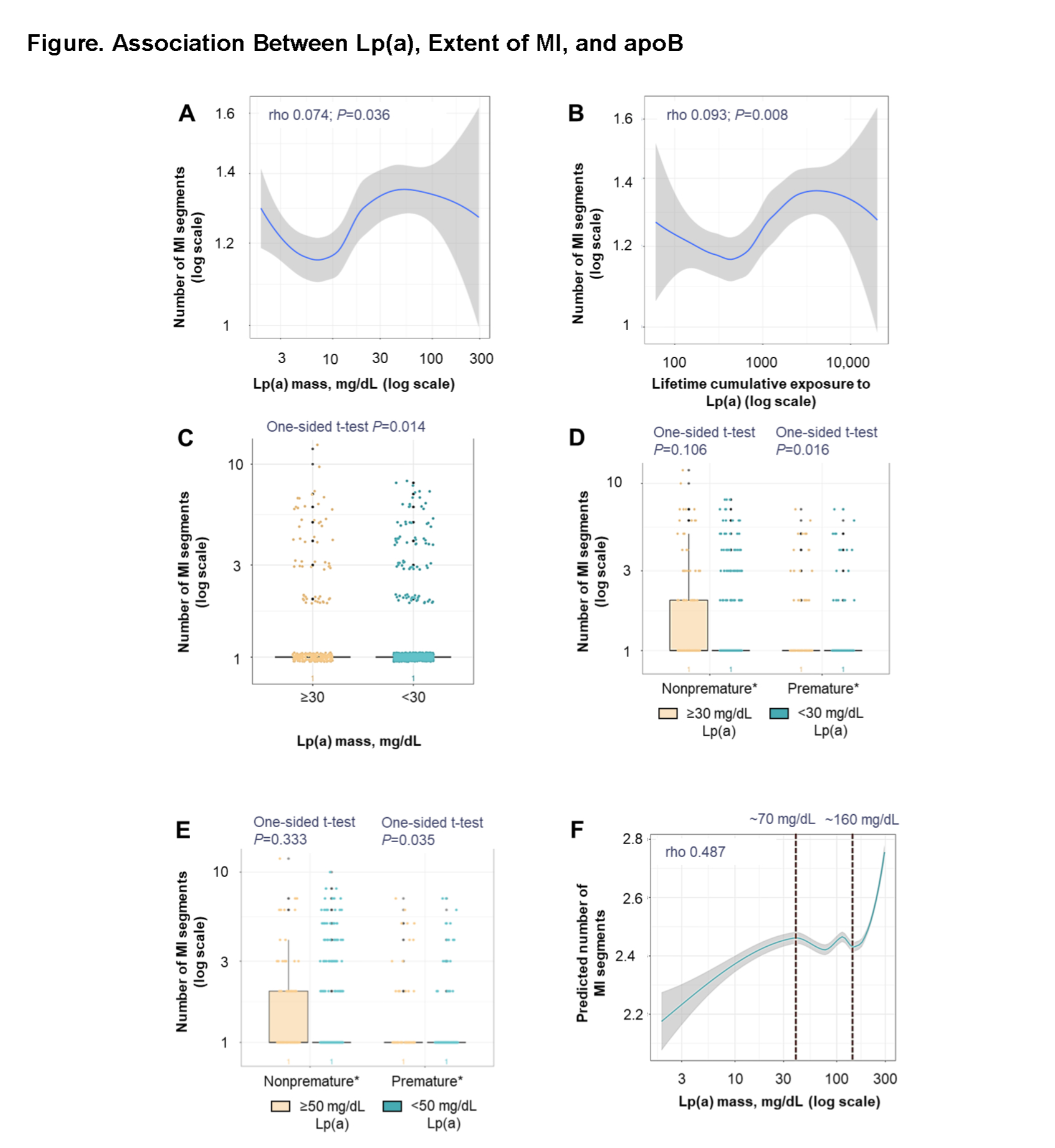
Results: Overall, 800 pts were included: 74.8% male; median (range) age: 61.0 (55.0–68.0) and 57.0 (52.0–65.0) years for cases and controls, respectively (both n=400). Median Lp(a) mass: 11.1 (IQR 41.1; upper limit of Q1, Q3: 5.3, 46.4) mg/dL. Circulating Lp(a) levels and lifetime cumulative exposure to Lp(a) (age multiplied by Lp[a]) correlated with infarct size (rho=0.07 and 0.09, respectively; Fig A, B). Higher Lp(a) levels were associated with significantly larger infarct size vs lower Lp(a) levels (P=0.014; Fig C). Infarct size was significantly larger in pts with Lp(a) levels >30 mg/dL or >50 mg/dL and premature atherosclerosis (P=0.016 and P=0.035, respectively; Fig D, E), but not in pts with nonpremature atherosclerosis. When conditioned on apoB, increasing Lp(a) was associated with increasing infarct size (rho=0.487; Fig F).
Conclusions: Our findings suggest that elevated Lp(a) >30 mg/dL is independently associated with increasing infarct size, particularly in pts with premature atherosclerosis.
  • Voros, Szilard  ( G3 Therapeutics , Midlothian , Virginia , United States )
  • Dayspring, Thomas  ( Global Institute for Research, LLC , Richmond , Virginia , United States )
  • Boatwright, Wess  ( Novartis Pharmaceuticals Corporation , East Hanover , New Jersey , United States )
  • Brown, Bradley  ( G3 Therapeutics , Midlothian , Virginia , United States )
  • Lozama, Tony  ( Novartis Pharmaceuticals Corporation , East Hanover , New Jersey , United States )
  • Watson, David  ( King’s College London , London , UK , United Kingdom )
  • Barnes, Michael  ( G3 Therapeutics , Midlothian , Virginia , United States )
  • Rodriguez, Fatima  ( Stanford University School of Medicine , Stanford , California , United States )
  • Mehta, Anurag  ( Virginia Commonwealth University School of Medicine , Richmond , Virginia , United States )
  • Fayad, Zahi  ( BioMedical Engineering and Imaging Institute, Icahn School of Medicine at Mount Sinai , New York , New York , United States )
  • Author Disclosures:
    Szilard Voros: DO have relevant financial relationships ; Ownership Interest:Global Genomics Group:Active (exists now) | Thomas Dayspring: DO have relevant financial relationships ; Advisor:NewAmsterdam Pharma:Past (completed) | Wess Boatwright: No Answer | Bradley Brown: No Answer | Tony Lozama: DO have relevant financial relationships ; Employee:Novartis Pharmaceutical Corporation:Active (exists now) | David Watson: DO NOT have relevant financial relationships | Michael Barnes: No Answer | Fatima Rodriguez: DO have relevant financial relationships ; Consultant:HealthPals:Past (completed) ; Consultant:Cleerly Health:Active (exists now) ; Consultant:Amgen:Active (exists now) ; Consultant:iRhythm:Active (exists now) ; Consultant:HeartFlow:Active (exists now) ; Consultant:Arrowhead Pharmaceuticals:Active (exists now) ; Consultant:Edwards:Active (exists now) ; Consultant:Inclusive Health:Active (exists now) ; Consultant:Esperion Therapeutics:Past (completed) ; Consultant:Kento Health:Active (exists now) ; Consultant:Movano Health:Active (exists now) ; Consultant:NovoNordisk:Past (completed) ; Consultant:Novartis:Active (exists now) | Anurag Mehta: DO have relevant financial relationships ; Research Funding (PI or named investigator):Amgen:Active (exists now) ; Research Funding (PI or named investigator):Novartis:Active (exists now) | Zahi Fayad: DO NOT have relevant financial relationships
Meeting Info:

Scientific Sessions 2025

2025

New Orleans, Louisiana

Session Info:
More abstracts on this topic:
A Non-odorant Olfactory Receptor Ligand Depolymerizes the Platelet Actin Cytoskeleton to Prevent Thrombosis

Aggarwal Anu, Godwin Matthew, Ali Mariya, Jennings Courtney, Rajasekar Bhairavi, Scalise Alliefair, Stauffer Shaun, Mccrae Keith, Mcintyre Thomas, Cameron Scott, Wang Nancy, Josyula Vara Prasad, Yang Moua, Young Shim, Kennedy Quinn, Samuel Reina, Sangwan Naseer, Guntupalli Suman

Additive Value of Lipoprotein(a), Remnant Cholesterol, and Inflammation for Risk Stratification of Myocardial Infarction: Evidence from the UK Biobank

Kazibwe Richard, Schaich Christopher, Kingsley Jeffrey, Rikhi Rishi, Namutebi Juliana, Chevli Parag, Mirzai Saeid, Shapiro Michael

You have to be authorized to contact abstract author. Please, Login
Not Available