Sodium-Glucose Cotransporter-2 Inhibitor Use Is Associated with Improved Cognitive Outcomes in Older Heart Failure Patients: A Comparative Analysis Using Real-World Clinical Data
Abstract Body (Do not enter title and authors here): Background: Cognitive impairment is a frequent and debilitating comorbidity in older adults with heart failure (HF). Sodium-glucose cotransporter-2 inhibitors (SGLT2i) improve HF-related outcomes, but their effect on cognitive outcomes is not well established.
Research Question: Does treatment with the SGLT2i empagliflozin or dapagliflozin reduce the incidence of cognitive impairment in older adults with HF?
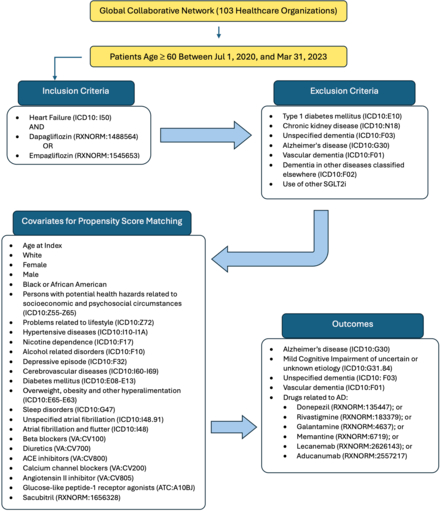
Methods: We conducted a retrospective, propensity score-matched cohort study using TriNetX, a global electronic health records database. Adults ≥60 years of age with a diagnosis of HF between July 1, 2020, and March 31, 2023, were included (Figure 1). Patients with pre-existing dementia, type 1 diabetes or chronic kidney disease were excluded. A total of 50,188 SGLT2i users (empagliflozin n=32,761 [65.3%]; dapagliflozin n=17,427 [34.7%]) were propensity score–matched 1:1 to non-user controls based on demographic and clinical variables. Outcomes were assessed over a 2-year follow-up, and included incident diagnosis of Alzheimer’s disease (AD), vascular dementia (VD), mild cognitive impairment (MCI), unspecified dementia, and drugs related to AD. Cox proportional hazards models were used to estimate hazard ratios (HRs).
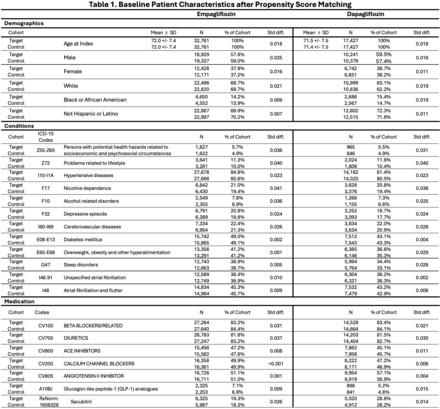
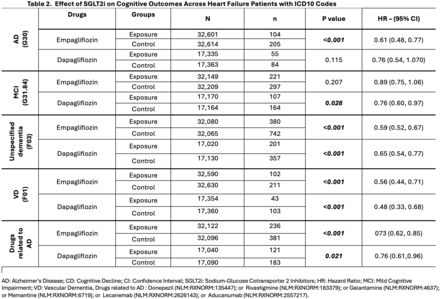
Results: The matched cohorts had a mean age of 72.0 years (empagliflozin) and 71.5 years (dapagliflozin); approximately 58–59% were male and 43–49% had diabetes mellitus. Baseline characteristics were adequately matched (Table 1). Empagliflozin use was associated with significantly reduced risk of AD (HR 0.61, 95% CI 0.48–0.77, p<0.001), VD (HR 0.56, 95% CI 0.44–0.71, p<0.001), unspecified dementia (HR 0.59, 95% CI 0.52–0.67, p<0.001), and initiation of drugs related to AD (HR 0.73, 95% CI 0.62–0.85, p<0.001) (Table 2) Dapagliflozin showed similar protective associations with VD (HR 0.48, 95% CI 0.33–0.68, p<0.001), unspecified dementia (HR 0.65, 95% CI 0.54–0.77, p<0.001), initiation of drugs related to AD (HR 0.76, 95% CI 0.61–0.96, p=0.021), and MCI (HR 0.76, 95% CI 0.60–0.97, p=0.028).
Conclusion: In a real-world study of older adults with heart failure, empagliflozin and dapagliflozin use was associated with a lower risk of incident cognitive impairment. While mechanisms such as improved cerebral perfusion, attenuation of neuroinflammation or modulation of metabolic and vascular pathways implicated in neurodegeneration are plausible, prospective studies are needed to confirm these associations and elucidate causal pathways.
Rahmani, Ali Reza
(
Stony Brook University
, Stony Brook , New York , United States )
Kim, Min-jeong
(
Stony Brook University
, Stony Brook , New York , United States )
Delorenzo, Christine
(
Stony Brook University
, Stony Brook , New York , United States )
Parsey, Ramin
(
Stony Brook University
, Stony Brook , New York , United States )
Skopicki, Hal
(
Stony Brook University
, Stony Brook , New York , United States )
Blumen, Helena
(
Stony Brook University
, Stony Brook , New York , United States )
Kalogeropoulos, Andreas
(
Stony Brook University
, Stony Brook , New York , United States )
Author Disclosures:
Ali Reza Rahmani:DO NOT have relevant financial relationships
| Min-Jeong Kim:DO NOT have relevant financial relationships
| Christine DeLorenzo:No Answer
| Ramin Parsey:No Answer
| Hal Skopicki:No Answer
| Helena Blumen:No Answer
| Andreas Kalogeropoulos:DO NOT have relevant financial relationships