Prediction of major adverse clinical events using fatty liver index in patients following percutaneous coronary intervention
Abstract Body (Do not enter title and authors here): Introduction: Fatty liver is recognized as a risk factor for cardiovascular disease, and its severity can be assessed using the fatty liver index (FLI), a non-invasive marker calculated from body mass index, waist circumference, triglyceride, and gamma-glutamyl transferase levels. Despite its clinical utility, the association between FLI and long-term outcomes after percutaneous coronary intervention (PCI) remains unclear.
Research Question: This study aimed to investigate whether FLI is associated with adverse clinical events, including all-cause death and repeat revascularization (RR), in patients undergoing PCI.
Methods: We analyzed data from 576 patients who underwent PCI at a single center, enrolled in a prospective cohort registry. Patients were divided into four groups according to FLI quartiles (Q1–Q4). The primary endpoint was the 5-year cumulative incidence of all-cause death and repeat revascularization (RR), including myocardial infarction and ischemia-driven revascularization.
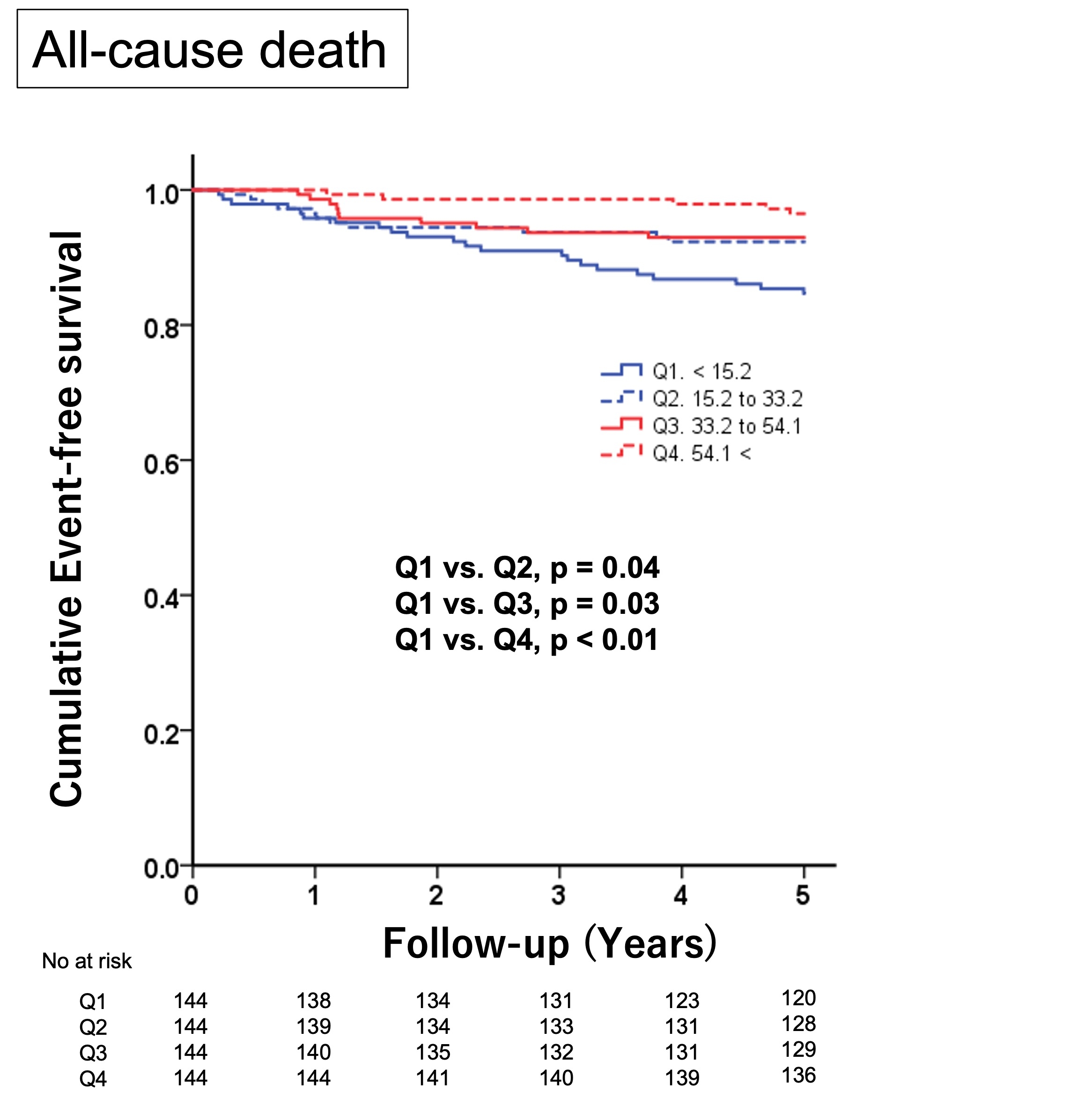
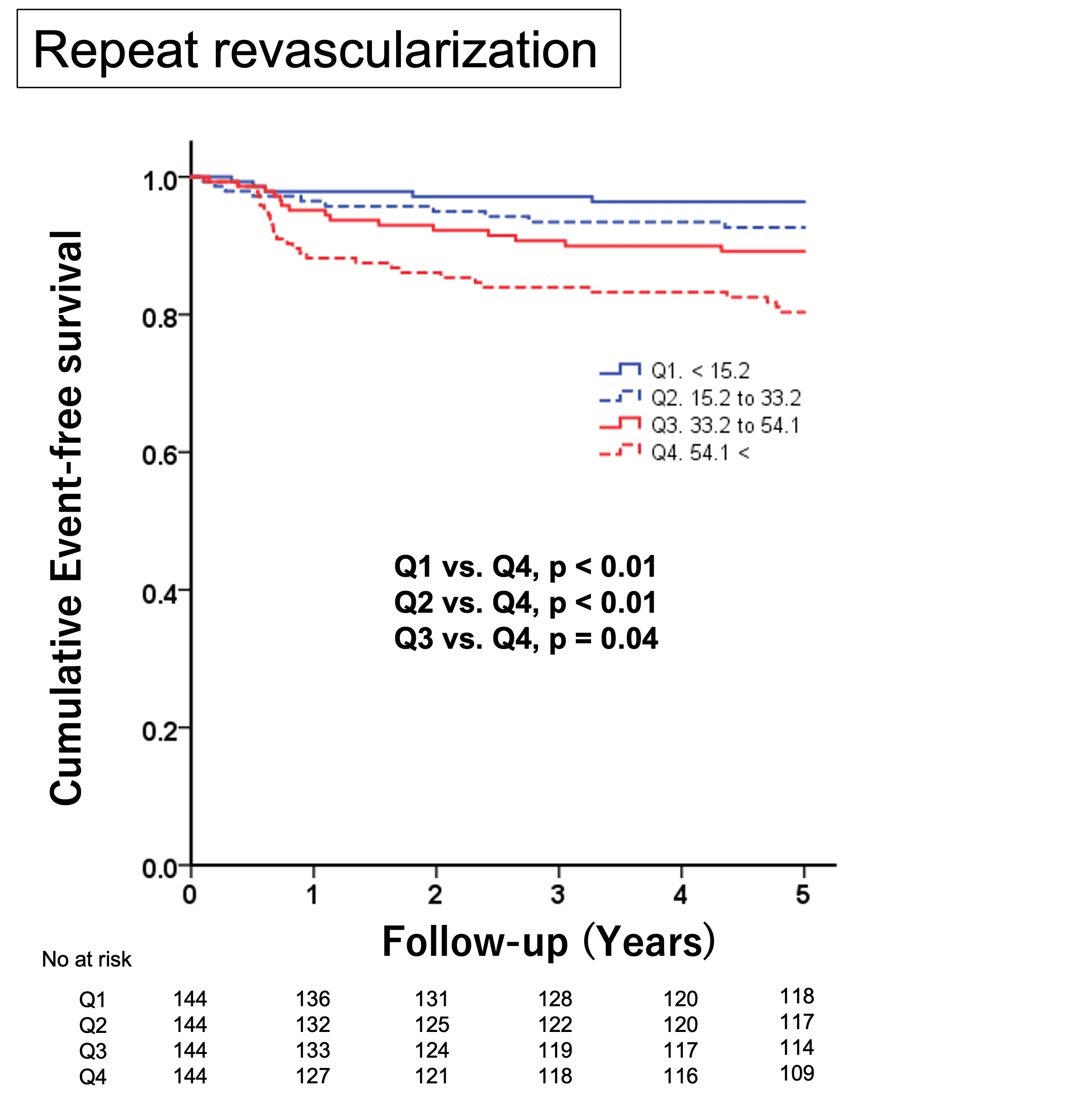
Results: During the 5-year follow-up, 48 patients died (8.3%), and 58 experienced RR (10%). The incidence of all-cause death was significantly higher in Q1 (15%) compared with Q2 (7.7%), Q3 (7.0%), and Q4 (3.5%) (log-rank p=0.04, 0.03, and <0.01, respectively) (Figure 1). Multivariate Cox regression analysis showed that a higher FLI was associated with a lower risk of all-cause death (adjusted hazard ratio [HR], 0.98; 95% confidence interval [CI], 0.97–0.99; p=0.03). In contrast, the incidence of RR was significantly higher in Q4 (19.7%) than in Q1 (3.6%), Q2 (7.3%), and Q3 (10.8%) (log-rank p<0.01, <0.01, and =0.04, respectively) (Figure 2). Multivariate analysis showed that a higher FLI was associated with a higher risk of RR (adjusted HR, 1.02; 95% CI, 1.01–1.03; p<0.01).
Conclusions: A low FLI was associated with higher all-cause mortality, while a high FLI was associated with increased risk of repeat revascularization. These findings suggest that FLI reflects different aspects of clinical risk after PCI, and its assessment may be useful for predicting long-term outcomes in this population.
Yoshizaki, Toru
(
UNIVERSITY OF YAMANASHI
, Chuo , Japan )
Nakamura, Takamitsu
(
Univ. of Yamanashi, Internal Med II
, Chuo, Yamanashi Prefecture , Japan )
Eguchi, Miu
(
UNIVERSITY OF YAMANASHI
, Chuo , Japan )
Omori, Kazuhira
(
UNIVERSITY OF YAMANASHI
, Chuo , Japan )
Horikoshi, Takeo
(
UNIVERSITY OF YAMANASHI
, Chuo , Japan )
Kobayashi, Tsuyoshi
(
UNIVERSITY OF YAMANASHI
, Chuo , Japan )
Sato, Akira
(
UNIVERSITY OF YAMANASHI
, Chuo , Japan )
Author Disclosures:
Toru Yoshizaki:DO NOT have relevant financial relationships
| Takamitsu Nakamura:No Answer
| Miu Eguchi:DO NOT have relevant financial relationships
| Kazuhira Omori:DO NOT have relevant financial relationships
| Takeo Horikoshi:DO NOT have relevant financial relationships
| Tsuyoshi Kobayashi:No Answer
| Akira Sato:DO NOT have relevant financial relationships