Preoperative Daily Step Count and Cognitive Performance Following Cardiac Surgery
Abstract Body (Do not enter title and authors here): Background: Cognitive decline is a common complication of cardiac surgery, linked to reduced quality of life and increased mortality. Even early, transient deficits are associated with long-term cognitive decline. While several perioperative risk factors have been studied, the role of preoperative physical activity, specifically daily step count, remains underexplored. We evaluated whether a lower preoperative daily step count is associated with postoperative cognitive decline.
Hypothesis: Lower preoperative step count is associated with greater risk of cognitive decline following cardiac surgery.
Methods: Patients ≥50 years undergoing elective cardiac surgery with cardiopulmonary bypass were prospectively and consecutively enrolled at a single academic medical center between September 2023 and March 2025. Daily step count was measured preoperatively and for the first 90 days after surgery using a commercially available activity tracker. Patients were categorized into two groups based on median preoperative step count: low steps (<6,500 steps/day) and high steps (≥6,500 steps/day). Cognitive performance was assessed using the Montreal Cognitive Assessment (MoCA) preoperatively, at discharge, at 30 days, and 90 days postoperatively. The primary outcome was a decrease in cognitive performance, defined as a MoCA score of ≥1 standard deviation below baseline. Group comparisons were conducted using Wilcoxon rank sum tests for continuous variables and Fisher’s exact tests for categorical variables.
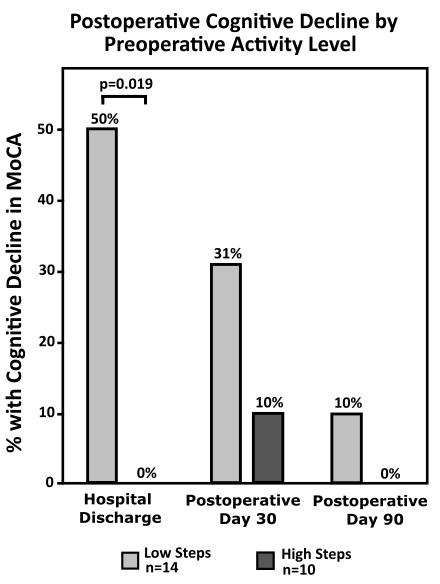
Results: We enrolled 24 participants (mean age 66.6±8.7 years; 54% male; 96% white). The median preoperative step count was 5,876 [IQR 4,763–8,781] steps/day, with 58% classified to be in the low steps group. Participants in the low steps group were more likely to be female (p = 0.047), with no other significant demographic or operative differences. Decrease in cognitive performance from baseline at discharge occurred in 50% of participants in the low steps group, compared to 0% in the high steps group (p=0.019), despite similar baseline MoCA scores. No significant group differences were observed in cognitive decline at 30 or 90 days postoperatively, or in recovery of step count by 90 days.
Conclusion: Lower preoperative daily step count was associated with increased risk of postoperative cognitive decline at discharge. Daily step count may serve as a simple, scalable target for preoperative intervention to reduce cognitive vulnerability after cardiac surgery.
Arai, Ema
(
University of Colorado SOM
, Aurora , Colorado , United States )
Daly, Jonathan
(
University of Colorado SOM
, Aurora , Colorado , United States )
Su, Yi
(
University of Colorado
, Aurora , Colorado , United States )
Cotton, Jake
(
University of Colorado
, Aurora , Colorado , United States )
Anigbogu, Chiagoziem
(
University of Colorado SOM
, Aurora , Colorado , United States )
Lum, Hillary
(
University of Colorado
, Aurora , Colorado , United States )
Stevens-lapsley, Jennifer
(
University of Colorado
, Aurora , Colorado , United States )
Robinson, Thomas
(
University of Colorado
, Aurora , Colorado , United States )
Rove, Jessica
(
University of Colorado
, Aurora , Colorado , United States )
Author Disclosures:
Ema Arai:DO NOT have relevant financial relationships
| Jonathan Daly:No Answer
| Yi Su:DO NOT have relevant financial relationships
| Jake Cotton:DO NOT have relevant financial relationships
| Chiagoziem Anigbogu:DO NOT have relevant financial relationshipsJennifer Stevens-Lapsley:DO NOT have relevant financial relationships
| Thomas Robinson:DO NOT have relevant financial relationships
| Jessica Rove:DO have relevant financial relationships
;
Speaker:Medtronic:Past (completed)
; Research Funding (PI or named investigator):Edwards:Past (completed)
; Consultant:Intuitive:Active (exists now)