
Logo

American Heart Association

  23
  0


Final ID: MP2004

Motion-Corrected Coronary CT Angiography in Patients with Atrial Fibrillation: A Segment-Based Image Quality Assessment

Abstract Body (Do not enter title and authors here): Introduction:
The image quality of coronary CT angiography (CCTA) has improved considerably; however, it remains suboptimal in certain cases, particularly in patients with atrial fibrillation (AF) due to motion artifacts. Recently, deep learning-based reconstruction techniques have emerged to address this limitation.

Purpose:
To evaluate the image quality of motion-corrected CCTA using CLEAR Motion (Canon Medical Systems Corporation), a deep learning-based motion correction algorithm, compared with conventional reconstruction in AF patients.

Methods:
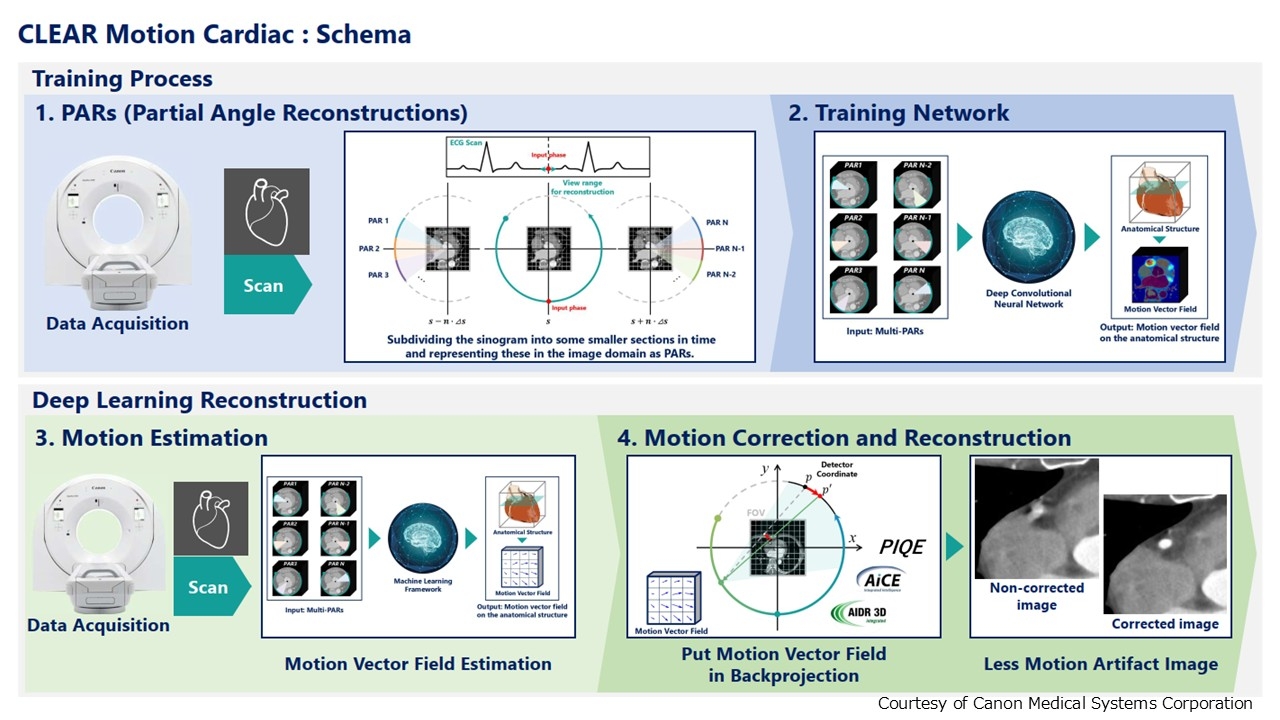
CLEAR Motion was installed on our CT system for clinical use. This algorithm applies Partial Angle Reconstructions (PARs) to estimate motion vector fields for the three major epicardial vessels, enabling motion correction and improved image quality. The motion vector fields are incorporated into backprojection, reducing motion artifacts through deep learning. We retrospectively analyzed consecutive AF patients who underwent CCTA between July 2023 and May 2024, excluding those with prior percutaneous coronary intervention or coronary artery bypass grafting. Image quality was assessed segmentally using a five-point scale (1–5) based on the American Heart Association and Society of Cardiovascular Computed Tomography guidelines by a blinded cardiologist.

Results:
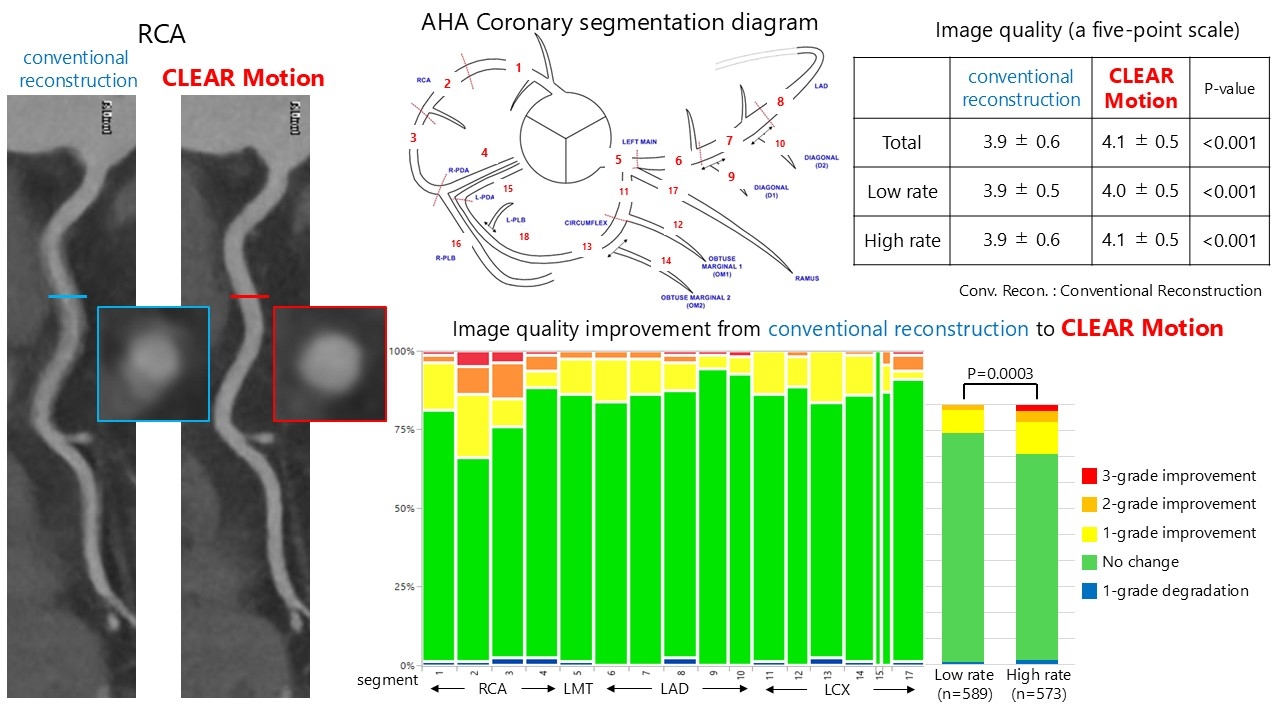
We evaluated 1,162 coronary segments from 80 patients (mean age 67.9 ± 9.5 years; 78% male; median heart rate 70 bpm). CLEAR Motion significantly improved image quality compared with conventional reconstruction (4.1 ± 0.5 vs. 3.9 ± 0.6; P < 0.001). Image quality improved across all segments, with the most pronounced enhancement observed in the mid-right coronary artery (RCA), where motion artifacts are typically most severe. In contrast, side branches showed the least improvement, likely due to the algorithm's focus on the three major epicardial coronary arteries. Patients were stratified by R–R interval into low-rate (>854 msec) and high-rate (<854 msec) groups. Image quality improved significantly in both groups (low-rate: 4.0 ± 0.5 vs. 3.9 ± 0.5, P < 0.001; high-rate: 4.1 ± 0.5 vs. 3.9 ± 0.6, P < 0.001), with a significantly greater improvement in image quality scores in the high-rate group (P < 0.001, two-way repeated measures ANOVA).

Conclusions:
CLEAR Motion significantly enhances image quality in AF patients, particularly in the mid-RCA and in those with higher heart rates.
  • Uchida, Noriya  ( Fujita health university hospital , Nagoya-city , Japan )
  • Kawai, Hideki  ( FUJITA HEALTH UNIVERSITY , Toyoake , Japan )
  • Sarai, Masayoshi  ( Fujita Health University , Toyoake , Japan )
  • Takahashi, Hiroshi  ( Fujita Health University , Toyoake , Japan )
  • Motoyama, Sadako  ( FUJITA HEALTH UNIVERSITY , Toyoake , Japan )
  • Izawa, Hideo  ( FUJITA HEALTH UNIVERSITY , Toyoake , Japan )
  • Author Disclosures:
    Noriya Uchida: DO NOT have relevant financial relationships | Hideki Kawai: DO NOT have relevant financial relationships | Masayoshi Sarai: No Answer | Hiroshi Takahashi: DO NOT have relevant financial relationships | Sadako Motoyama: No Answer | Hideo Izawa: No Answer
Meeting Info:

Scientific Sessions 2025

2025

New Orleans, Louisiana

Session Info:
More abstracts on this topic:
A Case of Dilated Cardiomyopathy and Systemic Thromboembolism in a Young Patient on Testosterone Replacement Therapy

Sabri Muhammad, Ijaz Naila, Nadeem Ramsha, Checchio Lucy, Riaz Faiza

AI-driven Aortic Valve Calcification Measurement in Coronary Artery Calcium Scan Detects Aortic Stenosis Comparably to Human Experts: An AI-CVD Study within the Framingham Heart Study

Naghavi Morteza, Atlas Kyle, Zhang Chenyu, Reeves Anthony, Atlas Thomas, Wasserthal Jakob, Yankelevitz David, Henschke Claudia, Wong Nathan

You have to be authorized to contact abstract author. Please, Login
Not Available