
Logo

American Heart Association

  20
  0


Final ID: MP1578

Outcomes of Ventricular Tachycardia Ablation in Patients with Baseline Noninducibility

Abstract Body (Do not enter title and authors here): Background: Ventricular tachycardia (VT) induction identifies targets for ablation and is an important procedural endpoint. Ablation approaches and outcomes for patients noninducible for VT at baseline are not well described.
Research question: What are the procedural characteristics and outcomes for patients presenting for VT ablation with baseline noninducibility?
Methods: Patients at a single VT referral center who were noninducible at the start of a VT ablation procedure were retrospectively identified. All procedures were performed under monitored sedation. Baseline induction consisted of programmed stimulation with up to 4 extrastimuli from 2 or more ventricular sites at 2 or more drive cycles with or without isoproterenol. Ablation strategies, procedural outcomes, and long-term results were characterized.
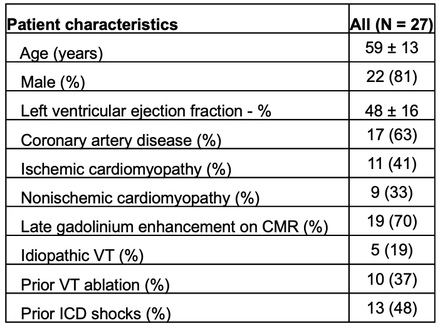
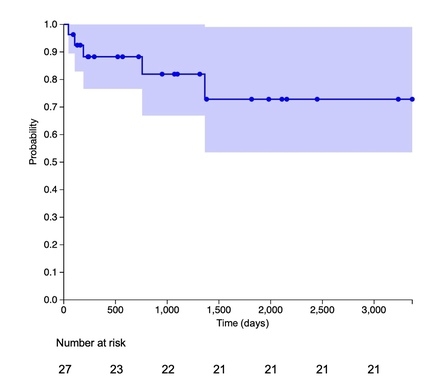
Results: A total of 27 of 160 patients referred for ablation were identified to have baseline noninducibility for VT (mean age 59 ± 13 years, 81% male, mean left ventricular ejection fraction 48 ± 16%, ischemic cardiomyopathy 41%, nonischemic cardiomyopathy 30%, Table). Prior ablation had been performed in 10/27 (37%) and 20/27 (74%) were previously treated with antiarrhythmic drugs (AADs). Mapping strategies included pace mapping of device electrograms (14/23, 61%) or prior EKGs (1/23, 4%) and pace or activation mapping of premature ventricular complexes perceived to match the clinical VT (13/23, 57%). Ablation of low voltage, fractionated, or late electrogram regions was performed in 6/27(22%). Ablation based on cardiac magnetic resonance imaging (CMR)-identified myocardial scar was performed in 7/27 (26%). VT remained noninducible in 22/23 (96%) of patients where programmed stimulation was repeated after ablation. One patient had arterial pseudoaneurysm following ablation, treated with thrombin injection. Mean follow-up was 1100 ± 967 days. VT recurred in 6/27 (22%) with a mean of 462 ± 466 days until first appropriate implantable cardioverter-defibrillator (ICD) therapy (Figure). At last follow-up, AADs were continued in 13/27 (48%) patients but had been discontinued or reduced in 16/20 (85%) prescribed AADs pre-ablation. A total of 5/27 (19%) of patients died during follow-up at a mean of 1229 ± 652 days after ablation.
Conclusion: VT ablation in patients noninducible at baseline was feasible and well-tolerated with infrequent VT recurrence. Prospective studies are needed to identify optimal ablation endpoints for this population.
  • Christian-miller, Nathaniel  ( University of Michigan , Ann Arbor , Michigan , United States )
  • Bogun, Frank  ( University of Michigan , Ann Arbor , Michigan , United States )
  • Deshmukh, Amrish  ( University of Michigan , Ann Arbor , Michigan , United States )
  • Arps, Kelly  ( University of Michigan , Ann Arbor , Michigan , United States )
  • Ghannam, Michael  ( University of Michigan , Ann Arbor , Michigan , United States )
  • Liang, Jackson  ( University of Michigan , Ann Arbor , Michigan , United States )
  • Chugh, Aman  ( University of Michigan , Ann Arbor , Michigan , United States )
  • Ghanbari, Hamid  ( University of Michigan , Ann Arbor , Michigan , United States )
  • Crawford, Thomas  ( University of Michigan , Ann Arbor , Michigan , United States )
  • Oral, Hakan  ( University of Michigan , Ann Arbor , Michigan , United States )
  • Latchamsetty, Rakesh  ( University of Michigan , Ann Arbor , Michigan , United States )
  • Author Disclosures:
    Nathaniel Christian-Miller: DO NOT have relevant financial relationships | Frank Bogun: No Answer | Amrish Deshmukh: DO NOT have relevant financial relationships | Kelly Arps: DO NOT have relevant financial relationships | Michael Ghannam: DO NOT have relevant financial relationships | Jackson Liang: No Answer | Aman Chugh: DO NOT have relevant financial relationships | Hamid Ghanbari: No Answer | Thomas Crawford: DO have relevant financial relationships ; Independent Contractor:Kestra:Past (completed) | Hakan Oral: DO have relevant financial relationships ; Individual Stocks/Stock Options:ARGA:Active (exists now) | Rakesh Latchamsetty: No Answer
Meeting Info:

Scientific Sessions 2025

2025

New Orleans, Louisiana

Session Info:

Advances in VT: Cutting-Edge Therapies, Techniques, and Risk Management

Sunday, 11/09/2025 , 11:50AM - 01:05PM

Moderated Digital Poster Session

More abstracts on this topic:
A Comparison of Anxiety and Depression in Patients with Symptoms of Palpitations Compared to High Risk Arrythmia Patients.

Treuth Mark, Patel Kunnal, Rissmiller Justin, Holdai Veera

A-band titin-truncating variant promotes the development of arrhythmia-induced cardiomyopathy in a novel genetically-engineered porcine model

Lee Kwonjae, Del Rio Carlos, Mcnally Elizabeth, Pfenniger Anna, Bhatnagar Ashita, Glinton Kristofor, Burrell Amy, Ober Rebecca, Mcluckie Alicia, Bishop Brian, Rogers Christopher, Geist Gail

More abstracts from these authors:
Bachmann’s bundle-related atrial tachycardias following catheter ablation of persistent atrial fibrillation

Christian-miller Nathaniel, Chugh Aman, Ghannam Michael, Al-sadawi Mohammed, Shah Muazzum, Arps Kelly, Deshmukh Amrish, Liang Jackson, Jongnarangsin Krit, Morady Fred, Oral Hakan

Late gadolinium enhanced cardiac magnetic resonance imaging scar is associated with a delayed effectiveness of radiofrequency ablation of premature ventricular contractions.

Al-sadawi Mohammed, Deshmukh Amrish, Arps Kelly, Liang Jackson, Latchamsetty Rakesh, Crawford Thomas, Jongnarangsin Krit, Bogun Frank, Ghannam Michael

You have to be authorized to contact abstract author. Please, Login
Not Available