

Logo

American Heart Association

  21
  0


Final ID: Mo2016

Comparative Evaluation of ChatGPT and DougallGPT on Interventional Cardiology Subspecialty Exam Content

Abstract Body (Do not enter title and authors here): Background:
Large language models (LLMs) like ChatGPT and DougallGPT have shown growing potential in medical education. However, there are limited studies evaluating their performance in highly specialized domains such as interventional cardiology. In this study, we assessed and compared the capabilities of ChatGPT and DougallGPT using questions from the CathSAP (Catheterization Self-Assessment Program), a widely used resource among interventional cardiology fellows preparing for interventional cardiology board examinations.

Methods:
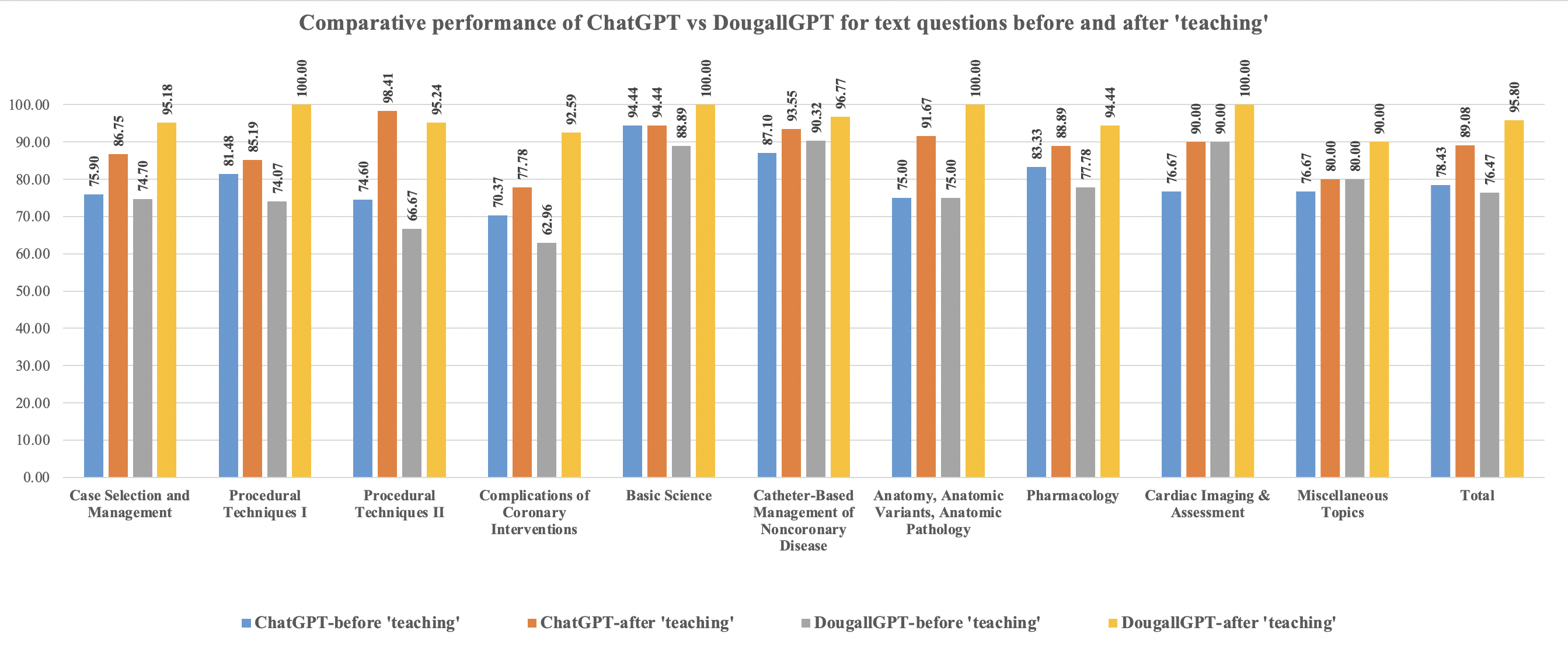
CathSAP contains 460 questions, including 357 text-based questions. Each LLM (ChatGPT [version 4.0] and DougallGPT) completed two sequential attempts on the text-based questions, allowing for assessment of initial performance and improvement after a ‘teaching’ intervention. The ‘teaching’ intervention involved providing the LLM with contextually relevant textual information from the 'Commentary' section of the corresponding CathSAP question. Subsequently, the statistical significance of differences in LLM response accuracy before and after exposure to relevant text was assessed using the chi-square test.

Results:
In the initial attempt, ChatGPT answered 78.4% of text questions correctly, compared to DougallGPT, which answered 76.47% of the questions correctly with no significant statistical difference overall (p=0.531) or within each section. DougallGPT showed a significantly greater improvement after ‘teaching’, achieving 95.8% correct compared to 89.1% for ChatGPT (p < 0.001).

Conclusion:
Both ChatGPT and DougallGPT showed substantial performance gains after ‘teaching’ on interventional cardiology text-based questions. While ChatGPT demonstrated a strong baseline performance, DougallGPT showed significantly higher accuracy after ‘teaching’, suggesting that domain-specific optimization may enhance the educational utility of LLMs in interventional cardiology. DougallGPT’s marked improvement following the teaching intervention suggests it may be particularly well-suited to incorporate complex, context-rich educational material. These findings highlight the potential for tailored LLMs to serve as effective adjunctive tools in subspecialty training and self-assessment. Future research should explore their integration into curriculum design and their ability to adapt to evolving clinical guidelines.
  • Nanda, Saumya  ( Maimonides Medical Center , Brooklyn , New York , United States )
  • K C, Prabal  ( Maimonides Medical Center , Brooklyn , New York , United States )
  • Kyaw, Pyae Hein  ( Maimonides Medical Center , brooklyn, NY , New York , United States )
  • Al Shihabi, Ahmad  ( Maimonides Medical Center , Brooklyn , New York , United States )
  • Shyam, Tharun  ( Maimonides Medical Center , Brooklyn , New York , United States )
  • Sardar, Partha  ( Columbia University Medical Center , New York , New York , United States )
  • Chatterjee, Saurav  ( North Shore Long Island Jewish Hosp , West Hartford , Connecticut , United States )
  • Author Disclosures:
    Saumya Nanda: DO NOT have relevant financial relationships | Prabal K C: DO NOT have relevant financial relationships | pyae hein kyaw: DO NOT have relevant financial relationships | Ahmad Al Shihabi: No Answer | Tharun Shyam: DO NOT have relevant financial relationships | Partha Sardar: DO NOT have relevant financial relationships | Saurav Chatterjee: No Answer
Meeting Info:

Scientific Sessions 2025

2025

New Orleans, Louisiana

Session Info:
More abstracts on this topic:
A Machine Learning Algorithm to Detect Pediatric Supraventricular Tachycardia Risk from Baseline ECGs

Arezoumand Amirhossein, Danala Gopichandh, Masnadi Khiabani Parisa, Ebert David, Behere Shashank

A ChatGLM-based stroke diagnosis and prediction tool

Song Xiaowei, Wang Jiayi, Ma Weizhi, Wu Jian, Wang Yueming, Gao Ceshu, Wei Chenming, Pi Jingtao

More abstracts from these authors:
You have to be authorized to contact abstract author. Please, Login
Not Available