
Logo

American Heart Association

  20
  0


Final ID: MP383

Race and Socioeconomic Status Influence Prehospital Treatment and Diagnosis of Patients With ST-Elevation Myocardial Infarction

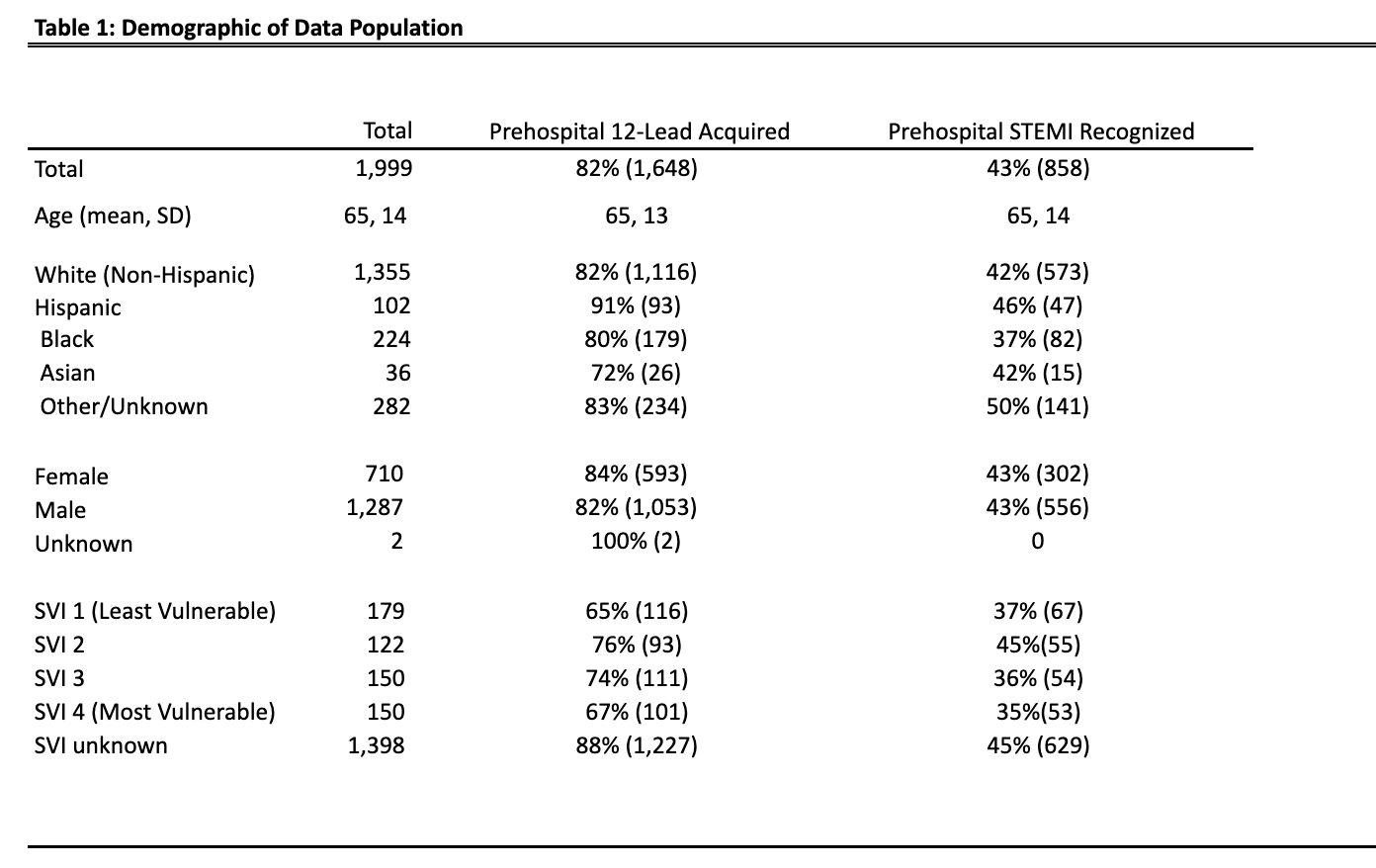
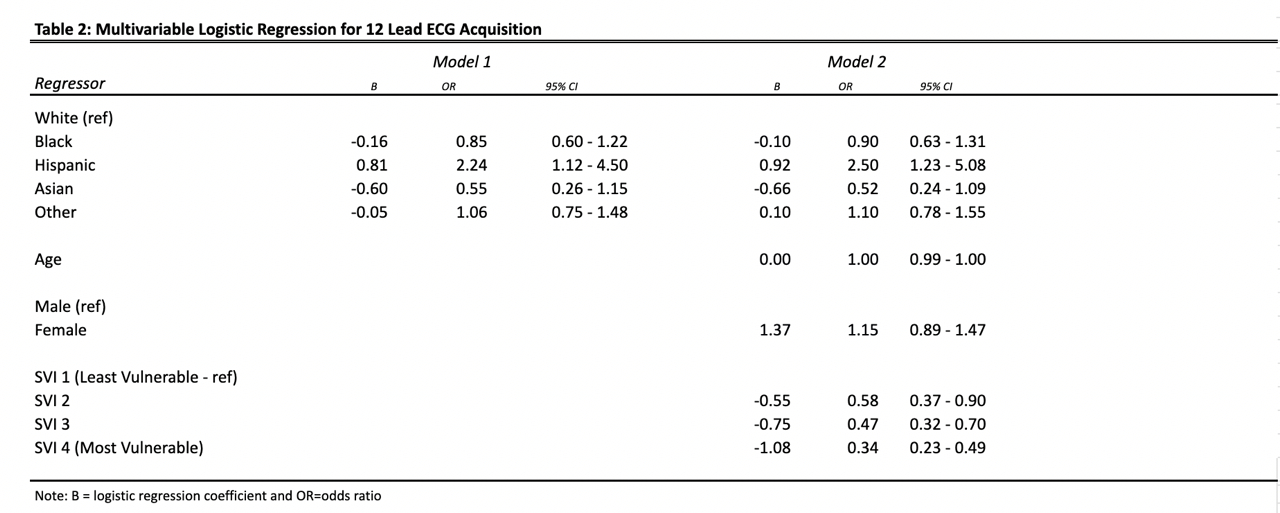
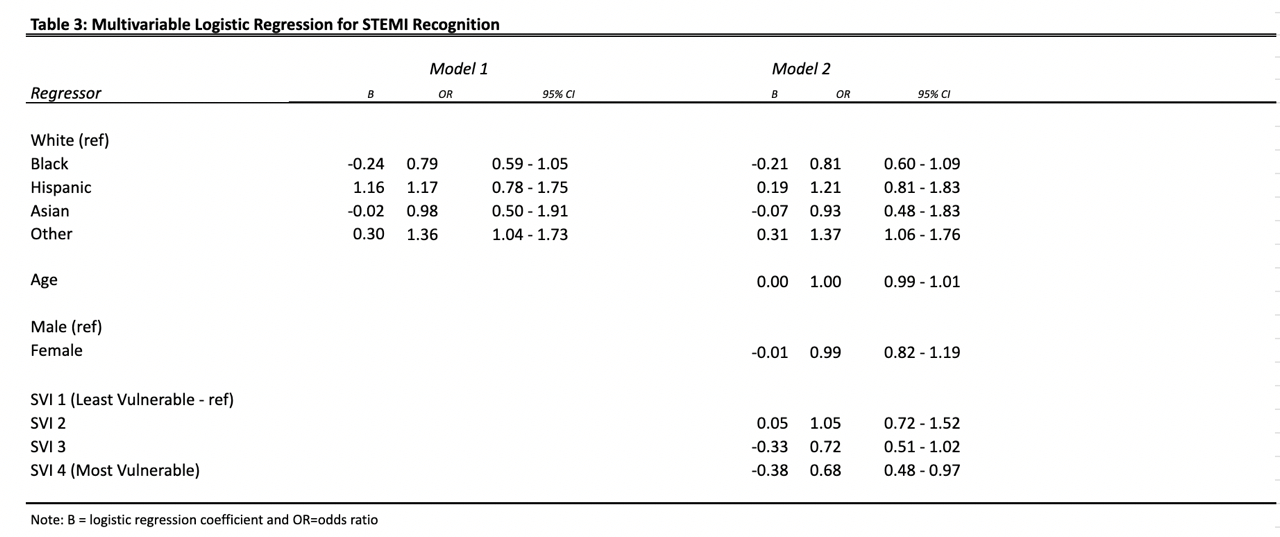
Abstract Body (Do not enter title and authors here): Prompt cardiac reperfusion reduces morbidity and mortality following an ST-elevation myocardial infarction (STEMI). Evidence demonstrates hospital-based treatment metrics for patients suffering STEMI such as door-to-balloon time can vary by patient race, gender, and socioeconomic status (SES). Approximately 2.5 million patients with chest pain call emergency medical services (EMS) every year in the United States to assess for the presence of a STEMI and provide immediate treatment prior to arriving at the hospital. It remains unclear if patient race, gender, or SES influence STEMI diagnosis and treatment in the prehospital environment. We analyzed 1,999 patients diagnosed with STEMI in the emergency department (ED) that received prehospital care in the United States in 2023 for two outcome variables. The primary outcome was if a 12-Lead ECG was acquired by EMS. The secondary outcome was if a STEMI was also diagnosed by EMS (concordance between ED and EMS STEMI diagnosis). Patients were stratified by gender, race, and the CDC’s Social Vulnerability Index at the census tract level of the EMS scene (SVI levels 1-4). For patients diagnosed in the ED with a STEMI, 82% (1,648) received a prehospital ECG. Overall, 43% (858) of patients diagnosed in the ED with a STEMI also had a prehospital diagnosis of STEMI. For patients diagnosed in the ED with a STEMI that received a 12-lead ECG by EMS providers, 75% (861) also had a prehospital STEMI diagnosis. Compared to White patients, Hispanic patients had higher odds of receiving a prehospital ECG (aOR, 2.5 [95% CI 1.23-5.08]). Patients of high social vulnerability (SVI 2-4) were found to have lower odds of receiving an ECG when compared to patients of lower social vulnerability (SVI 2 aOR, 0.58 [95% CI 0.37-0.90]; SVI 3 aOR, 0.47 [95% CI 0.32-0.70]; SVI 4 aOR, 0.34 [95% CI 0.23-0.49]). While we found no evidence of race-based difference in EMS to ED STEMI diagnostic concordance, the most vulnerable patients (SVI 4) had lower odds of an accurate EMS STEMI diagnosis (aOR 0.68 [95% CI 0.48-0.97]) when compared to the least vulnerable patient group. To our knowledge, this is the first evidence demonstrating that patients suffering STEMI located in the most vulnerable areas of the United States are less likely to receive a 12-lead ECG and less likely to be diagnosed accurately by EMS providers. Further research is needed to develop systems of care to mitigate racial and socioeconomic differences in prehospital STEMI care.
  • Yuengert, Connor  ( University of California Los Angeles , Los Angeles , California , United States )
  • Aoun, Jihad  ( William Beaumont University Hospital, Corewell Health , Detroit , Michigan , United States )
  • Mattingly-app, Aidan  ( University of California Los Angeles , Los Angeles , California , United States )
  • Taghavi, Shaida  ( University of California Los Angeles , Los Angeles , California , United States )
  • Williams, Tiffany  ( University of California Los Angeles , Los Angeles , California , United States )
  • Kennel, Jamie  ( Washington State University , Pullman , Washington , United States )
  • Author Disclosures:
    Connor Yuengert: DO NOT have relevant financial relationships | Jihad Aoun: No Answer | Aidan Mattingly-App: No Answer | Shaida Taghavi: No Answer | Tiffany Williams: No Answer | Jamie Kennel: DO NOT have relevant financial relationships
Meeting Info:

Scientific Sessions 2025

2025

New Orleans, Louisiana

Session Info:

Bridging Gaps in Health Equity: Addressing Racism, Inclusion, and Representation in Science and Medicine

Saturday, 11/08/2025 , 10:45AM - 11:55AM

Moderated Digital Poster Session

More abstracts on this topic:
Artificial Intelligence ECG-Extracted Features Predict Microvascular Obstruction in ST-segment Elevation Myocardial Infarction

Traverse Jay, Meyers Pendell, Sharkey Scott, Schwager Sarah, Stanberry Larissa, Herman Robert

Agreement of Refractory Ventricular Fibrillation Subtyping Methods in Out-of-Hospital Cardiac Arrest Resuscitation

King Julia, Coult Jason, Blackwood Jennifer, Kwok Heemun, Johnson Nicholas, Daya Mohamud, Sayre Michael, Kudenchuk Peter, Rea Thomas

You have to be authorized to contact abstract author. Please, Login
Not Available