Logo

American Heart Association

  30
  0


Final ID: MP1015

Dose-Dependent Effects of Radiation on the Coronary Arteries: Results from Proton Beam Cardiac Radioablation in Swine

Abstract Body (Do not enter title and authors here): Background: Cardiac radioablation (CRA) is emerging as a treatment modality for refractory ventricular tachycardia (VT). This study aimed to evaluate the effects of radiation on the coronary arteries in a swine model of proton beam CRA.
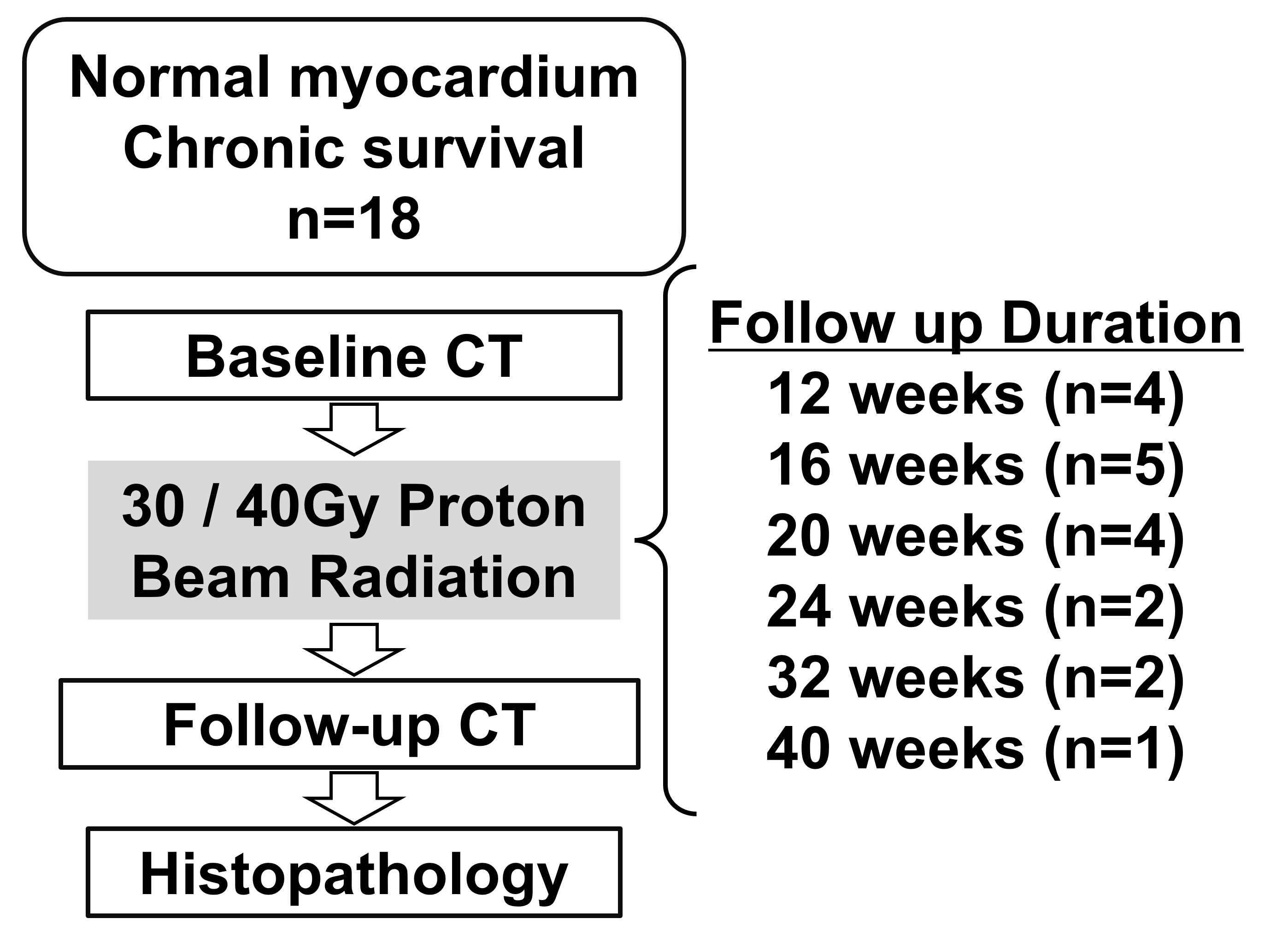
Methods: Eighteen domestic swine underwent 30–40 Gy pencil-beam scanning proton therapy in a single-fraction targeting the left ventricle with no attempt to spare coronary arteries and were euthanized 12-40 weeks later. Contrast-enhanced cardiac computed tomography (CT) was performed at baseline for treatment planning and at study end. Using dose-volume histograms, the maximum point (Dmax), mean (Dmean) doses and the minimal doses received by the highest irradiated volumes of 0.01 cc (D0.01cc) for the left main, left anterior descending, circumflex, and right coronary artery, as well as the large diagonal and obtuse marginal branches were calculated. The Dmax location for each artery was mapped from the baseline planning CT onto the follow-up CT using deformable registration. Coronary artery segments were harvested from the Dmax sites for histological analysis. Receiver operating characteristic (ROC) analysis was performed to identify dose thresholds for predicting histologically severe coronary stenoses (≥75%).
Results: Ninety-six coronary artery segments were analyzed. No stenoses were observed by CT imaging before irradiation. By histological analysis post-euthanasia, 25/96 (26%) coronary segments sampled at the Dmax site per artery had ≥75% stenosis. The median Dmax was 4.7 Gy for the <75% stenosis group and 29.7 Gy for the ≥75% stenosis group (p<0.001). The AUC-ROC for the association between Dmax and severe stenosis was 92.2%. A Dmax value of 20.1 Gy in a single fraction best predicted severe stenosis, with sensitivity of 92.3% and specificity of 87.1%. The AUC-ROC for the association between severe stenosis versus Dmean and D0.01cc was 84.8% and 91.6%, respectively. Based on histopathologic analysis, intimal hyperplasia was the most common coronary artery abnormality at the Dmax sites.
Conclusion: In this pre-clinical model of proton beam CRA, coronary stenoses occurred in a dose-dependent manner, with Dmax being a better dosimetric predictor of stenosis than Dmean and D0.01cc. These data provide for the first time radiation dose constraint information for the epicardial coronary arteries that can be considered in treatment planning for CRA and radiation for thoracic malignancies.
  • Hirao, Tatsuhiko  ( Mayo Clinic , Rochester , Minnesota , United States )
  • Siontis, Konstantinos  ( Mayo Clinic , Rochester , Minnesota , United States )
  • Rettmann, Maryam  ( Mayo Clinic , Rochester , Minnesota , United States )
  • Deisher, Amanda  ( Mayo Clinic , Rochester , Minnesota , United States )
  • Koya, Taro  ( Mayo Clinic , Rochester , Minnesota , United States )
  • Gades, Naomi  ( Mayo Clinic , Phoenix , Arizona , United States )
  • Kruse, Jon  ( Mayo Clinic , Rochester , Minnesota , United States )
  • Merrell, Kenneth  ( Mayo Clinic , Rochester , Minnesota , United States )
  • Shumway, Dean  ( Mayo Clinic , Rochester , Minnesota , United States )
  • Packer, Douglas  ( Intermountain Health , Murray , Utah , United States )
  • Author Disclosures:
    Tatsuhiko Hirao: DO NOT have relevant financial relationships | Konstantinos Siontis: No Answer | Maryam Rettmann: DO NOT have relevant financial relationships | Amanda Deisher: DO NOT have relevant financial relationships | Taro Koya: DO NOT have relevant financial relationships | Naomi Gades: DO NOT have relevant financial relationships | Jon Kruse: No Answer | Kenneth Merrell: No Answer | Dean Shumway: DO NOT have relevant financial relationships | Douglas Packer: DO have relevant financial relationships ; Other (please indicate in the box next to the company name):COI will be uploaded to my account:Active (exists now)
Meeting Info:

Scientific Sessions 2025

2025

New Orleans, Louisiana

Session Info:

Oncological Considerations in Arrhythmia Management

Saturday, 11/08/2025 , 01:45PM - 03:00PM

Moderated Digital Poster Session

More abstracts on this topic:
Automated quantification of amyloid burden in cardiac amyloidosis

Greco Francesco, Aimo Alberto, Musetti Veronica, Celi Alessandra, Polito Syria, Castiglione Vincenzo, Vergaro Giuseppe, Emdin Michele, Pucci Angela

AI-driven Aortic Valve Calcification Measurement in Coronary Artery Calcium Scan Detects Aortic Stenosis Comparably to Human Experts: An AI-CVD Study within the Framingham Heart Study

Naghavi Morteza, Atlas Kyle, Zhang Chenyu, Reeves Anthony, Atlas Thomas, Wasserthal Jakob, Yankelevitz David, Henschke Claudia, Wong Nathan

More abstracts from these authors:
PFA should NOT be performed on all heart failure patients with AF

Packer Douglas, Shah Sanjiv

Time Course of Late Gadolinium Enhancement Intensity in Ventricular Myocardium after Proton Beam Irradiation in Swine

Koya Taro, Rettmann Maryam, Hirao Tatsuhiko, Deisher Amanda, Newman Laura, Kruse Jon, Shumway Dean, Merrell Kenneth, Packer Douglas, Siontis Konstantinos

You have to be authorized to contact abstract author. Please, Login
Not Available