Logo

American Heart Association

  18
  0


Final ID: MP463

Pre-ablation Weight Loss Through Bariatric Surgery Reduces In-hospital Complications After Catheter Ablation in Patients With Atrial Fibrillation/Atrial Flutter

Abstract Body (Do not enter title and authors here): Background: Obesity is associated with increased in-hospital complications in patients with atrial fibrillation and atrial flutter (AF/AFL). The effects of weight loss intervention through bariatric surgery remain controversial, as it has been reported to increase in-hospital mortality in AF/AFL patients but also shown to reduce AF recurrence after ablation. However, its impact on short-term outcomes in AF/AFL patients undergoing ablation remains unclear.
Hypothesis: Pre-ablation weight loss via bariatric surgery reduces in-hospital complications in AF/AFL patients afterablation.
Methods: Data from the National Inpatient Sample (2016-2022) were used. Patients with a primary diagnosis of AF/AFL who underwent catheter ablation were included, while those with body mass index (BMI) < 30 kg/m2 were excluded. Eligible patients were categorized into 4 groups based on BMI or bariatric surgery status: 1) Class I obesity(N=2,450), 2) Class II obesity (N=2,430), 3) Class III obesity (N=3,740), and 4) Pre-ablation weight loss (N=527). Demographics and in-hospital outcomes were analyzed. Multivariable analysis was performed with adjustment for age, sex, race, and comorbidities.
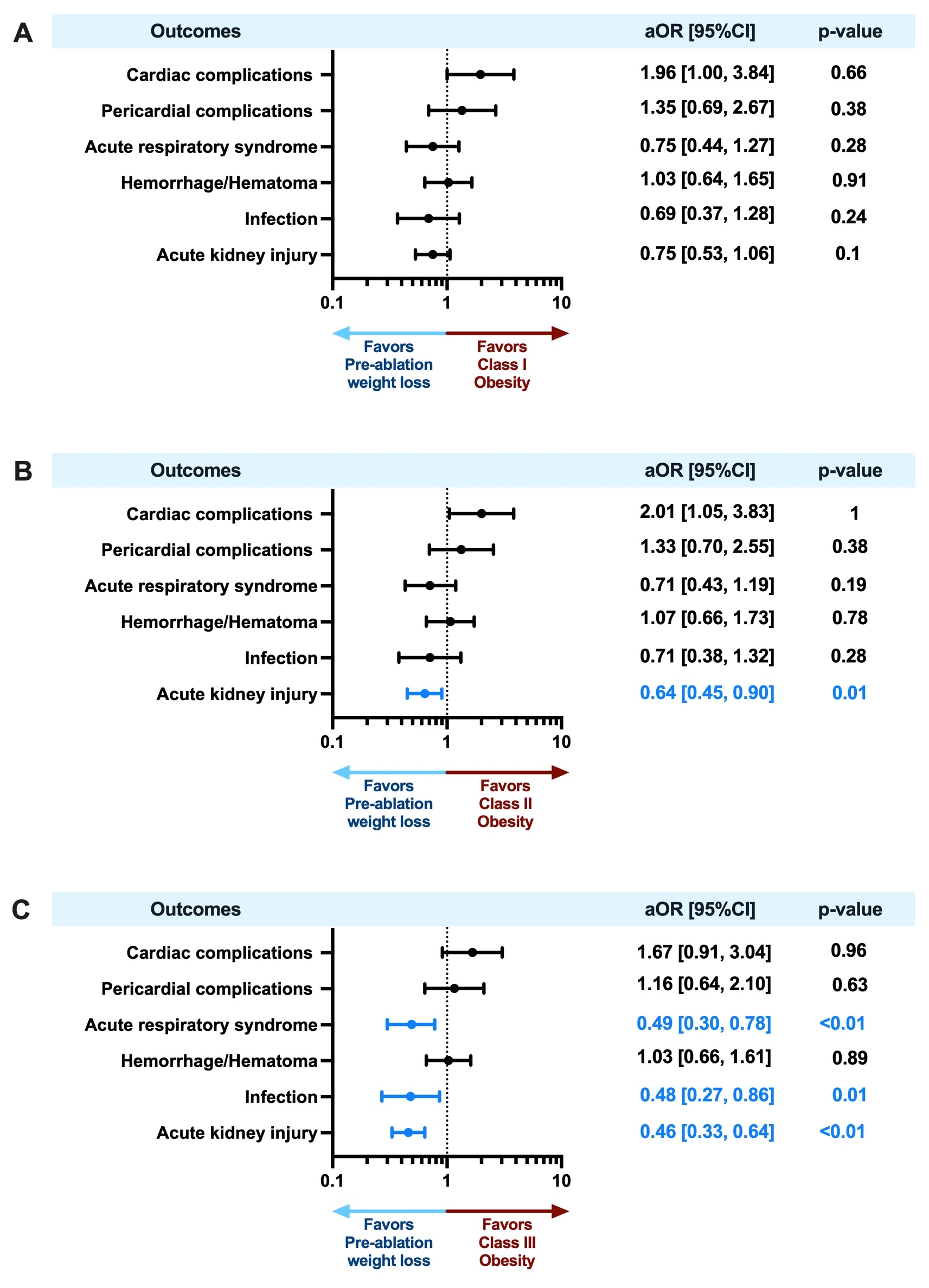
Results: Our results showed that class I obesity patients were the oldest (66±11 years), while class III obesity patients were the youngest (61±11 years); the mean age in the weight loss group was 64±10 years. Most patients in the overweight and obese groups were male, whereas females predominated in the weight loss group (p<0.01). Patients in the weight loss group had fewer comorbidities than those with obesity (p < 0.01). The weight loss group had significantly shorter hospital length of stay (LOS) (p<0.01; β-coefficient [95%CI]: -0.44 [-0.79, -0.09], -1.01 [-1.45, -0.57] vs. classesII–III obesity, respectively) and lower incidence of acute kidney injury (p<0.01 vs. classes II–III obesity), acute respiratory syndrome and infection (p<0.01 vs. class III obesity). The incidence of cardiac/pericardial complications and hemorrhage/hematoma were comparable across groups. In-hospital outcomes did not differ between patients in the weight loss group and those with class I obesity (Figure 1).
Conclusion: Pre-ablation weight loss through bariatric surgery was associated with short-term benefits in AF/AFLpatients after catheter ablation, including reduced in-hospital LOS and complications, particularly among those with Class III obesity, and may help prevent long-term adverse outcomes.
  • Yanpiset, Panat  ( Texas Tech University Health Sciences Center , Lubbock , Texas , United States )
  • Puchongmart, Chanokporn  ( Texas Tech University Health Sciences Center , Lubbock , Texas , United States )
  • Thiravetyan, Ben  ( Texas Tech University Health Sciences Center , Lubbock , Texas , United States )
  • Wattanachayakul, Phuuwadith  ( Albert Einstein Medical Center , Philadelphia , Pennsylvania , United States )
  • Srikulmontri, Thitiphan  ( Albert Einstein Medical Center , Philadelphia , Pennsylvania , United States )
  • Suenghataiphorn, Thanathip  ( Griffin Hospital , Derby , Connecticut , United States )
  • Saowapa, Sakditad  ( Texas Tech Health Sciences Center , Lubbock , Texas , United States )
  • Apaijai, Nattayaporn  ( CERT Center , Chiang Mai , Thailand )
  • Author Disclosures:
    Panat Yanpiset: DO NOT have relevant financial relationships | Chanokporn Puchongmart: DO NOT have relevant financial relationships | Ben Thiravetyan: DO NOT have relevant financial relationships | Phuuwadith Wattanachayakul: DO NOT have relevant financial relationships | Thitiphan Srikulmontri: DO NOT have relevant financial relationships | Thanathip Suenghataiphorn: DO NOT have relevant financial relationships | Sakditad Saowapa: DO NOT have relevant financial relationships | Nattayaporn Apaijai: DO NOT have relevant financial relationships
Meeting Info:

Scientific Sessions 2025

2025

New Orleans, Louisiana

Session Info:

Multiple Axes of Risk: Cardiometabolic Underpinnings of Myocardial, Atherosclerotic and Arrhythmic Disease

Saturday, 11/08/2025 , 03:15PM - 04:30PM

Moderated Digital Poster Session

More abstracts on this topic:
Comparative Efficacy of Glucagon-Like Peptide-1 Receptor Agonists and Co-Agonists for Weight Loss Among Patients Without Diabetes: A Network Meta-Analysis

Moiz Areesha, Filion Kristian, Reynier Pauline, Lelievre Audrey, Toutounchi Helia, Tsoukas Michael, Yu Oriana, Peters Tricia, Eisenberg Mark

Cardiovascular and Rhythm Benefits of GLP-1 Receptor Agonists in Obese Patients: A Real-World Multicenter Study

Yousafzai Osman, Annie Frank, Kanwal Kainat, Mahmoud Mohamed, Rinehart Sarah

More abstracts from these authors:
Circulating Androgen Precursors and Cardiovascular Risk: Insights From NHANES 2017-2023

Kulthamrongsri Narathorn, Kulthamrongsri Kritpong, Srikulmontri Thitiphan, Nuchpramool Prachawanee, Yinadsawaphan Thanaboon, Suenghataiphorn Thanathip, Lorlowhakarn Koravich, Thiravetyan Ben, Puchongmart Chanokporn, Wattanachayakul Phuuwadith, Ngaohirunpat Sorawis

Real-World Outcomes of Tirzepatide Versus GLP-1 Receptor Agonists in Patients with Type 2 Diabetes and Peripheral Arterial Disease

Srikulmontri Thitiphan, Pantarote Suchanart, Kulthamrongsri Narathorn, Puchongmart Chanokporn, Yanpiset Panat, Wattanachayakul Phuuwadith, Amanullah Aman

You have to be authorized to contact abstract author. Please, Login
Not Available