Proteomics Discovery and Epicardial Adipose Tissue: PROMISE Clinical Trial Substudy
Abstract Body (Do not enter title and authors here): Background Epicardial adipose tissue (EAT) is a metabolically active tissue. EAT volume and density (a marker of tissue inflammation), which can be quantified using cardiac computed tomography (CT), have been associated with cardiometabolic disease risk. Limited studies support that EAT has local paracrine inflammatory effects on coronary arteries, but broad biologic pathways that may improve our understanding of EAT volume and inflammation have not been evaluated.
Hypothesis We hypothesized that circulating inflammatory markers are associated with EAT and coronary artery disease.
Methods The Prospective Multicenter Imaging Study for Evaluation of Chest Pain (PROMISE) clinical trial randomized participants to CT angiography (CTA) vs. standard of care. For this study, we analyzed 1523 participants randomized to CTA with available plasma at baseline. EAT volume (indexed to BSA; cm3/m2) and EAT density (HU, a marker of adipose tissue inflammation) were measured using a validated deep-learning algorithm on cardiac CT images. We compared 502 unique proteins (Olink) with EAT measures using linear regression, adjusted for age, sex, self-reported race, BMI, diabetes, LDL-C, HDL-C, triglycerides and creatinine.
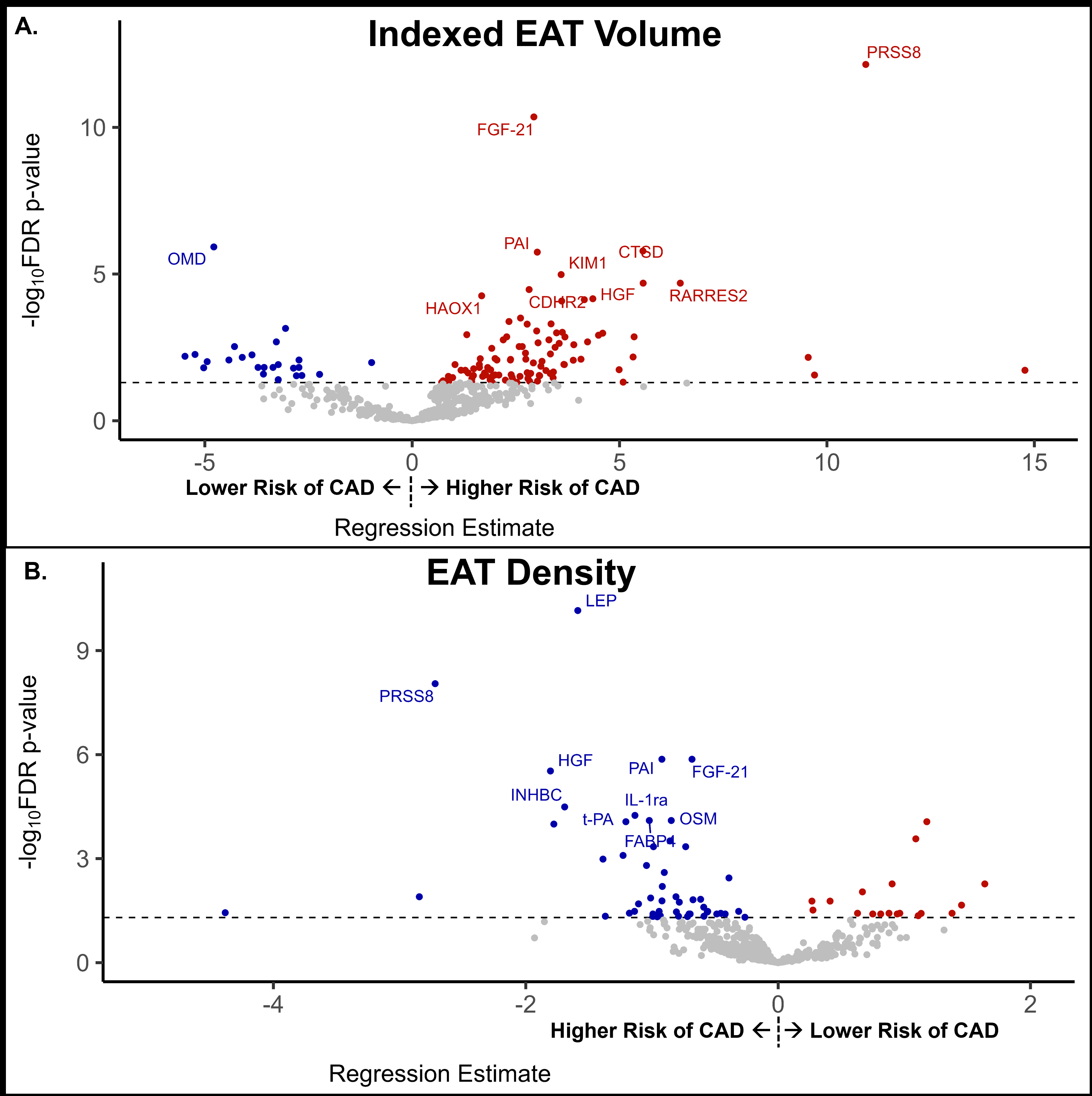
Results Of 502 proteins, 124 (24.7%) were associated with EAT volume (FDR p<0.05). Of these, 100 were positively associated, including markers of hepatic glucose homeostasis (PRSS8, FGF-21) and 24 were inversely associated, including a marker of vascular calcification (OMD) (Figure). In models for EAT density, 70 proteins were significant (13.9%); 18 were positively associated and 52 inversely associated, including metabolic and inflammatory proteins (LEP, HGF, INHBC, IL-1ra). Overall, 57 overlapping proteins were associated with both EAT volume and EAT density. 13 of these proteins were concordantly associated with a composite high-risk coronary phenotype in PROMISE, including higher levels of INHBC, ACE2, GDF-15, CTSD, FGF-21, CDHR2, and MLN and lower levels of BOC, ADGRG2, LPL, OMD, CLUL1 and APLP1.
Conclusions In a large clinical trial of CTA, we have identified circulating metabolic and inflammatory proteins associated with EAT volume and inflammation independent of clinical variables, many of which are also associated with coronary artery disease. These findings highlight proteomic pathways which may mediate the known association between EAT and cardiovascular disease, and further highlight biomarkers as potential prognostic and therapeutic targets.
Regan, Jessica
(
Duke Molecular Physiology Institute
, Durham , North Carolina , United States )
Kwee, Lydia
(
Duke Molecular Physiology Institute
, Durham , North Carolina , United States )
Karpurapu, Anish
(
Duke University
, Vienna , Virginia , United States )
De Calvacamp, Caroline
(
Duke Molecular Physiology Institute
, Durham , North Carolina , United States )
Pagidipati, Neha
(
Duke Clinical Research Institute
, Durham , North Carolina , United States )
Nasir, Khurram
(
Houston Methodist
, Houston , Texas , United States )
Foldyna, Borek
(
Massachusetts General Hospital
, Boston , Massachusetts , United States )
Douglas, Pamela
(
Duke Clinical Research Institute
, Durham , North Carolina , United States )
Shah, Svati
(
Duke Molecular Physiology Institute
, Durham , North Carolina , United States )
Author Disclosures:
Jessica Regan:DO NOT have relevant financial relationships
| Lydia Kwee:DO NOT have relevant financial relationships
| Anish Karpurapu:DO NOT have relevant financial relationships
| Caroline de Calvacamp:No Answer
| Neha Pagidipati:DO have relevant financial relationships
;
Research Funding (PI or named investigator):Alnylam:Active (exists now)
; Consultant:Esperion:Active (exists now)
; Consultant:Eli Lilly:Active (exists now)
; Consultant:Corsera:Active (exists now)
; Consultant:Corcept:Active (exists now)
; Consultant:Boehringer Ingelheim:Active (exists now)
; Consultant:Bayer:Active (exists now)
; Consultant:Amgen:Active (exists now)
; Research Funding (PI or named investigator):Merck:Active (exists now)
; Research Funding (PI or named investigator):Novo Nordisk:Active (exists now)
; Research Funding (PI or named investigator):Novartis:Active (exists now)
; Research Funding (PI or named investigator):Eli Lilly:Active (exists now)
; Research Funding (PI or named investigator):Boehringer Ingelheim:Active (exists now)
; Research Funding (PI or named investigator):Bayer:Active (exists now)
; Research Funding (PI or named investigator):Amgen:Active (exists now)
| Khurram Nasir:No Answer
| Borek Foldyna:No Answer
| Pamela Douglas:DO have relevant financial relationships
;
Researcher:HeartFlow:Past (completed)
; Other (please indicate in the box next to the company name):UpToDate- author:Active (exists now)
; Advisor:Novo Nordisk:Active (exists now)
; Advisor:Amgen:Active (exists now)
; Advisor:Foresite Labs:Past (completed)
; Advisor:Cleerly:Past (completed)
| Svati Shah:DO NOT have relevant financial relationships