

Logo

American Heart Association

  17
  0


Final ID: MP687

Elimination of Ventricular Tachycardia and Premature Ventricular Complexes Following Surgical Excision of Left Ventricular False Tendon

Abstract Body (Do not enter title and authors here):
Description of Case: This is a 17 year old male referred for frequent premature ventricular contractions (PVCs) and numerous salvos of non-sustained monomorphic ventricular tachycardia (VT). Activation mapping during two prior electrophysiology studies illustrated ventricular ectopy emanating from a left ventricular false tendon (LVFT). Ablations to this area resulted in acute though only transient resolution of ectopy.

Salvos of VT recurred, and ventricular ectopy burden became frequent, with ambulatory heart rhythm monitor post-ablation illustrating 835 salvos over 7 days (figure 1). The longest run was 15 beats and the fastest rate was 222 bpm. There was morphology variation and variable cycle length from 100 to 220 bpm. Overall ventricular ectopy burden was high, with 8% isolated PVCs and 2.4% couplets. Verapamil was initiated, improving but not eliminating this burden. Therapy subsequently was transitioned to Amiodarone.

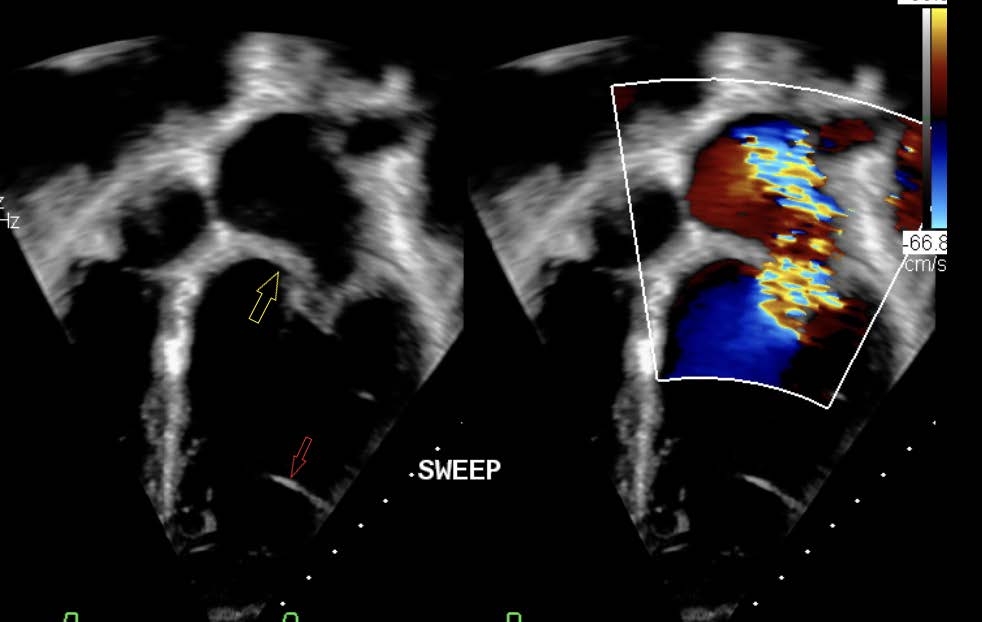
Echocardiogram showed a dysplastic mitral valve with severe regurgitation and moderate left ventricle dilation with normal systolic function (figure 2). MRI confirmed these findings. The patient underwent subsequent surgical replacement of the mitral valve with excision of the observable remnant of the LVFT. Post-operatively, runs of ventricular tachycardia ceased, and ventricular ectopy burden became infrequent (<0.1%). Amiodarone was weaned without increase in ventricular ectopy or VT recurrence.

Discussion: LVFTs can cause VT, and should be considered a potential arrhythmogenic source when performing activating mapping studies. If identified as the etiology of arrhythmia, medical management and ablation are first-line. However, no clear escalation in management exists for refractory ectopic burdens.

While not a primary indication for cardiac surgery, excision of the LVFT may be pursued if a concurrent operation may be indicated. Caution is imperative to only remove physiologically non-essential structures, particularly as the LVFT may be involved in the mitral valve apparatus, as demonstrated here. LVFT excision may also be considered in cases refractory to aggressive catheter or pharmacologic treatment with significant clinical manifestations. This is an opportunity for further research, as candidate criteria must be developed. Other research areas include better characterizing the histopathology and electrophysiological profile of LVFTs in human subjects and developing best practices in an area not fully investigated.
  • Hurley, Jonathan  ( Tulane University School of Medicine , New Orleans , Louisiana , United States )
  • Peeler, Benjamin  ( Ochsner Health Center Department of Cardiothoracic Surgery , New Orleans , Louisiana , United States )
  • Hoyt, Walter  ( Ochsner Health Center Department of Pediatric Cardiology , New Orleans , Louisiana , United States )
  • Author Disclosures:
    Jonathan Hurley: DO NOT have relevant financial relationships | Benjamin Peeler: No Answer | Walter Hoyt: No Answer
Meeting Info:

Scientific Sessions 2025

2025

New Orleans, Louisiana

Session Info:

Out of Sync: Puzzling Cases in Electrophysiology

Saturday, 11/08/2025 , 03:15PM - 04:30PM

Moderated Digital Poster Session

More abstracts on this topic:
4D Cardiac Optogenetics Enable Complex Arrhythmia Modelling and Precise Interventional Simulation

Wexler Yehuda, Grinstein Harel, Landesberg Michal, Glatstein Shany, Huber Irit, Arbel Gil, Gepstein Lior

A novel risk score predicts the prevalence of left atrial low-voltage areas and rhythm outcome in patients undergoing long-standing persistent atrial fibrillation ablation

Ooka Hirotaka, Nakao Sho, Kusuda Masaya, Ariyasu Wataru, Kudo Satoshi, Fujii Subaru, Mano Toshiaki, Matsuda Yasuhiro, Masuda Masaharu, Okamoto Shin, Ishihara Takayuki, Nanto Kiyonori, Tsujimura Takuya, Hata Yosuke, Uematsu Hiroyuki

You have to be authorized to contact abstract author. Please, Login
Not Available