
Logo

American Heart Association

  17
  0


Final ID: MP218

Influence of Religiosity on Symptoms and the Quality of end-of-life Cardiovascular Disease Patients

Abstract Body (Do not enter title and authors here): Introduction Religiosity is a core component of palliative care and whose roles in patients with cancer were described. However, there is a paucity of studies in cardiovascular disease (CVD).
Hypothesis Religiosity can alleviate the symptoms of CVD patients in end-of-life (EOL).
Aims To clarify the influence of religiosity on physical symptoms, quality of care (QOC) and quality of death (QOD) in EOL care for CVD patients.
Methods We conducted a nationwide cross-sectional mortality follow-back survey using a questionnaire for bereaved caregivers of patients who had died of CVD in Japan. Measurements included Memorial Symptom Assessment Scale (MSAS), Care Evaluation Scale (CES) and Good Death Inventory (GDI). We assessed each outcome by the presence of religiosity.
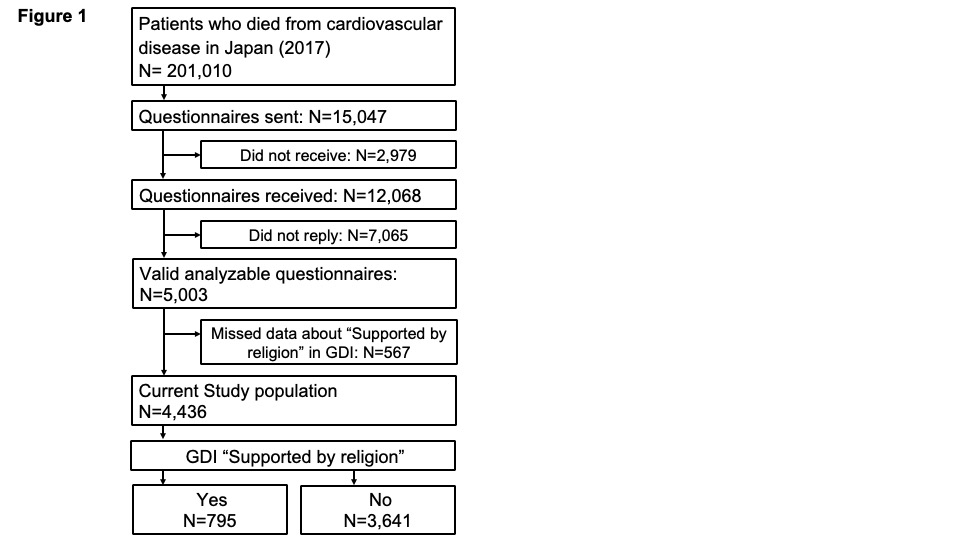
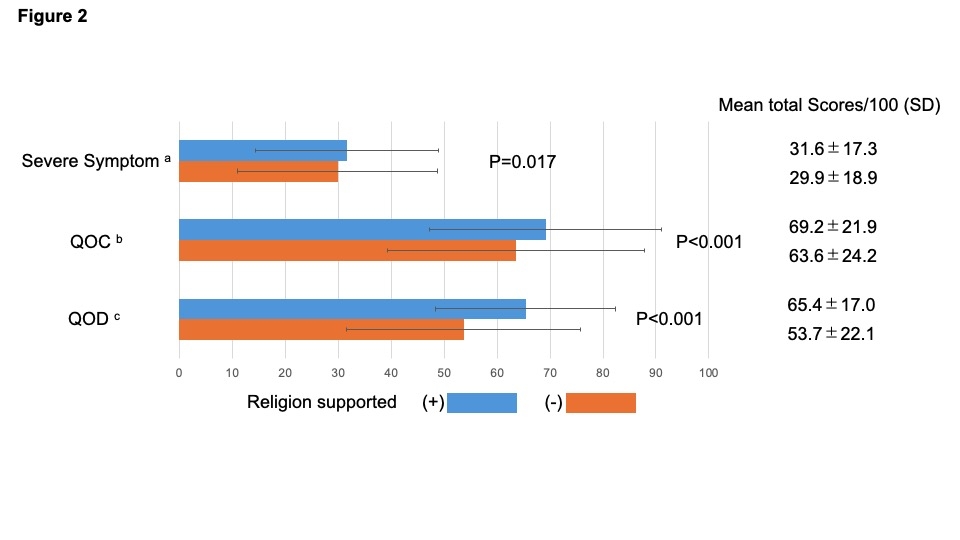
Results Of the questionnaire distributed to 15,047 descendants, we finally analyzed 4,436 responses about religiosity. 795 (17.9%) descendants answered that patients had been supported by religion 1 month before death. The religion-supported group was older (Religion: 88.9±8.7 vs. No Religion: 86.7±9.4, P<0.001), more frequent in females (70.9% vs. 60.3%, P<0.001), less frequently stayed at hospital 1 months before death (15.8% vs. 24.0%, P<0.001), and significantly more likely to report having fewer symptoms in MSAS sub-score and being more satisfied in CES and GDI sub-score. The results were the same except for “Lack of energy” and “Nausea” in MSAS after adjusting the confounders. The total mean score of CES and GDI was also significantly higher in the religion-supported group (69.2±21.9 vs. 63.6±24.2, P<0.001, 65.4±17.0 vs. 53.7±22.1, P<0.001, respectively).
Conclusion Religiosity could benefit CVD patients in EOL care by reducing physical symptoms and improving QOC and QOD.
  • Kaneda, Kazuhisa  ( Kyoto University , Kyoto , Japan )
  • Shiomi, Hiroki  ( Kyoto University , Kyoto , Japan )
  • Mizuno, Atsushi  ( ST. LUKE S INTERNATIONAL HOSPITAL , Tokyo , Japan )
  • Ono, Koh  ( KYOTO UNIVERSITY , Kyoto , Japan )
  • Author Disclosures:
    Kazuhisa Kaneda: DO NOT have relevant financial relationships | Hiroki Shiomi: No Answer | Atsushi Mizuno: DO NOT have relevant financial relationships | Koh Ono: DO NOT have relevant financial relationships
Meeting Info:

Scientific Sessions 2025

2025

New Orleans, Louisiana

Session Info:

Behavioral and Contextual Correlates of Self-Care in Cardiovascular Disease: Evidence Across the Lifespan

Saturday, 11/08/2025 , 10:45AM - 11:55AM

Moderated Digital Poster Session

More abstracts on this topic:
Advanced Care Planning in the CCU: What are the Numbers?

Sweeney Daniel, Uppal Priya, Jamrozik Thomas, Hutchison Paul

Discrimination in Healthcare and Incident Stroke or Myocardial Infarction

Green Michael, Navar Ann Marie, Obrien Emily, Brookhart M., Thorpe Roland, Dupre Matthew

More abstracts from these authors:
Rivaroxaban for 18 Months versus 6 Months in Cancer Patients with Low-risk Pulmonary Embolism: ONCO PE Trial

Yamashita Yugo, Morimoto Takeshi, Muraoka Nao, Shioyama Wataru, Chatani Ryuki, Shibata Tatsuhiro, Nishimoto Yuji, Ono Koh, Kimura Takeshi

The Feasibility and Adherence of Online Intensive Cardiac Rehabilitation Program for Coronary Artery Disease-A pilot Study

Kaneda Kazuhisa, Ozasa Neiko, Washida Koichi, Umeda Yoko, Yoshiuchi Sawako, Imai Saeko, Yoshida Toshiko, Kimura Takeshi, Ono Koh

You have to be authorized to contact abstract author. Please, Login
Not Available