Communication by Specialty, Seniority, and Gender During Congenital Heart Center Medical Decision-Making Conferences
Abstract Body (Do not enter title and authors here): Background: Congenital heart centers commonly use team decision-making conferences to choose interventional or medical strategies for patients. These conferences crucially impact clinical outcomes, team function and culture, yet little is known about content and contributors.
Goal: We aimed to understand conference communication patterns and determine whether intentional efforts to increase participation in decision-making across faculty were successful.
Methods: Our Heart Institute weekly case management conference includes 50-125 attendees (in-person and virtual). Our faculty was approximately 50% female during the study. Beginning October 2023, our College of Business faculty observed conferences in-person and tracked data on every voice interaction including speaker, duration, and content of speech. We introduced four new moderators (indcluding two female faculty), reviewed recorded data, and employed faculty coaching to encourage more speakers. We used interrupted time series analysis to evaluate our efforts to widen participation (i.e. discussion less centralized to leaders), and specifically the participation of female or junior faculty in decision-making.
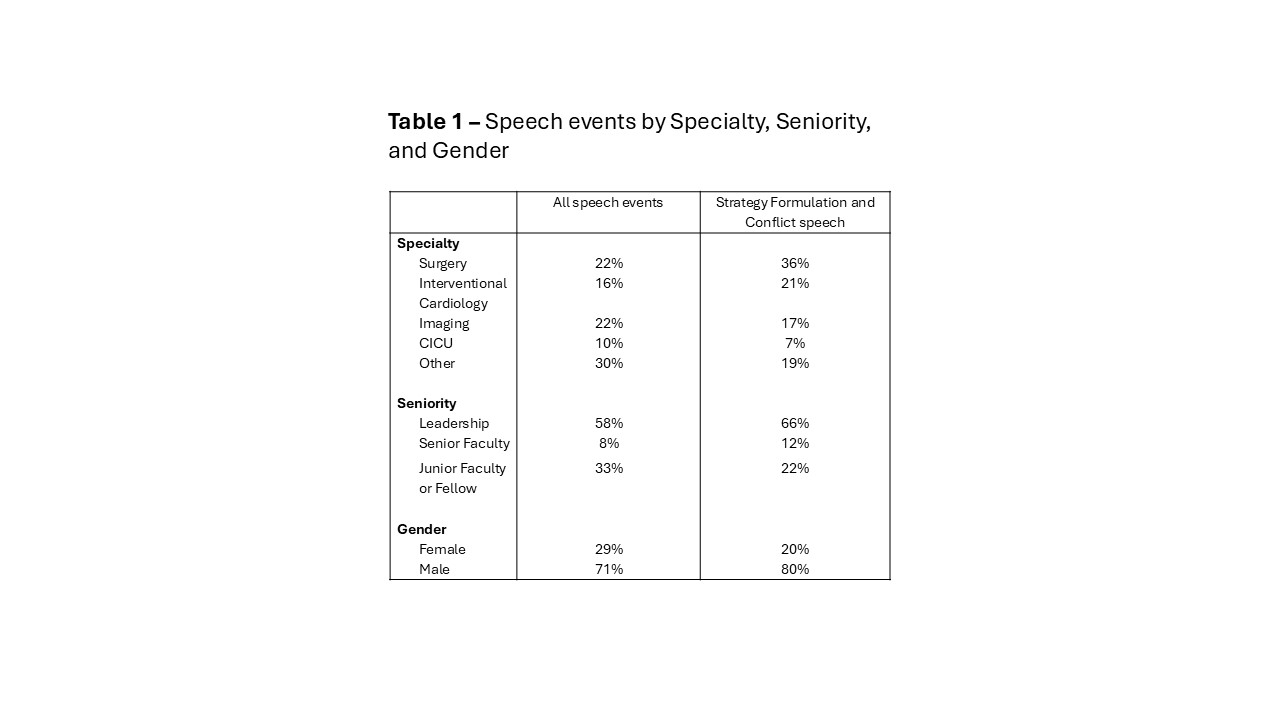
Results: From 10/2023-3/2025, we analyzed 145+ hours of conference, 894 discussions, and 22,500 speech events. Time dedicated to communication domains was 38% data presentation (e.g., clinical history, imaging), 49% strategy formulation, 5% conflict, and 8% other. Table 1 demonstrates the % speech events by specialty, seniority, and gender for all speech and just strategy or conflict speech. Leadership and senior faculty spoke more frequently in strategy discussions, and junior faculty or women spoke less frequently when compared to all speech events. Our time series analysis showed that changing moderators did not immediately change discussion centralization (i.e. participation) (β = -.22, z = 1.92). However, after that initial intervention we observed a significant decrease in discussion centralization (β = -.41, z = -3.59). There was no significant change in participation among either female or junior faculty.
Conclusions: Intentional efforts yielded broader participation in case management discussions overall, but did not immediately impact participation of junior or female faculty. There may be yet unmeasured benefits of changes to conference to these two faculty groups and our heart center. We plan to examine the impact of conference discussion practices on culture and clinical outcomes.
Gaies, Michael
(
Cincinnati Children's Hospital
, Cincinnati , Ohio , United States )
Awtrey, Eli
(
Carl H. Lindner College of Business
, Cincinnati , Ohio , United States )
Divanovic, Allison
(
CINCINNATI CHILDRENS HOSPITAL
, Cincinnati , Ohio , United States )
Heydarian, Haleh
(
CINCINNATI CHILDRENS HOSPITAL
, Cincinnati , Ohio , United States )
Cooper, David
(
Cincinnati Children's Hospital Medical C
, Cincinnati , Ohio , United States )
Hill, Garick
(
Cincinnati Children's Hospital
, Cincinnati , Ohio , United States )
Morales, David
(
Cincinnati Children's Hospital
, Cincinnati , Ohio , United States )
Author Disclosures:
Michael Gaies:DO NOT have relevant financial relationships
| Eli Awtrey:DO NOT have relevant financial relationships
| Allison Divanovic:No Answer
| Haleh Heydarian:No Answer
| David Cooper:No Answer
| Garick Hill:DO have relevant financial relationships
;
Consultant:Ultragenyx:Past (completed)
| David Morales:DO have relevant financial relationships
;
Consultant:Syncardia, Inc.:Active (exists now)
; Consultant:Berlin Heart:Active (exists now)
; Consultant:Azyio Inc.:Past (completed)
; Consultant:Abbott medical Inc.:Active (exists now)
; Consultant:PECA Labs:Active (exists now)