
Logo

American Heart Association

  14
  0


Final ID: MP348

Self-Monitoring And Responsive Technology for postpartum blood pressure control (SMART postpartum BP program): A Feasibility Study

Abstract Body (Do not enter title and authors here): Background: Hypertensive disorders of pregnancy (HDP) affect 15% of pregnant individuals and contribute significantly to maternal morbidity and mortality. Recent work in the U.K. suggests that extended home blood pressure monitoring (HBPM) after delivery, combined with blood pressure (BP) medication self-management, may improve cardiovascular outcomes at 9-months postpartum. Our objective was to develop a similar program using an established text-based HBPM program and assess the feasibility among a racially diverse cohort of postpartum patients with the HDP in the U.S.

Methods: We conducted an unblinded single-arm pilot feasibility trial among postpartum individuals with HDP who delivered at Penn Medicine. All participants completed our institution’s 10-day, automated, text-based HBPM program that is standard of care for postpartum patients with hypertension. Between August and October 2024, we invited patients who completed the 10-day program to extend HBPM for an additional 10 weeks and provided a self-management guide for medication adjustment to achieve a goal BP < 140/90. Patients could participate regardless of BP medication use at enrollment. Following program completion, we conducted semi-structured interviews to identify barriers and facilitators to engagement. The primary implementation outcomes were extended program completion, engagement, and feasibility.

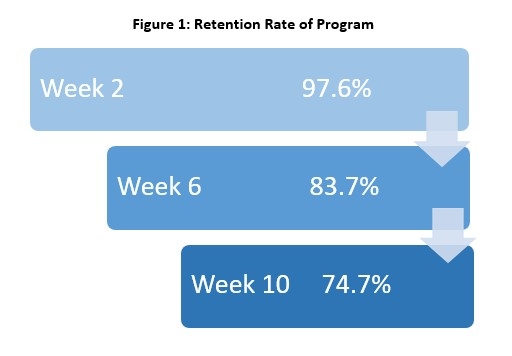
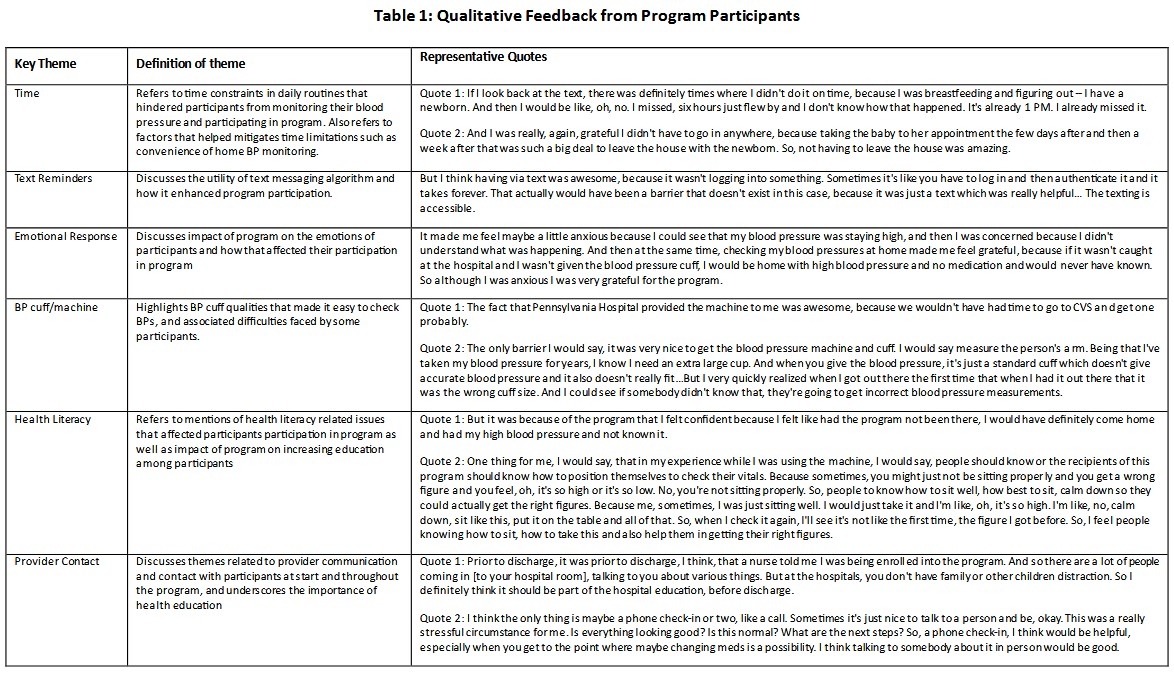
Results: Of 426 eligible patients, 166 (36%) were enrolled in the intervention. The mean age was 33 years (SD 5.6), 42.8% identified as Black, and 66.3% were privately insured. Retention was 83.7% at week 6 and 74.7% at week 10 (Figure 1). Participants who discontinued were less likely to have chronic hypertension or be prescribed BP medication at enrollment. On average, participants submitted 13.4 (SD 12.0) BP measurements during the program. The most common barrier to program engagement was time, and factors that supported engagement were the text reminders, convenience of measuring BP at home, and receiving a BP monitor. Stress/anxiety was a common theme and mostly associated with high BP readings; participants described feeling reassured that they were being monitored remotely. Other themes included health literacy/education and health care provider contact (see Table 1).

Conclusion: Extended home-based BP monitoring with self-management tools is feasible and shows promise for integration into standard of care for postpartum patients with hypertension.
  • Afari, Henrietta  ( HOSP UNIVERSITY OF PENNSYLVANI , Philadelphia , Pennsylvania , United States )
  • Hirshberg, Adi  ( HOSP UNIVERSITY OF PENNSYLVANI , Philadelphia , Pennsylvania , United States )
  • Rajendran, Aardra  ( HOSP UNIVERSITY OF PENNSYLVANI , Philadelphia , Pennsylvania , United States )
  • Levine, Lisa  ( University of Pennsylvania , Philadelphia , Pennsylvania , United States )
  • Lewey, Jennifer  ( University of Pennsylvania , Philadelphia , Pennsylvania , United States )
  • Author Disclosures:
    Henrietta Afari: DO NOT have relevant financial relationships | ADI HIRSHBERG: DO NOT have relevant financial relationships | Aardra Rajendran: No Answer | Lisa Levine: DO NOT have relevant financial relationships | Jennifer Lewey: No Answer
Meeting Info:

Scientific Sessions 2025

2025

New Orleans, Louisiana

Session Info:

Managing Hypertension in Women: Pregnancy and Beyond

Saturday, 11/08/2025 , 10:45AM - 11:40AM

Moderated Digital Poster Session

More abstracts on this topic:
Aberrant MicroRNA Expression May Underlie Cardiac Dysfunction in a rat model of Preeclampsia

Vaka Ramana, Campbell Nathan, Edwards Kristin, Hoang Ngoc, Zheng Baoying, Lamarca Babbette

Cognitive Impairment Impedes the Acquisition of Self-Care Management Skills in Patients with Heart Failure

Irie Daisuke, Kurimoto Ritsuko, Matoba Satoaki

More abstracts from these authors:
Association of Ideal Cardiovascular Health and Gestational Diabetes in NHANES 2007-2018

Broni Eric, Sadiq Rabail, Levine Lisa, Echouffo Justin, Retnakaran Ravi

Preexisting Inflammatory Disorders are Associated with Hypertensive Disorders of Pregnancy

Sheehan Megan, Zhao Manyun, Chen Jinbo, Lewey Jennifer

You have to be authorized to contact abstract author. Please, Login
Not Available