
Logo

American Heart Association

  19
  0


Final ID: MP1980

Polygenic Risk Score and the Risk of Repeat Coronary Revascularization After Index Procedure: Findings from the UK Biobank

Abstract Body (Do not enter title and authors here):
Background
Patients undergoing coronary revascularization (CR), including percutaneous coronary intervention (PCI) or coronary artery bypass grafting (CABG), are at increased risk of repeat CR. This risk often overlaps with factors predisposing patients to coronary artery disease based on their polygenic risk score (PRS).

Methods
We conducted a retrospective analysis using UK Biobank data (03/13/2006–06/12/2023). Adults (≥18 years) who underwent index CR after recruitment were included. The primary outcome was repeat CR risk. Outcomes were assessed across three PRS categories for coronary artery disease: high (>80th percentile), intermediate (20th–80th percentile), and low (<20th percentile). Adjusted hazard ratios (HRs) with 95% confidence intervals (CIs) were calculated, with statistical significance set at p<0.05.

Results
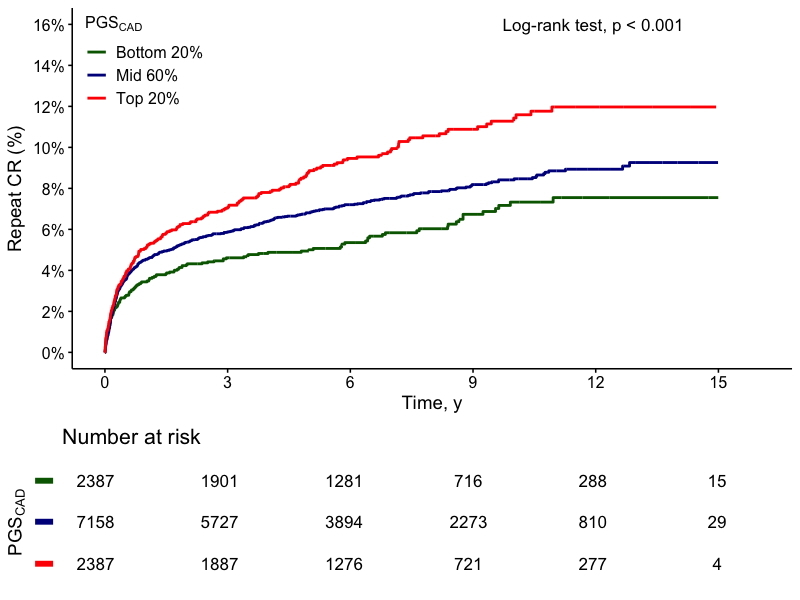
The study included 12,288 patients with a history of CR. The average age at diagnosis of CR was 66.89 years [95% CI: 66.76–67.02], with high-risk PRS patients presenting at a younger age than those at low risk [65.51 vs. 68.15 years; p<0.001]. A higher proportion of females was observed in the high-risk PRS group compared to the low-risk group [30.88% vs. 20.36%; p<0.001]. The risk of repeat CR after index procedure was significantly higher in high-risk PRS patients [HR: 1.73; 95% CI: 1.39–2.14; p<0.001] and intermediate-risk patients [HR: 1.30; 95% CI: 1.08–1.57; p=0.01] compared to low-risk PRS patients (Figure 1). High PRS risk was also associated with an increased risk of cardiovascular-related mortality [HR: 1.32; 95% CI: 1.08–1.62; p=0.01]. The risk of major adverse cardiovascular events [HR: 0.96; 95% CI: 0.88–1.04; p=0.31], all-cause mortality [HR: 1.09; 95% CI: 0.93–1.28; p=0.28], and non-fatal ischemic stroke [HR: 1.35; 95% CI: 0.96–1.91; p=0.08] were comparable between high- and low-risk PRS groups.

Subgroup analysis showed that patients who underwent index PCI had a higher risk of repeat CR in the high-risk vs. low-risk PRS group [HR: 1.90; 95% CI: 1.53–2.37; p<0.001]. In contrast, repeat CR risk was similar across PRS groups for those undergoing CABG [HR: 1.25; 95% CI: 0.95–1.65; p=0.10].

Conclusion
Patients with a high PRS for coronary artery disease had an increased likelihood of repeat CR and cardiovascular-related mortality after the index procedure. The strategic use of PRS models may aid in identifying those who would benefit from routine monitoring and/or intensive management following the index procedure.
  • Goyal, Aman  ( Cleveland Clinic Foundation , Cleveland , Ohio , United States )
  • Shi, Zhuqing  ( NorthShore University Health System , Chicago , Illinois , United States )
  • Chunawala, Zainali  ( University of Texas Southwestern , Dallas , Texas , United States )
  • Hulick, Peter  ( NorthShore University Health System , Chicago , Illinois , United States )
  • Mathew, Verghese  ( NorthShore University Health System , Chicago , Illinois , United States )
  • Ricciardi, Mark  ( NorthShore University Health System , Chicago , Illinois , United States )
  • Xu, Jianfeng  ( NorthShore University Health System , Chicago , Illinois , United States )
  • Qamar, Arman  ( NorthShore University Health System , Chicago , Illinois , United States )
  • Author Disclosures:
    Aman Goyal: DO NOT have relevant financial relationships | Zhuqing Shi: DO NOT have relevant financial relationships | Zainali Chunawala: DO NOT have relevant financial relationships | Peter Hulick: No Answer | Verghese Mathew: No Answer | Mark Ricciardi: No Answer | Jianfeng Xu: No Answer | Arman Qamar: No Answer
Meeting Info:

Scientific Sessions 2025

2025

New Orleans, Louisiana

Session Info:

Coronary Revasc

Monday, 11/10/2025 , 12:15PM - 01:10PM

Moderated Digital Poster Session

More abstracts on this topic:
A Case of Dilated Cardiomyopathy and Systemic Thromboembolism in a Young Patient on Testosterone Replacement Therapy

Sabri Muhammad, Ijaz Naila, Nadeem Ramsha, Checchio Lucy, Riaz Faiza

AI-informed Coronary Artery Tortuosity Index (CArTI) from Cardiac CT Angiography Predicts 5-Year Cardiovascular Risk

Lebowitz Mendel, Modanwal Gourav, Dhamdhere Rohan, Mutha Pushkar, De Cecco Carlo, Van Assen Marly, Madabhushi Anant

You have to be authorized to contact abstract author. Please, Login
Not Available