Effect of Empagliflozin on Device-Measured Thoracic Impedance in Patients with Type 2 diabetes treated with an implantable cardioverter-defibrillator: A subanalysis of the EMPA-ICD trial.
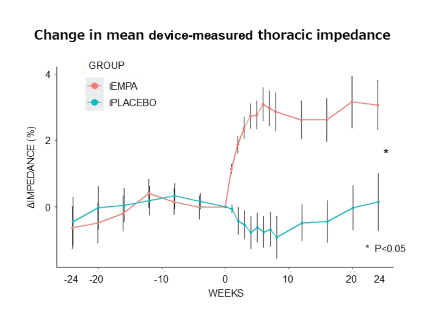
Abstract Body (Do not enter title and authors here): Background: Sodium-glucose cotransporter 2 inhibitors (SGLT2i) have been shown to have a beneficial effect on the prognosis of patients with heart failure. The mechanism of the effect is thought to be multifactorial. The diuretic effect of SGLT2i is also thought to be involved in the mechanism of this effect, however, the detailed nature of the anti-congestive effect of SGLT2i, particularly the differences between it and conventional diuretics, which do not have a favorable effect on the prognosis of heart failure patients, is not clear. Research Questions: This study was conducted to explore the question of how SGLT2i shows the anti-congestive and prognosis improving effect in heart failure patients. To answer this question, we compared the effect of SGLT2i and placebo on thoracic impedance (TI), which is negatively correlated with fluid accumulation in the thoracic cavity and pulmonary congestion, measured by implantable cardioverter defibrillators (ICD) in the participants of the EMPA-ICD trial. Methods: This study was conducted as a subanalysis of the EMPA-ICD trial, a prospective, multicenter, placebo-controlled, double-blind, randomized trial comparing the efficacy of empagliflozin 10 mg once daily and matching placebo in the treatment of arrhythmias. The primary endpoint of this subanalysis was defined as the change in mean TI at 24 weeks after the start of the intervention, and the magnitude and characteristics of the changes in TI in both groups were compared to discuss the mechanism of the beneficial effect of SGLT2i. Results: Sixty-one patients were enrolled. The primary endpoint, the mean change in TI at 24 weeks after the start of intervention, was greater in the empagliflozin group (+3.1±0.85% in the empagliflozin group, +0.14±1.2% in the placebo group, p<0.05). Comparing changes over time, TI increased significantly in the empagliflozin group one week after starting treatment, continued to increase gradually for six weeks, and then leveled off. In the placebo group, TI remained almost constant. Conclusions: In patients with type 2 diabetes treated with an ICD, TI increased over 6 weeks in the empagliflozin group and remained high thereafter. This gradual and sustained effect of empagliflozin may improve congestion without a rapid reduction in intravascular volume, thereby reducing sympathetic and renin-angiotensin-aldosterone system activation, and may contribute to an improved prognosis in patients with heart failure.
Sumiyoshi, Takayuki
(
Juntendo University
, Tokyo , Japan )
Iijima, Kenichi
(
Juntendo University
, Tokyo , Japan )
Fujiki, Shinya
(
Niigata University
, Niigata , Japan )
Tanaka, Takahiro
(
Niigata University
, Niigata , Japan )
Minamino, Tohru
(
Juntendo University
, Tokyo , Japan )
Author Disclosures:
TAKAYUKI SUMIYOSHI:DO NOT have relevant financial relationships
| Kenichi Iijima:DO NOT have relevant financial relationships
| Shinya Fujiki:DO NOT have relevant financial relationships
| Takahiro Tanaka:DO NOT have relevant financial relationships
| Tohru Minamino:No Answer