Logo

American Heart Association

  19
  0


Final ID: MP928

Validation of the Padua Prediction Score in Predicting Venous Thromboembolism Among Patients with Chronic Kidney Disease Admitted to the Intensive Care Unit: A Retrospective Cohort Study

Abstract Body (Do not enter title and authors here): Introduction/Background
Chronic kidney disease (CKD) is associated with a prothrombotic state, increasing the risk of venous thromboembolism (VTE) among critically ill patients. Despite thromboprophylaxis, VTE remains a significant complication due to factors such as immobilization and catheter use. The Padua Prediction Score (PPS) is a validated risk stratification tool for medical inpatients, but its utility in critically ill CKD patients has not been adequately assessed.
Research Questions/Hypothesis:
This study aimed to evaluate the diagnostic accuracy of the PPS in predicting VTE among CKD patients admitted to the ICU. The null hypothesis was that no association exists between high PPS (≥4) and the development of VTE in this population.
Methods/Approach:
A retrospective cohort study was conducted at the National Kidney and Transplant Institute ICU from January 2019 to May 2024. Adult CKD patients admitted to the ICU who underwent diagnostic testing for VTE were included. Patients with prior anticoagulation or active bleeding were excluded. VTE was diagnosed via lower extremity venous duplex ultrasound and/or chest CT angiography. PPS scores were categorized as low (<4) or high (≥4). Descriptive statistics were used to characterize the population, and sensitivity, specificity, and predictive values were computed to assess PPS performance.
Results/Data:
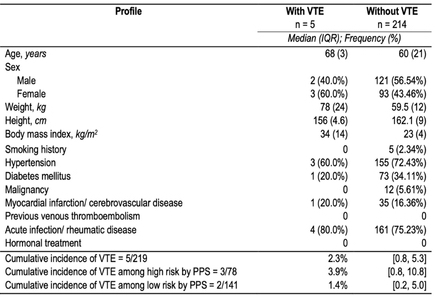
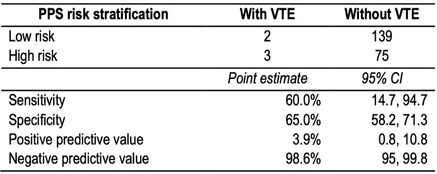
Among 219 eligible CKD ICU patients, the cumulative incidence of VTE was 2.3% overall—3.9% in the high-risk PPS group and 1.4% in the low-risk group (Table 1). PPS demonstrated 60.0% sensitivity and 65.0% specificity. The positive predictive value (PPV) was 3.9%, while the negative predictive value (NPV) was 98.6% (Table 2). These findings suggest high reliability in ruling out VTE in low-risk patients but poor discrimination in identifying high-risk individuals.
Conclusion:
The PPS showed limited accuracy in predicting VTE among ICU-admitted CKD patients, with low sensitivity and PPV, but a high NPV. While PPS may still be useful in identifying low-risk individuals who may not require aggressive surveillance or intervention, its predictive performance in ICU settings warrants caution. Future studies with larger multicenter cohorts and complete diagnostic testing are recommended to refine VTE risk assessment in this population.
  • Tuazon, John Carlo  ( National Kidney and Transplant Institute , Quezon City , Metro Manila , Philippines )
  • Adiong, Areefah  ( National Kidney and Transplant Institute , Quezon City , Metro Manila , Philippines )
  • Author Disclosures:
    John Carlo Tuazon: DO NOT have relevant financial relationships | Areefah Adiong: No Answer
Meeting Info:

Scientific Sessions 2025

2025

New Orleans, Louisiana

Session Info:

Vascular Genetics, Genomics, and Risk Scores

Saturday, 11/08/2025 , 03:15PM - 04:30PM

Moderated Digital Poster Session

You have to be authorized to contact abstract author. Please, Login
Not Available