Plasma Protein N-Glycosylation Profiles Are Associated with Future Cardiovascular Events: Analyses from the JUPITER and TNT Trials
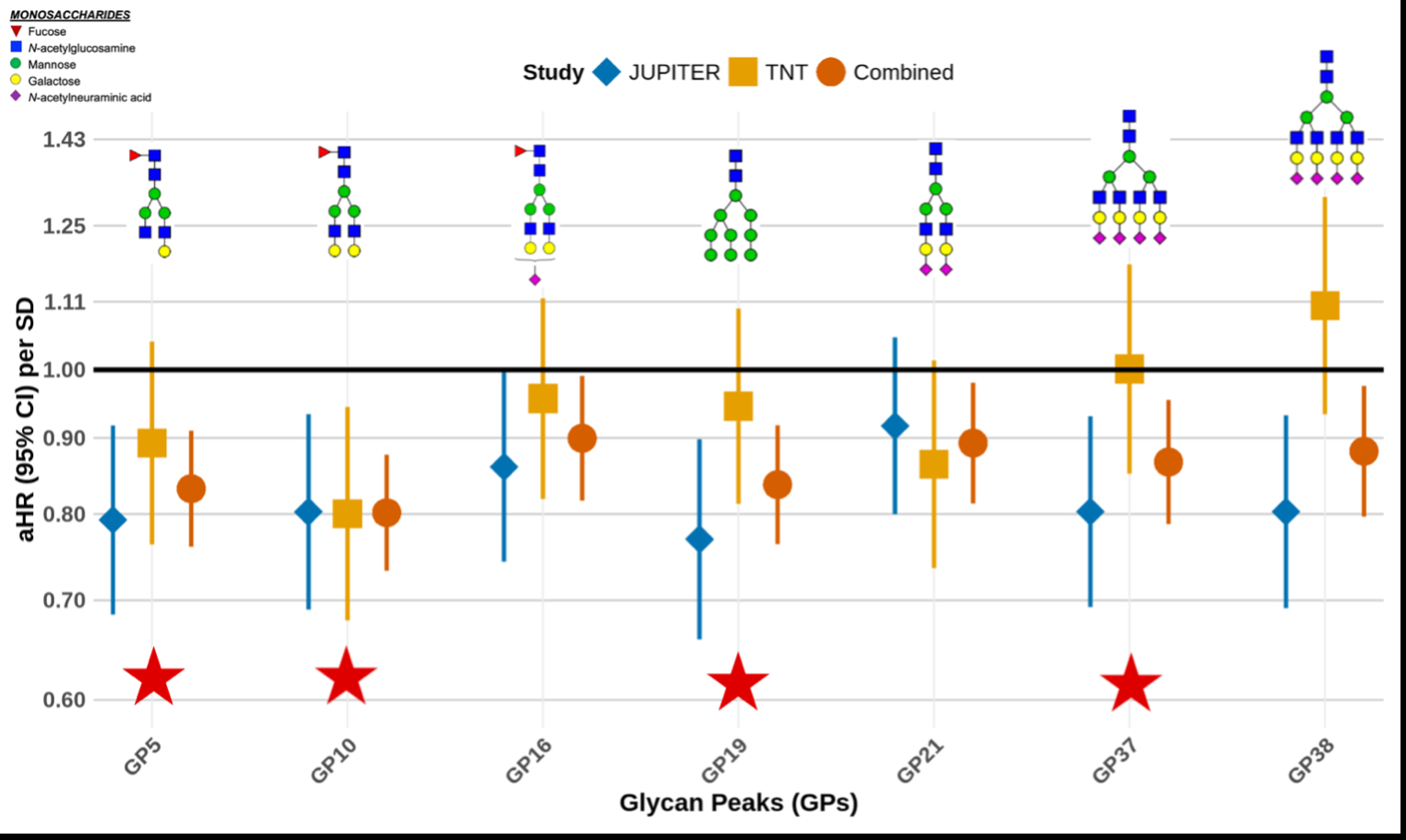
Abstract Body (Do not enter title and authors here): Background: Glycosylation—a key post-translational modification—plays a critical role in biological pathways of atherosclerosis. We previously demonstrated associations between N-glycosylation of immunoglobulin G and cardiovascular disease (CVD). However, the relationship between N-glycosylation of other plasma proteins and CVD remains largely unexplored. Methods: We analyzed N-glycosylation of baseline plasma proteins using ultra-high-performance liquid chromatography in two nested case-control studies of incident CVD: JUPITER (NCT00239681; 513 pairs; primary prevention) and TNT (NCT00327691; 436 pairs; secondary prevention). We used conditional logistic regression to evaluate associations between 39 measured chromatographic N-glycan peaks (GP1-39) and incident CVD. The fully adjusted model accounted for age, sex, race, LDL, HDL, hypertension, diabetes, smoking, hs-CRP, BMI, aspirin use, and treatment assignment. We then performed a fixed-effects meta-analysis to combine effect estimates across cohorts. Using stepwise regression, we derived a glycan score in JUPITER and validated it in TNT. We also performed Spearman correlations between N-glycans and clinical biomarkers. Results: The meta-analysis identified specific N-glycosylation patterns independently associated with CVD. These included mono- and digalactosylated glycans with core fucose (GP5,10), a tetragalactosylated tetrasialylated glycan (GP37), and an oligomannose glycan (GP19), all inversely associated with CVD in the fully adjusted model (aHR per SD:0.80–0.90; FDR<0.05) (Figure 1). In contrast, antennary fucosylated glycans (GP27,33,39) were positively associated with CVD in the baseline model accounted for age, sex, and treatment assignment (FDR<0.05), but these associations lost significance after adjusting for inflammatory covariates. Notably, all three antennary fucosylated structures were positively correlated with hs-CRP in both cohorts (FDR<0.05), suggesting a potential link to inflammation-mediated CVD risk. A glycan score of seven GPs was associated with increased CVD risk in JUPITER (aHR per SD:1.91; 95%CI:1.59–2.30; P<0.001), independent of other risk factors, and validated in TNT (P=0.03). It improved the AUC from 0.73 to 0.76 in JUPITER (P<0.001) and from 0.66 to 0.67 in TNT (P=0.03). Conclusion: Specific N-glycosylation profiles of plasma proteins are associated with future CVD events. Furthermore, a composite glycan score enhanced CVD risk prediction beyond established risk factors.
Ammar, Mohammed
(
Harvard Medical School
, Boston , Massachusetts , United States )
Hoshi, Rosangela
(
Brigham and Womens Hospital
, Boston , Massachusetts , United States )
Yazdani, Azam
(
Brigham and Womens Hospital
, Boston , Massachusetts , United States )
Trbojevic-akmacic, Irena
(
Genos Ltd
, Zagreb , Croatia )
Glynn, Robert
(
Brigham and Womens Hospital
, Boston , Massachusetts , United States )
Giulianini, Franco
(
Brigham and Womens Hospital
, Boston , Massachusetts , United States )
Ridker, Paul
(
Brigham and Womens Hospital
, Boston , Massachusetts , United States )
Cummings, Richard
(
Beth Israel Deaconess Medical Center
, BOSTON , Massachusetts , United States )
Lauc, Gordan
(
Genos Ltd
, Zagreb , Croatia )
Demler, Olga
(
Brigham and Womens Hospital
, Boston , Massachusetts , United States )
Mora, Samia
(
Brigham and Womens Hospital
, Boston , Massachusetts , United States )
Author Disclosures:
Mohammed Ammar:DO NOT have relevant financial relationships
| Olga Demler:No Answer
| Samia Mora:DO have relevant financial relationships
;
Other (please indicate in the box next to the company name):Co-Inventor on Pending Patent Application: Method for prediction of future cardiovascular disease (Genos, Inc):Expected (by end of conference)
; Other (please indicate in the box next to the company name):Co-inventor on Issued Patent: Methods and systems for predicting colorectal cancer incidence and mortality, issued to LabCorp, Inc:Active (exists now)
| Rosangela Hoshi:DO NOT have relevant financial relationships
| Azam Yazdani:No Answer
| Irena Trbojevic-Akmacic:No Answer
| Robert Glynn:No Answer
| Franco Giulianini:DO NOT have relevant financial relationships
| Paul Ridker:No Answer
| Richard Cummings:DO NOT have relevant financial relationships
| Gordan Lauc:No Answer