Overcoming cardiovascular nonresponse to exercise in healthy, older adults.
Abstract Body (Do not enter title and authors here): Introduction: Routine physical activity reduces the risk of death and cardiometabolic diseases and increases cardiovascular fitness measured as peak oxygen uptake (VO2peak). However, the change in VO2peak with exercise training has significant variability, and many healthy individuals do not show improvement in VO2peak with recommended doses of exercise. In young, healthy individuals exercise nonresponse has been overcome with increased frequency and intensity (dose) of exercise but the effect of age on this phenomenon is unknown.
Research Question: Do changes in VO2peak in response to aerobic exercise training have a dose-response relationship in healthy, older adults?
Methods: 61 sedentary, healthy older adults were recruited and randomized to one year of Yoga/Tai-Chi, or graded aerobic exercise with training load measured by training impulse (TRIMP), a measure accounting for time and intensity based on heart rate. Peak VO2 was measured at baseline and one year via a modified Astrand-Saltin treadmill protocol with Douglas bag technique.
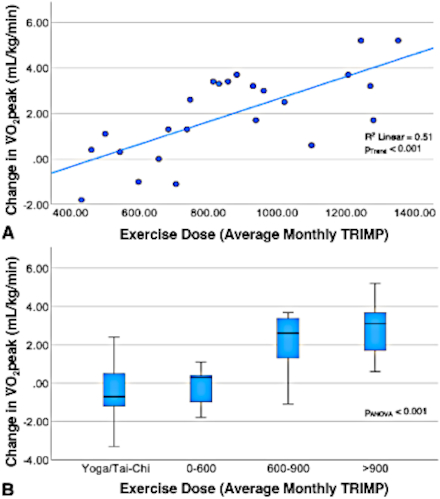
Results: The mean age was 67 +/- 6.2 years. There were no significant differences in baseline characteristics between groups. One year of aerobic training significantly increased VO2peak when compared to one year of strength/balance training in older patients (+2.25 mL/kg/min [1.33, 3.17]). The VO2peak response had a moderate correlation with training load (R2 of 0.51, pTrend<0.001) (Figure 1A). Grouping by TRIMP/month at steady state months 6-12, (<600, 600-900, >900/month), medium and high TRIMP doses had significantly more gains in VO2peak compared to the low TRIMP and static control groups (p<0.001) (Figure 1B). A dose of 744 TRIMPs/month (roughly 90 minutes of vigorous activity per week) was required to improve VO2peak by 1.75mL/kg/min (0.5 MET). Using multivariate logistic regression, exercise nonresponse, defined as change in VO2peak <1.75 mL/kg/min, was found not to be associated with age, sex, lean body mass, body fat percentage, BMI, or baseline VO2peak.
Conclusion: The VO2peak of healthy, older adults has a dose-response relationship with aerobic training load, suggesting exercise nonresponse may be overcome and addressing a lack of knowledge for this growing population. Improvements in VO2peak were seen at moderate TRIMP doses of 600 TRIMPs/month, and increased proportionally with higher achieved training impulses.
Pillai, Balakrishnan
(
University of Texas, Southwestern
, Dallas , Texas , United States )
Berry, Jarett
(
UT Tyler School of Medicine
, Tyler , Texas , United States )
Levine, Benjamin
(
UT SOUTHWESTERN MEDICAL CENTER
, Dallas , Texas , United States )
Sarma, Satyam
(
UT Southwestern
, Dallas , Texas , United States )
Author Disclosures:
Balakrishnan Pillai:DO NOT have relevant financial relationships
| Jarett Berry:DO have relevant financial relationships
;
Consultant:Cooper Institute:Past (completed)
| Benjamin Levine:DO NOT have relevant financial relationships