
Logo

American Heart Association

  52
  0


Final ID: 4343268

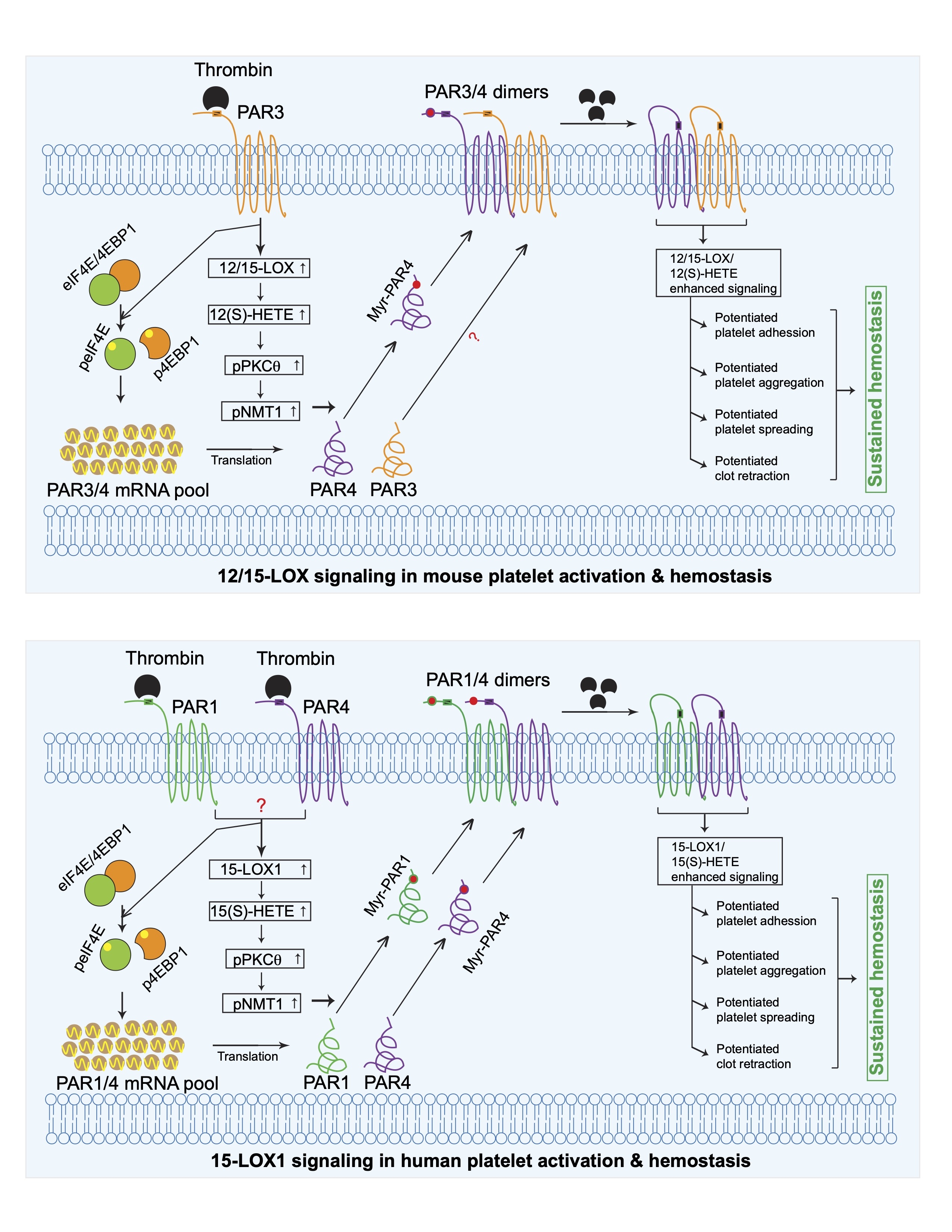
ALOX15 mediates thrombin-induced myristoylation, trafficking and interaction of PARs leading to platelet activation and hemostasis

Abstract Body (Do not enter title and authors here): Background: Platelets express 12-lipoxygenase (ALOX12) and 12/15-lipoxygenase (ALOX15) which exhibit positional specificity in the oxygenation of polyunsaturated fatty acids such as arachidonic acid. Although ALOX12 has been studied extensively in platelets, its role in platelet function is controversial. On the other hand, the role of ALOX15 in platelet activation has never been investigated.
Hypothesis: Does ALOX15 (aka 12/15-LOX) play a role in platelet activation and hemostasis?
Methods: 12/15-LOX-/- mice as well as pharmacological and molecular approaches were used.
Results: Genetic deletion of 12/15-LOX suppressed thrombin-induced PAR4 myristoylation and its membrane trafficking causing a reduction in its interaction with PAR3 in mouse platelets. We also found that 12/15-LOX via activation of protein kinase Cq (PKCq) mediates N-myristoyltransferase 1 (NMT1) phosphorylation in the modulation of thrombin-induced PAR4 myristoylation. In line with these observations, genetic deletion or inhibition of 12/15-LOX or pharmacological blockade of PKCq or NMT1 attenuated thrombin-induced PAR4 myristoylation, trafficking, and its interaction with PAR3 leading to reduced mouse platelet activation. Consistent with these observations, genetic deletion or inhibition of 12/15-LOX or blockade of PKCq or NMT1 exhibited prolonged bleeding time and delayed clotting and clot-retraction times in mice. Intriguingly, thrombin induces myristoylation and trafficking of both PAR1 and PAR4 facilitating their interaction in the plasma membrane of human platelets and inhibition of 15-LOX1, the human orthologue of murine 12/15-LOX, attenuated these effects. In addition, inhibition of 15-LOX1 blunted thrombin-induced human platelet activation and clot-retraction. Thus, our findings unfold a novel role for 12/15-LOX in the myristoylation and trafficking of PAR4 in mice and PAR1/4 in humans facilitating PAR3/4 interactions in mice and PAR1/4 interactions in humans leading to platelet activation and hemostasis.
Conclusions: Our observations reveal a novel role for 12/15-LOX in the myristoylation and trafficking of PARs leading to their interactions in the plasma membrane potentiating platelet activation and hemostasis. Based on these observations, 12/15-LOX could be an ideal target for drug development against platelet disorders.
  • Govatati, Suresh  ( University of Tennessee HSC , Memphis , Tennessee , United States )
  • Hoque, Md Monirul  ( University of Tennessee HSC , Memphis , Tennessee , United States )
  • Thota, Swapna  ( University of Tennessee HSC , Memphis , Tennessee , United States )
  • Rao, Gadiparthi  ( University of Tennessee HSC , Memphis , Tennessee , United States )
  • Author Disclosures:
    Suresh Govatati: DO NOT have relevant financial relationships | Md Monirul Hoque: DO NOT have relevant financial relationships | Swapna Thota: No Answer | Gadiparthi Rao: DO NOT have relevant financial relationships
Meeting Info:

Scientific Sessions 2025

2025

New Orleans, Louisiana

Session Info:

Sol Sherry Distinguished Lecture in Thrombosis

Sunday, 11/09/2025 , 03:30PM - 04:45PM

Abstract Oral Session

More abstracts on this topic:
Cardiomyocyte-specific PLCe1 knock-down attenuates Angiotensin II-induced cardiac hypertrophy.

Ni Kareemah, Rigaud Vagner, Vigneault Patrick, Xiao Chunyang, Klattenhoff Carla, Ellinor Patrick

Early Versus Late Direct Oral Anticoagulant Initiation After Acute Ischemic Stroke With Atrial Fibrillation: A Bayesian Meta-Analysis of Randomized Controlled Trials

Queiroga Flavia, Rivera Andre, Arrighini Giang Son, Barrera Nelson, Queiroz Ivo, Bhatia Neal, El-chami Mikhael, Merchant Faisal

More abstracts from these authors:
CXCL1 and CXCL2 act downstream to ATF6 and GRP78 in hypoxia-induced retinal neovascularization

Yadavalli Chandra Sekhar, Kumar Raj, Govatati Suresh, Rao Gadiparthi

You have to be authorized to contact abstract author. Please, Login
Not Available