
Logo

American Heart Association

  18
  0


Final ID: MP2195

Using Machine Learning Methods to Predict Adverse Events in Patients Undergoing Transcatheter Left Atrial Appendage Occlusion

Abstract Body (Do not enter title and authors here): Background: Cardiovascular risk models generally use standard statistical methods that limit their performance for common outcomes and don’t allow for prediction of rare outcomes. Machine learning methods may address these shortcomings. The objective of this study was to determine how performance would vary across methods for prediction of in-hospital clinical events in the NCDR Left Atrial Appendage Occlusion (LAAO) Registry.

Methods: Using data from the LAAO Registry, logistic regression (LR), LASSO, and XG Boost were used to predict the combined outcome of all major in-hospital adverse events (MAE), as well as 11 individual events for patients undergoing transcatheter LAAO. Randomly selected 70% development and 30% validation cohorts were used for model creation and to assess performance. Models were assessed using the 16 original variables used in the previously developed logistic regression risk model and with an expanded list of 51 total variables.

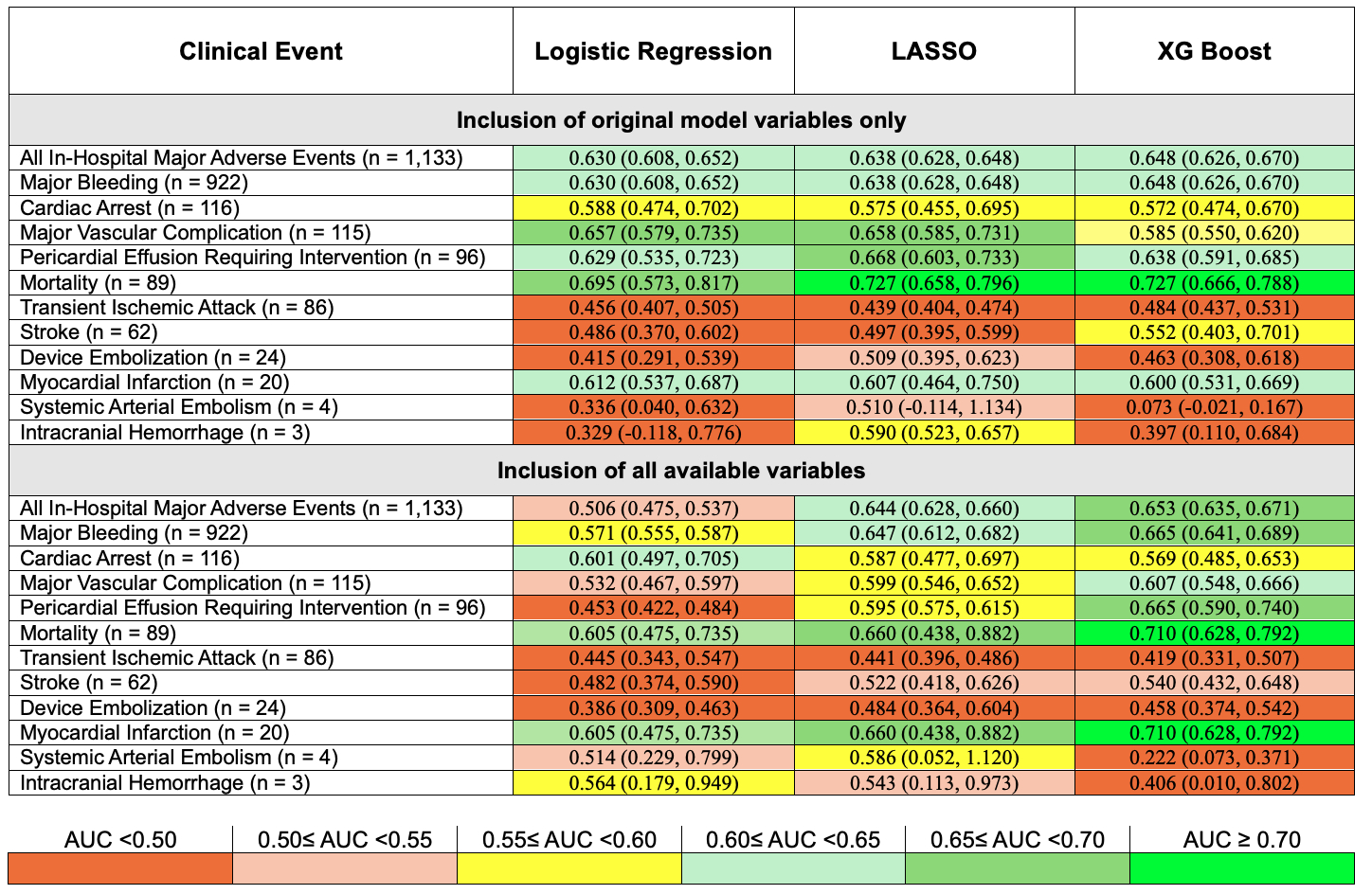
Results: The development cohort included data from 57,192 transcatheter LAAO procedures performed with the Watchman FLX device, and the validation cohort included 24,511 procedures. The overall incidence rate for the composite of all MAE was 1.39%, with rates for individual events ranging from <0.01% up to 1.13%. XG Boost had the best performance for combined MAE using original model variables in the validation cohort (AUC 0.648 [95% CI 0.626-0.670] vs. 0.630 [95% CI 0.608-0.642] for LR and 0.638 [95% CI 0.626-0.670] for LASSO). When an expanded list of candidate variables were included, XG Boost (AUC 0.653 [95% CI 0.635-0.671]) performed marginally better than LASSO (AUC 0.644 [95% CI 0.628-0.660]) for MAE in the validation cohort, whereas LR performed poorly (AUC 0.515 [95% CI 0.501-0.529]). Performance across all methods declined and was generally worse for most infrequent events (Figure). XG Boost generally outperformed the other model types and performed better with an expanded list of variables, but this was not consistently the case, particularly for very rare events. However, prediction of mortality using XG Boost was incrementally better.

Conclusions: In a nationwide registry cohort, the XG Boost machine learning method improved prediction of a composite of all MAE and several individual events over standard methods, particularly when using an expanded list of variables. Prediction of rare mortality events was also improved, although this was not consistently the case for other rare outcomes.
  • Faridi, Kamil  ( Yale School of Medicine , New Haven , Connecticut , United States )
  • Mortazavi, Bobak  ( Texas AM University , College Station , Texas , United States )
  • Huang, Sicong  ( Texas AM University , College Station , Texas , United States )
  • Zimmerman, Sarah  ( Yale University , New Haven , Connecticut , United States )
  • Friedman, Daniel  ( Duke University , Durham , North Carolina , United States )
  • Khera, Rohan  ( Yale School of Medicine , New Haven , Connecticut , United States )
  • Krumholz, Harlan  ( Yale University , New Haven , Connecticut , United States )
  • Curtis, Jeptha  ( YALE UNIVERSITY , New Haven , Connecticut , United States )
  • Freeman, James  ( YALE UNIV SCHOOL MEDICINE , New Haven , Connecticut , United States )
  • Author Disclosures:
    Kamil Faridi: DO have relevant financial relationships ; Research Funding (PI or named investigator):NIH/NHLBI:Active (exists now) | Bobak Mortazavi: DO have relevant financial relationships ; Other (please indicate in the box next to the company name):Kirkland & Ellis, Expert Witness:Active (exists now) ; Research Funding (PI or named investigator):NSF:Active (exists now) ; Research Funding (PI or named investigator):NIDDK:Active (exists now) ; Research Funding (PI or named investigator):NHLBI:Active (exists now) ; Individual Stocks/Stock Options:Google:Active (exists now) ; Individual Stocks/Stock Options:Nvidia:Active (exists now) ; Individual Stocks/Stock Options:Microsoft:Active (exists now) ; Individual Stocks/Stock Options:Apple:Active (exists now) | Sicong Huang: DO NOT have relevant financial relationships | Sarah Zimmerman: DO NOT have relevant financial relationships | Daniel Friedman: DO have relevant financial relationships ; Consultant:Abbott:Active (exists now) ; Research Funding (PI or named investigator):Abbott:Active (exists now) ; Research Funding (PI or named investigator):Boston Scientific:Active (exists now) ; Research Funding (PI or named investigator):Medtronic:Active (exists now) ; Research Funding (PI or named investigator):Phillips:Active (exists now) ; Consultant:Alleviant:Active (exists now) ; Consultant:Boston Scientific:Active (exists now) ; Consultant:Medtronic:Active (exists now) | Rohan Khera: DO have relevant financial relationships ; Research Funding (PI or named investigator):Bristol-Myers Squibb:Active (exists now) ; Research Funding (PI or named investigator):NovoNordisk:Active (exists now) ; Research Funding (PI or named investigator):BridgeBio:Active (exists now) | Harlan Krumholz: No Answer | Jeptha Curtis: DO NOT have relevant financial relationships | James Freeman: DO have relevant financial relationships ; Advisor:Medtronic:Active (exists now) ; Advisor:Abbott:Active (exists now) ; Advisor:PaceMate:Active (exists now) ; Advisor:Johnson & Johnson MedTech:Active (exists now) ; Advisor:Boston Scientific:Active (exists now)
Meeting Info:

Scientific Sessions 2025

2025

New Orleans, Louisiana

Session Info:

AI and Biomarker-Driven Approaches to Atrial Fibrillation and Stroke Risk Stratification

Monday, 11/10/2025 , 12:15PM - 01:15PM

Moderated Digital Poster Session

More abstracts on this topic:
Variability of Outpatient Cardiology Clinician Performance Metric Achievement in the Veteran Affairs Health System

Chow Christine, Gaba Harshita, Odonnell Colin, Salahuddin Taufiq, Doll Jacob

Medication Safety in the Digital Age: Leveraging Technology to Increase Right Route Medication Orders for Patients with Feeding Tubes

Reagin Richard, Burnham Nicole, Serber Stacy, Antonio Darvin, Carlton Sean, Schenone Brian

More abstracts from these authors:
Claims-Based versus Registry-Reported Stroke Events in the NCDR Left Atrial Appendage Occlusion Registry

Faridi Kamil, Ross Joseph, Krumholz Harlan, Yeh Robert, Curtis Jeptha, Freeman James, Wang Yongfei, Pereira Lucy, Zimmerman Sarah, Friedman Daniel, Sharma Richa, Higgins Angela, Mortazavi Bobak

Inpatient Outcomes for Patients with Peripheral Artery Disease Hospitalized for Acute Myocardial Infarction

Gusdorf Jason, Faridi Kamil, Wang Tracy, Mena-hurtado Carlos, Smolderen Kim, Rymer Jennifer, Curtis Jeptha, Secemsky Eric

You have to be authorized to contact abstract author. Please, Login
Not Available