
Logo

American Heart Association

  26
  0


Final ID: MP729

A Non-Contacting Blood Flow Sensor for Assessing Pediatric Vascular Graft Patency

Abstract Body (Do not enter title and authors here): Introduction: For infants born with single ventricle physiology, the initial palliation involves the implantation of a systemic to pulmonary vascular graft, typically a modified Blalock-Taussig shunt (mBTS) or a Sano shunt. However, irregular blood flow through the life-sustaining shunt can be life-threatening, and state-of-the-art monitoring approaches are either invasive or indirect. Alternative approaches for periodic monitoring of blood flow in a nonclinical setting are needed.
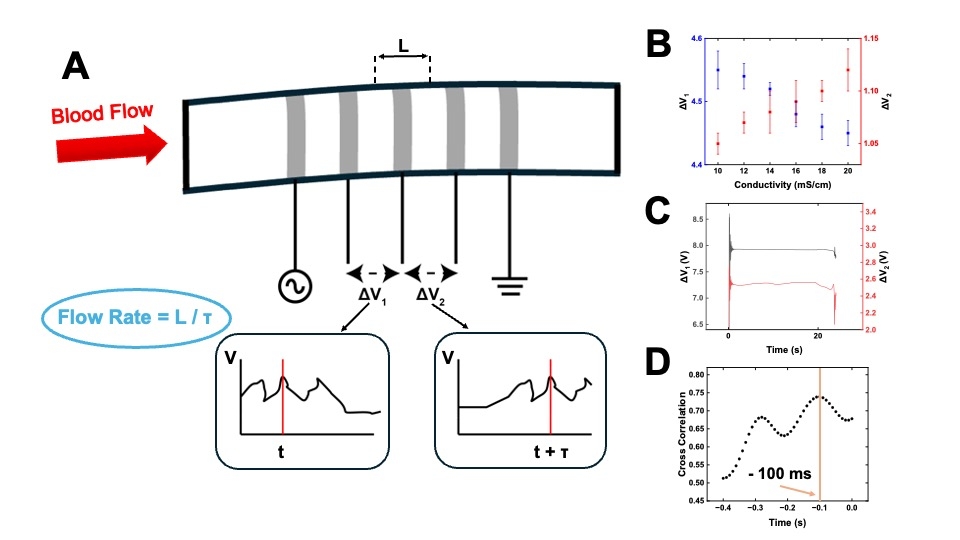
Methods: A novel contactless blood flow sensor was developed for integration on the shunt exterior for early detection of flow irregularities. This sensing strategy avoids device-related thrombosis by combining the capacitively-coupled contactless conductivity detection (C4D) principle with time-of-flight measurements to quantify blood flow. Five metal rings are positioned along the shunt exterior, each capacitively-coupled to the conductive blood. The first and last electrodes are used to impose a sinusoidal driving signal and voltage differences are measured between adjacent pairs among the three central electrodes. Time varying conductivity can be tracked and by cross-correlation of the two recordings, in which the downstream measurement is a time-delayed copy of the upstream one, and knowing the precise spacing of the pairs, flow rate can be computed.
Results: Sensor prototypes consisted of platinum rings fitted on polytetrafluoroethylene tubing. Capacitive coupling of the rings to blood was evaluated first. Response to varying solution conductivities was then characterized, demonstrating a linear response with the highest sensitivity at lower conductivities. Following successful sensor calibration measurements in test fluid, ex vivo flow measurements using bovine blood were collected at 30 and 50 mL/min. Based on the electrode locations, the delay for the flow rates was expected to be 100 and 70 ms, respectively. Peaks were observed at 100 ms and 60 ms, corresponding to 30 mL/min (0% error) and 42.9 mL/min (14.2% error), respectively. Errors were comparable to current “gold-standard” devices.
Conclusions: We successfully demonstrated the feasibility of non-contact flowing monitoring in a format suitable for pediatric vascular shunts. This low power approach can support a fully implantable device to provide early warning of inadequate blood flow and inform timely intervention to reduce morbidity and mortality in infants with single ventricle physiology.
  • Chen, Ruitong  ( University of Southern California , Los Angeles , California , United States )
  • Hudson, Trevor  ( University of Southern California , Los Angeles , California , United States )
  • Wang, Xuechun  ( Harvard University , Cambridge , Massachusetts , United States )
  • Liang, Jingjing  ( University of Southern California , Los Angeles , California , United States )
  • Nowlen, Alanna  ( University of Southern California , Los Angeles , California , United States )
  • Nigam, Vishal  ( Seattle Children's Hospital , Seattle , Washington , United States )
  • Meng, Ellis  ( University of Southern California , Los Angeles , California , United States )
  • Author Disclosures:
    Ruitong Chen: DO NOT have relevant financial relationships | Trevor Hudson: No Answer | Xuechun Wang: No Answer | Jingjing Liang: DO NOT have relevant financial relationships | Alanna Nowlen: No Answer | Vishal Nigam: No Answer | Ellis Meng: DO have relevant financial relationships ; Ownership Interest:Senseer Health Inc.:Active (exists now) ; Ownership Interest:Fluid Synchrony LLC:Active (exists now)
Meeting Info:

Scientific Sessions 2025

2025

New Orleans, Louisiana

Session Info:

Optimizing Outcomes in Pediatric Cardiac Surgery: Risk Factors, Innovations, and Systems-Level Insights

Saturday, 11/08/2025 , 01:45PM - 03:00PM

Moderated Digital Poster Session

More abstracts on this topic:
A Tale of Two Surgeries: Single Stage Versus Two Staged Approach to Creating an Ovine Model of Fontan Palliation

Kievert Jennifer, Morrison Adrienne, Nelson Kirsten, Heuer Eric, Shinoka Toshiharu, Breuer Christopher, Carrillo Sergio Alejandro, Kelly John, Spiess Joshua, Deshetler Cameron, Yuhara Satoshi, Watanabe Tatsuya, Jimenez Michael, Naguib Aymen, Mckee Christopher, Yates Andrew

A Randomized Placebo-Controlled Trial of Pitavastatin Calcium to Treat Combined Dyslipidemia of Obesity in Adolescents – The Pediatric Heart Network Dyslipidemia of Obesity Intervention in Teens (DO IT!) Trial

De Ferranti Sarah, Cartoski Mark, Brothers Julie, San Giovanni Christine, Zachariah Justin, Pena Sandra, Mahle William, Peterson Amy, Magge Sheela, Raghuveer Geetha, Sharma Binu, Arslanian, Md Silva, Kazlova Valiantsina, Sponseller Craig, Freemon Dandrea, Stylianou Mario, Mccrindle Brian, Mietus-snyder Michele, Urbina Elaine, Ware Adam, Teng Jessica, Trachtenberg Felicia, Russell Mark, Shah Amy

You have to be authorized to contact abstract author. Please, Login
Not Available