
Logo

American Heart Association

  16
  0


Final ID: MP1796

Brugada or STEMI? -Brugada-like ECG caused by ischemia of large conus branch veiled the ST-elevation of inferior myocardial infarction-

Abstract Body (Do not enter title and authors here): Introduction: Conus branch ischemia is rare; however, when present, it typically induces Brugada-like ST-elevation in the precordial leads of 12-lead electrocardiography (ECG), mimicking left anterior descending artery (LAD) occlusion, whereas it is generally not associated with reciprocal ST-depression.
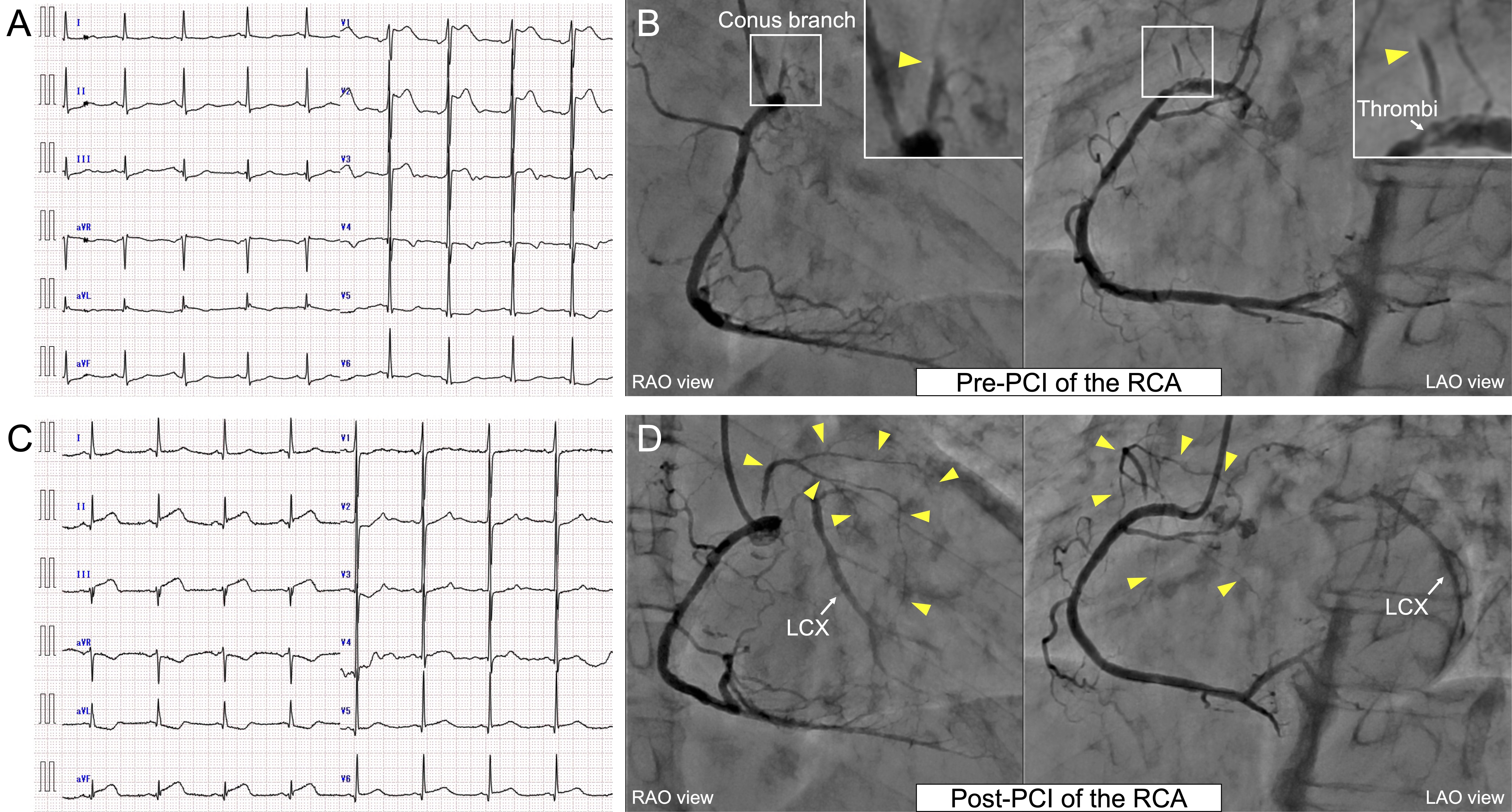
Case: A 77-year-old male presented with acute-onset chest pain following exercise. Upon arrival, ECG revealed type 2 Brugada-like changes in leads V1-V3 (Figure A). Transthoracic echocardiography demonstrated wall motion abnormalities in the inferior wall. Emergent coronary angiography identified thrombi at the conus branch bifurcation in the proximal right coronary artery (RCA), with slow flow in both the main RCA and the conus branch (Figure B). Additionally, chronic total occlusion of the left circumflex artery (LCX) and collateral circulation from both the distal RCA and the LAD to the LCX were observed. Given the presence of floating thrombi, percutaneous coronary intervention to the RCA was performed. Restoration of conus branch flow led to the resolution of Brugada-like ECG changes and unveiled the ST-elevation in the inferior leads (Figure C-D). Post revascularization, ECG monitoring during hospitalization revealed no recurrence of Brugada-like ECG changes.
Discussion: In this case, the conus branch perfused not only the right ventricular outflow tract but also the broad area of the right ventricular anterior wall. The resulting ischemia led to Brugada pattern ST-elevations in the precordial leads along with reciprocal changes in the inferior leads, thereby masking the inferior ST-elevation associated with RCA occlusion.
Conclusion: Brugada-like ECG changes may be induced by various etiologies. When the conus branch supplies the right ventricular outflow tract and the anterior right ventricular wall, it may veil the ST-elevation of inferior myocardial infarction. Sole reliance on ECG findings can mislead diagnosis of culprit lesion, therefore meticulous and comprehensive assessment is essential when interpreting Brugada-like ECG changes.
  • Abe, Yuto  ( NHO Mito Medical Center , Ibaraki , Ibaraki , Japan )
  • Minagawa, Shun  ( Mito Kyodo Hospital , Mito , Ibaraki , Japan )
  • Koizumi, Tomomi  ( NHO Mito Medical Center , Ibaraki , Ibaraki , Japan )
  • Ishizu, Tomoko  ( University of Tsukuba , Tsukuba , Ibaraki , Japan )
  • Author Disclosures:
    Yuto Abe: DO NOT have relevant financial relationships | Shun Minagawa: No Answer | Tomomi Koizumi: DO NOT have relevant financial relationships | Tomoko Ishizu: No Answer
Meeting Info:

Scientific Sessions 2025

2025

New Orleans, Louisiana

Session Info:

Lessons from the Front Lines: Challenging Coronary Case Reports

Sunday, 11/09/2025 , 09:15AM - 10:15AM

Moderated Digital Poster Session

More abstracts on this topic:
A Rare Cause of a Classic Presentation of NSTEMI: Case of 39-Year-Old Female with Hypothyroidism Induced Myocarditis

Quadri Fayz, Qazi Mariam, Teague Taylor

Advanced Diagnosis of Hypertrophic Cardiomyopathy with AI-ECG and Differences Based on Race and Subtype

Lewontin Myra, Perry Allison, Amos Kaitlyn, Ayers Michael, Kaplan Emily, Bilchick Kenneth, Barber Anita, Bivona Derek, Kramer Christopher, Parrish Anna, Mcclean Karen, Thomas Matthew

You have to be authorized to contact abstract author. Please, Login
Not Available