
Cardiovascular Risk Factors and Disparities Among Middle Eastern and North African Americans
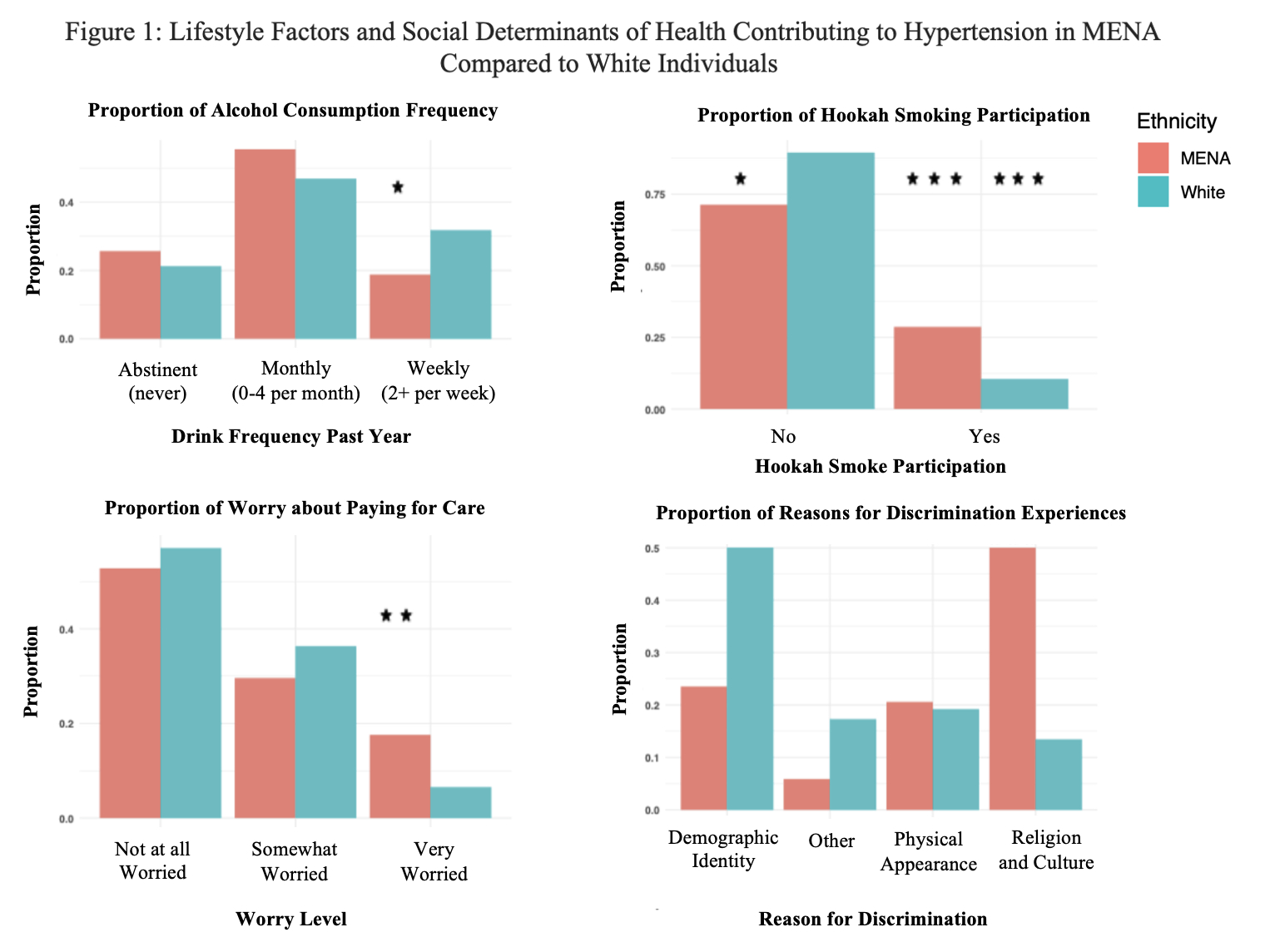
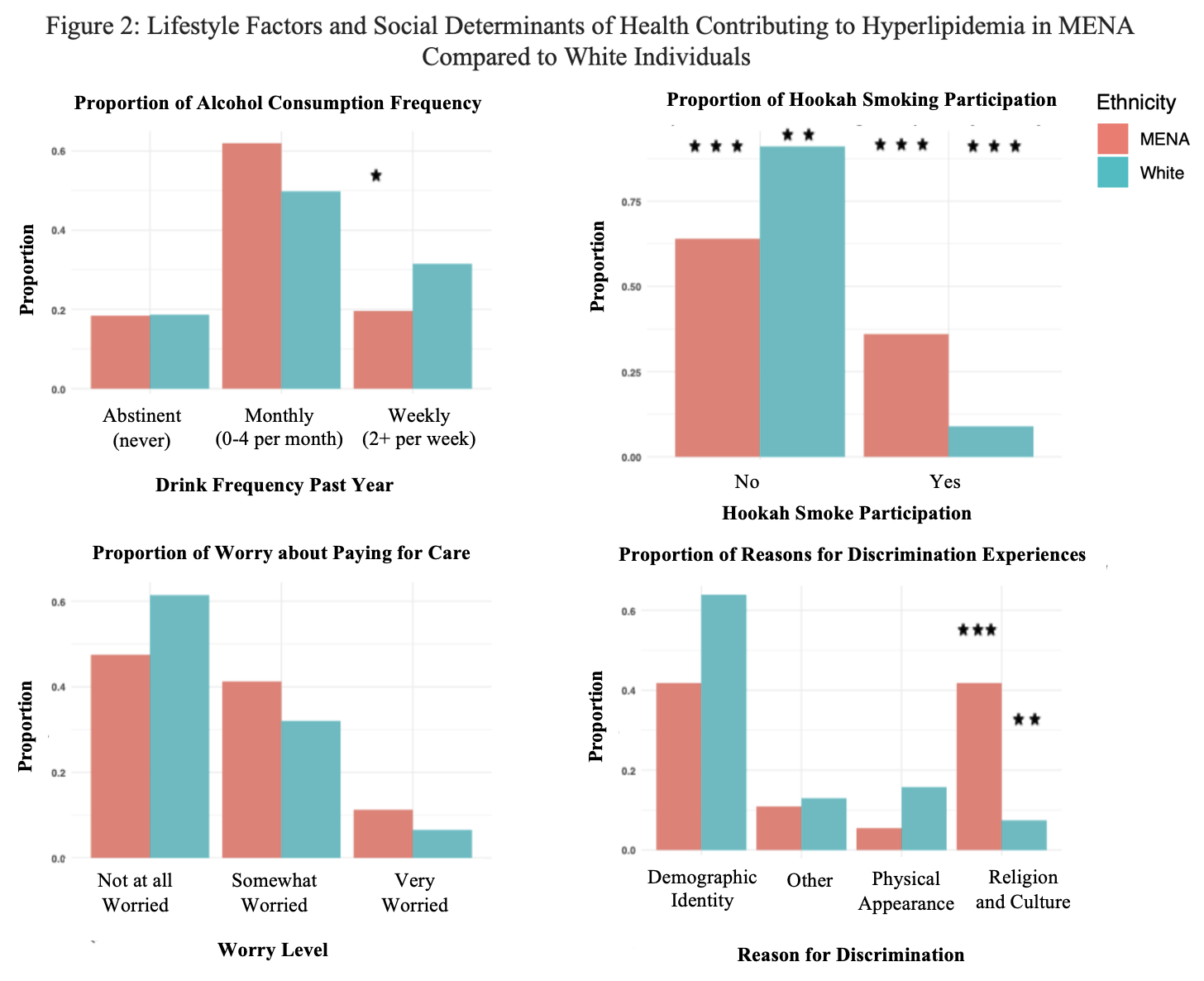
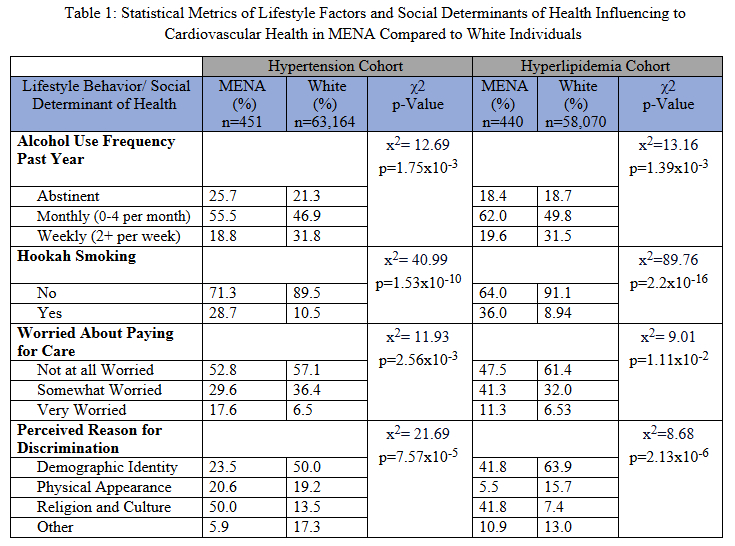
Abstract Body (Do not enter title and authors here): Background: Middle Eastern and North African (MENA) Americans are an understudied minority group. Their classification as White in the U.S. racial system limits available health data, posing challenges for conducting research on MENA American health. With an estimated 3.5 million MENA Americans living in the U.S., it is vital to collect disaggregated health data and conduct focused research on MENA American health. This study compared factors contributing to hyperlipidemia (HLD) and hypertension (HTN) among MENA Americans and White individuals, addressing the need for disaggregated data. Methods: The NIH's All of Us (AoU) Research Program is one of the very few health databases that includes a MENA racial category. Using data from AoU, this retrospective study compared lifestyle correlates between MENA Americans and White participants with HTN or HLD, including analyses with propensity score-matched controls. The study included 451 MENA American HTN, 440 MENA American HLD, 63,164 White HTN, and 58,070 White HLD participants. Results: Findings show hookah use was more prevalent among MENA American HTN and HLD cohorts (28.7% and 36.0%, respectively) compared to White counterparts (10.5% and 8.9%, respectively). Conversely, frequent alcohol consumption was higher among the White HTN and HLD cohorts (31.8% and 31.5%, respectively) compared to MENA American HTN and HLD cohorts (18.8% and 19.6%, respectively). Both MENA American cohorts reported more experiences of religious and cultural discrimination in health settings (HLD cohorts: 41.8% vs 7.41%; HTN cohorts: 50.0% vs 13.5%). Lastly, MENA Americans with HTN reported being very worried about paying for care more often compared to their White counterparts (17.6% vs 6.5%, respectively). Conclusion: These results highlight distinct lifestyle and health-related challenges faced by MENA Americans that may contribute to varying rates of HTN and HLD, and thus cardiovascular risk. These results underscore the need for disaggregated and granular data on MENA American communities to understand the nuances and health needs within this understudied minority group. Increased health research on MENA Americans can then inform public health and clinical interventions that promote cultural competence within health settings and address health disparities impacting the MENA American community.
Issa, Ramzy
( Northwestern Medicine
, Chicago
, Illinois
, United States
)
Hassan, Osama
( Northwestern Medicine
, Chicago
, Illinois
, United States
)
Muttar, Sara
( Northwestern Medicine
, Chicago
, Illinois
, United States
)
Marzouk, Sammer
( Northwestern Medicine
, Chicago
, Illinois
, United States
)
Alkhalili, Sawsan
( Northwestern Medicine
, Chicago
, Illinois
, United States
)
Allawi, Raad
( Northwestern Medicine
, Chicago
, Illinois
, United States
)
Al-kazaz, Mohamed
( Northwestern University
, Chicago
, Illinois
, United States
)
Author Disclosures:
Ramzy Issa:DO NOT have relevant financial relationships
| Osama Hassan:DO NOT have relevant financial relationships
| Sara Muttar:No Answer
| Sammer Marzouk:DO NOT have relevant financial relationships
| Sawsan Alkhalili:No Answer
| Raad Allawi:DO NOT have relevant financial relationships
| Mohamed Al-Kazaz:DO have relevant financial relationships
;
Consultant:Kiniksa Pharmaceuticals :Active (exists now)
; Research Funding (PI or named investigator):Ventyx BioSciences:Active (exists now)
; Research Funding (PI or named investigator):Cardiol Therapeutics,:Active (exists now)
; Consultant:Edwards LifeSciecnes :Past (completed)
; Research Funding (PI or named investigator):Kiniksa Pharmaceuticals :Active (exists now)
; Speaker:Kiniksa Pharmaceuticals :Active (exists now)