
Logo

American Heart Association

  18
  0


Final ID: MP160

Basis of Myocardial Elasticity Derived from Cardiac MRI in a Swine Model of Ischemic Heart Failure

Abstract Body (Do not enter title and authors here): Background:
The progression of CHF after MI has been traditionally evaluated by serial changes in EF. However, mechanical parameters can provide a greater insight into cardiac function. Wall strain measures myocardial deformation, and reflects contractile function as a percentage change in length. Wall stress represents the force per unit area on the myocardium, as an evaluation of LV afterload. The relationship between wall stress and wall strain is termed Young’s modulus, and it represents cardiac elasticity. This study leverages in-vivo Young’s modulus analysis derived from cardiac MRI, which has the potential to quantify the extent of myocardial remodeling, and aid in early detection of heart failure progression.

Hypothesis:
We hypothesize that Young’s modulus offers a more detailed assessment of regional wall motion abnormality than conventional imaging measures alone.

Methods:
Male Yucatan mini-swine underwent 90-minute balloon occlusion-reperfusion of the left anterior descending coronary artery to induce MI (N=13). Cardiac MRIs were obtained at baseline and 1-month post-MI. Cardiac wall stress and wall strain were calculated separately in the anteroseptal (infarcted) and inferolateral (non-infarcted) regions, and in the longitudinal and circumferential fiber orientations. These measurements were correlated to determine the Young’s modulus of the LV.

Results:
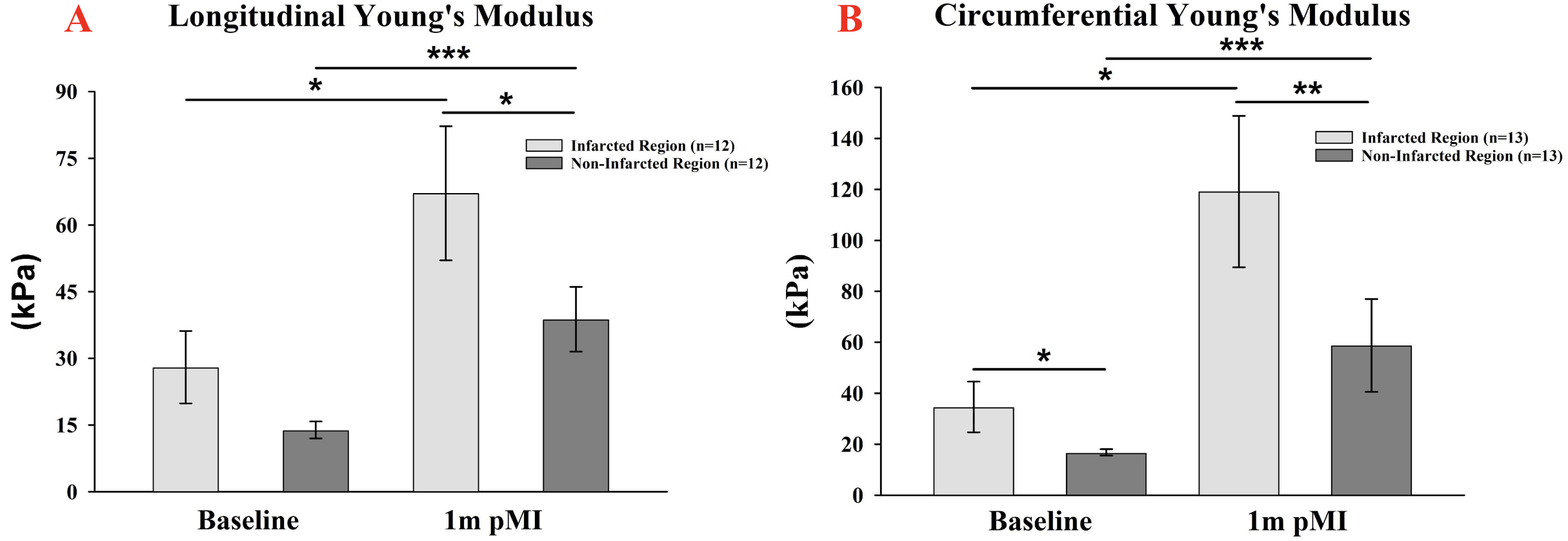
Anteroseptal and inferolateral longitudinal Young’s modulus increased from 28.01±8.14 to 67.14±15.08 kPa (p < 0.05) from 13.88±1.92 to 38.80±7.29 kPa (p < 0.001), respectively. Anteroseptal and inferolateral circumferential Young’s modulus increased from 34.61±10.33 to 119.17±30.94 kPa (p < 0.05) and from 16.77±1.32 to 58.76±18.98 kPa (p < 0.001), respectively. The regional changes were accompanied by a decrease in EF from 60.6±1.5 to 50.9±3.3% (p < 0.01).

Discussion:
Our findings show that Young’s modulus is a valuable parameter in quantifying regional changes that occur with LV systolic dysfunction after ischemic insult; specifically that regional abnormalities occur in the non-infarcted area as well as the infarcted area––a change that would not be picked up by global LV EF. Thus, quantifying regional and directional cardiac elasticity non-invasively is a novel parameter that warrants further study. Prior research has explored the in-vitro characteristics of cardiac elasticity, but there is limited research that details the in-vivo changes within any disease affecting myocardial fiber contractility.
  • Lefkowitz, Eli  ( University of Arizona , Tucson , Arizona , United States )
  • Moulton, Michael  ( University of Nebraska Medical Center , Omaha , Nebraska , United States )
  • Avery, Ryan  ( Northwestern University , Chicago , Illinois , United States )
  • Appleton, Christopher  ( Mayo Clinic , Scottsdale , Arizona , United States )
  • Goldman, Steven  ( University of Arizona , Tucson , Arizona , United States )
  • Ref, Jacob  ( University of Arizona , Tucson , Arizona , United States )
  • Gee, Aidan  ( Johns Hopkins University , Baltimore , Maryland , United States )
  • Bravo, Fox  ( University of Arizona , Tucson , Arizona , United States )
  • Mostafizi, Pouria  ( University of Arizona , Tucson , Arizona , United States )
  • Fox, Kenneth  ( University of Arizona , Tucson , Arizona , United States )
  • Lancaster, Jordan  ( University of Arizona , Tucson , Arizona , United States )
  • Koevary, Jennifer  ( University of Arizona , Tucson , Arizona , United States )
  • Acharya, Tushar  ( University of Arizona , Tucson , Arizona , United States )
  • Author Disclosures:
    Eli Lefkowitz: DO NOT have relevant financial relationships | Michael Moulton: No Answer | Ryan Avery: No Answer | Chris Appleton: DO NOT have relevant financial relationships | Steven Goldman: DO have relevant financial relationships ; Individual Stocks/Stock Options:Avery Therapeutics/ Sarver Heart Center:Active (exists now) | Jacob Ref: DO NOT have relevant financial relationships | Aidan Gee: DO NOT have relevant financial relationships | Fox Bravo: DO NOT have relevant financial relationships | Pouria Mostafizi: No Answer | Kenneth Fox: No Answer | Jordan Lancaster: No Answer | Jennifer Koevary: No Answer | Tushar Acharya: No Answer
Meeting Info:

Scientific Sessions 2025

2025

New Orleans, Louisiana

Session Info:

Silent Signals: Detecting Risk Early Using Innovative Imaging and Biomarkers

Saturday, 11/08/2025 , 03:15PM - 04:25PM

Moderated Digital Poster Session

More abstracts on this topic:
A Pressure-Volume Loops Approach Predicts Outcomes After Double Switch Operation For Congenitally Corrected Transposition Of The Great Arteries with Intact Ventricular Septum

Thatte Nikhil, Del Nido Pedro, Ghelani Sunil, Hammer Peter, Marx Gerald, Beroukhim Rebecca, Gauvreau Kimberlee, Callahan Ryan, Prakash Ashwin, Emani Sitaram, Hoganson David

A Selective Agonist of the Beta 2 Retinoic Acid Receptor Reduces Necrosis, Lipid Peroxidation, and Oxidative Stress in Doxorubicin-induced Cardiotoxicity

Varzideh Fahimeh, Jankauskas Stanislovas, Kansakar Urna, Tang Xiao-han, Gudas Lorraine, Levi Roberto, Gambardella Jessica, Santulli Gaetano

More abstracts from these authors:

A Large Animal Model of Persistent Atrial Fibrillation

Mostafizi Pouria, Goldman Steven, Moukabary Talal, Lefkowitz Eli, Ref Jacob, Daugherty Sherry, Grijalva Adrian, Cook Kyle Eric, Chinyere Ike, Lancaster Jordan, Koevary Jen

Tissue Engineered Biologic Promotes Cardiac Repair in Animal Models of Chronic Ischemic Heart Failure via Immunomodulation

Tulino Allison, Benson Daniel, Grijalva Adrian, Fink Jordan, Ref Jacob, Koevary Jen, Goldman Steven, Lancaster Jordan

You have to be authorized to contact abstract author. Please, Login
Not Available