
Early Versus Late Initiation of Oral Anticoagulants After Ischemic Stroke in Atrial Fibrillation: A Systematic Review and Meta-Analysis of Randomized Controlled Trials
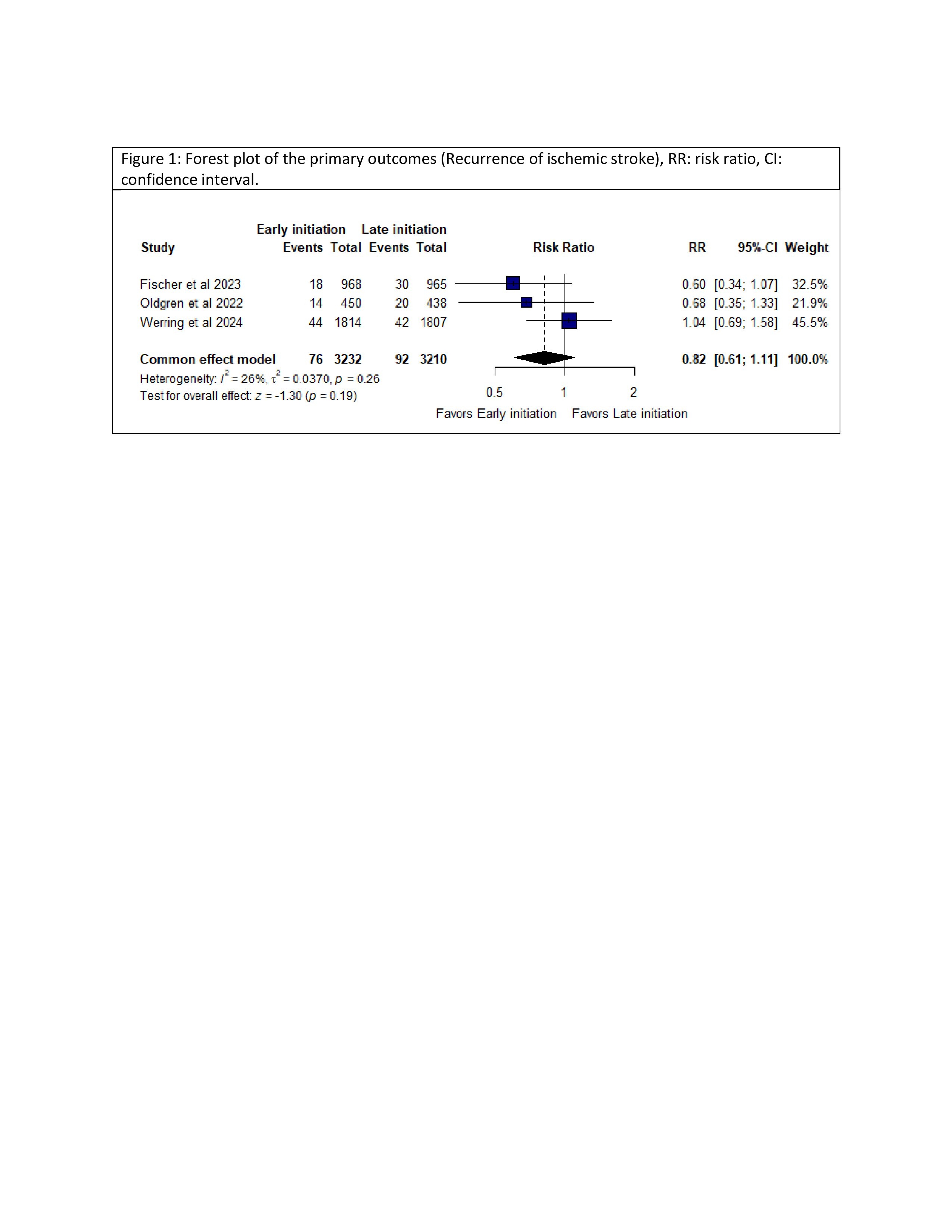
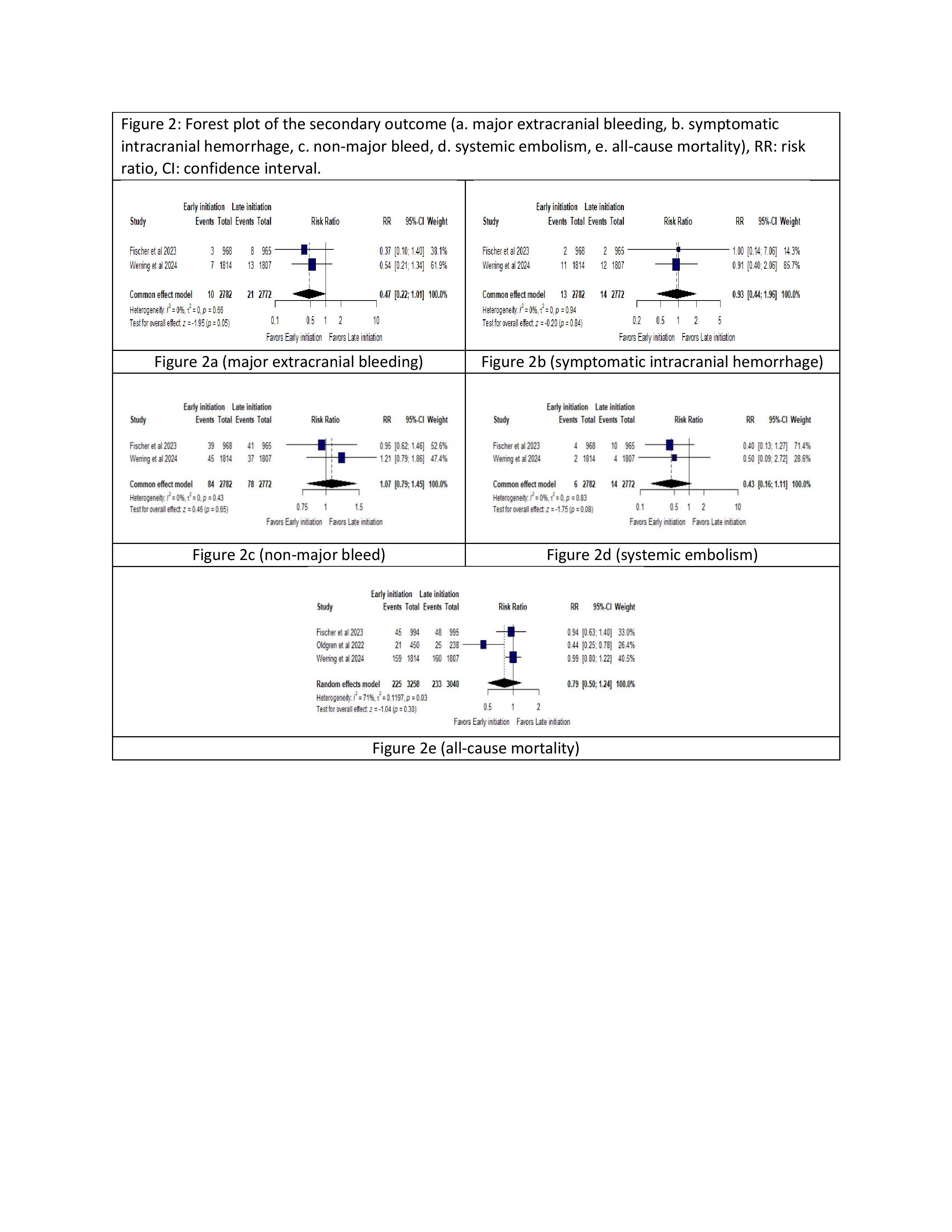
Abstract Body (Do not enter title and authors here): Background: Atrial fibrillation (AF) is present in approximately 20% of ischemic stroke patients. While oral anticoagulants (OACs) are effective in reducing stroke risk, the optimal timing for initiating OACs after acute ischemic stroke remains uncertain, with varying recommendations across guidelines. Hypothesis: Early initiation of OACs following ischemic stroke in patients with AF is as safe and effective as late initiation in preventing recurrent ischemic events. Methods: We conducted a systematic review and meta-analysis of randomized controlled trials (RCTs) comparing early versus late OAC initiation in adults with AF and recent ischemic stroke. A comprehensive literature search of PubMed, Scopus, Web of Science, EMBASE, and Cochrane CENTRAL was performed through October 2024. The primary outcome was recurrent ischemic stroke. Secondary outcomes included major extracranial bleeding, symptomatic intracranial hemorrhage (sICH), non-major bleeding, systemic embolism, and all-cause mortality. Risk ratios (RRs) were calculated using a random-effects model. Results: Three RCTs involving 6,522 patients were included. No significant difference was observed in recurrent ischemic stroke between early and late OAC initiation (RR: 0.82; 95% CI: 0.61–1.11; P=0.19). Similarly, no significant differences were seen in major extracranial bleeding (RR: 0.47; 95% CI: 0.22–1.01; P=0.05), sICH (RR: 0.93; 95% CI: 0.44–1.96; P=0.84), non-major bleeding (RR: 1.07; 95% CI: 0.79–1.45; P=0.65), systemic embolism (RR: 0.43; 95% CI: 0.16–1.11; P=0.08), or all-cause mortality (RR: 0.79; 95% CI: 0.50–1.24; P=0.30). Conclusion: Early initiation of OACs after ischemic stroke in patients with AF appears to be as safe as delayed initiation, with no increased risk of bleeding or mortality. Although the difference in efficacy was not statistically significant, the trend toward reduced stroke recurrence with early therapy supports further investigation. These findings may inform individualized decision-making in the acute stroke setting.
Manasrah, Almothana
( UHS-WIlson Medical Center
, Binghamton
, New York
, United States
)
Tanashat, Mohammad
( Yarmouk University
, Irbid
, Jordan
)
Amin, Ahmed Mazen
( Mansoura university
, Mansoura
, Egypt
)
Albandak, Maram
( The University of Toledo
, Toledo
, Ohio
, United States
)
Abuelazm, Mohamed
( Tanta University
, Tanta
, Egypt
)
Ur Rehman, Afzal
( UHS-WIlson Medical Center
, Binghamton
, New York
, United States
)
Author Disclosures:
AlMothana Manasrah:DO NOT have relevant financial relationships
| Mohammad Tanashat:No Answer
| Ahmed Mazen Amin:DO NOT have relevant financial relationships
| Maram Albandak:DO NOT have relevant financial relationships
| Mohamed Abuelazm:DO NOT have relevant financial relationships
| Afzal ur Rehman:No Answer