
Logo

American Heart Association

  22
  0


Final ID: Su3093

Circadian Troponin Dynamics Reveal Sex-Specific Signals for Acute Coronary Syndrome Management

Abstract Body (Do not enter title and authors here): Introduction: The circadian variation of high-sensitivity cardiac troponin has been established, but whether sex-based differences in these rhythms affect early acute coronary syndrome risk evaluation remains unknown.
Research Questions: The research examines whether high-sensitivity cardiac troponin I (hs-cTnI) displays distinct diurnal patterns between men and women and investigates if these differences affect the prediction of 30-day major adverse cardiac events (MACE) for patients suspected of acute coronary syndrome independently.
Methods: The RACE-IT stepped-wedge randomized trial underwent secondary analysis in nine Michigan emergency departments from July 2020 to April 2021. Our analysis included patients from the primary trial who had recorded an hs-cTnI value among 32,609 participants. All the hs-cTnI samples received timestamp data and measurements fell between 2–18 ng/L using the Beckman-Coulter assay. We used Cosinor regression models to assess diurnal variation and Cox proportional hazards models to examine the relationship with 30-day MACE while controlling for cardiovascular risk factors. Our study presented Midline Estimating Statistic Of Rhythm (MESOR) values, which show the average level of hs-cTnI throughout the day.
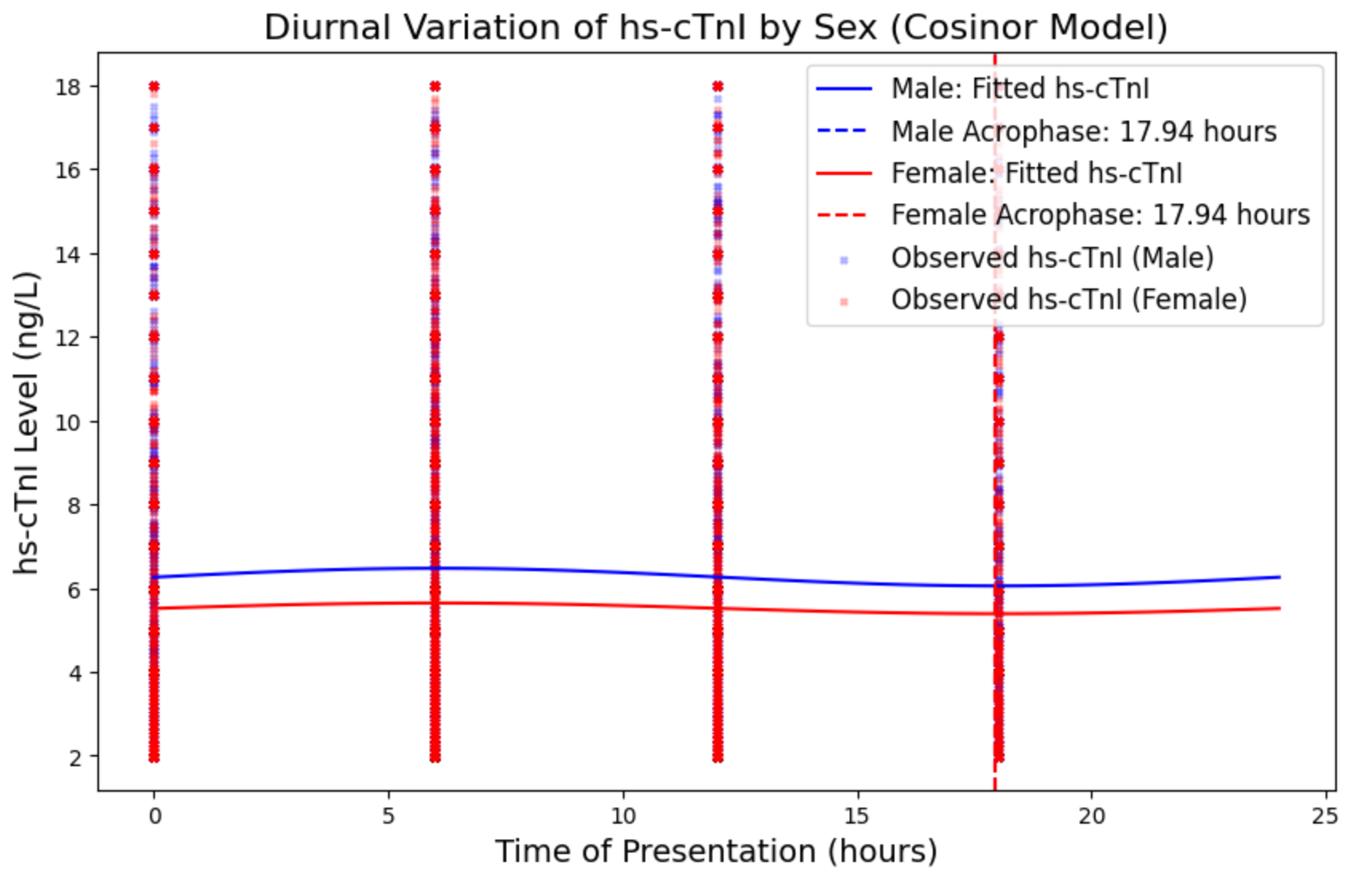
Results: The participants had an average age of 57 years, 42% were male, and 32% were Black. Mesor hs-cTnI measurements were higher among men (6.3 ng/L versus 5.5 ng/L; p < 0.001) while their diurnal amplitude was also greater (β = 0.21 versus 0.13; p < 0.001). Peak concentrations occurred at ~06:00 h in both sexes (Figure 1). The multivariable analysis identified male sex (HR = 2.35; 95% CI: 1.67–3.31) and presentation time near midnight (per 6-hour interval HR = 0.65; 95% CI: 0.54–0.79) as independent factors predicting 30-day MACE. When hs-cTnI levels rose by 1 ng/L, patients experienced a 7% higher MACE risk, reflected by an HR of 1.07 (95% CI: 1.03–1.12). The research findings remained consistent when data were stratified by age, and patients with previous cardiovascular disease were excluded from the analysis.
Conclusions: Men exhibit stronger diurnal hs-cTnI rhythms while sex and time of presentation provide separate prognostic insights. Using sex- and time-specific hs-cTnI thresholds can refine early acute coronary syndrome risk assessment and identify patients who require enhanced monitoring or treatment. Prospective studies integrating circadian biomarker patterns into diagnostic algorithms are warranted.
  • Emakhu, Joshua  ( Henry Ford Health , Detroit , Michigan , United States )
  • Soman, Sana  ( HENRY FORD HOSPITAL , Detroit , Michigan , United States )
  • Hawatian, Kegham  ( HENRY FORD HOSPITAL , Detroit , Michigan , United States )
  • Cook, Bernard  ( HENRY FORD HOSPITAL , Detroit , Michigan , United States )
  • Mccord, James  ( HENRY FORD HOSPITAL , Detroit , Michigan , United States )
  • Miller, Joseph  ( HENRY FORD HOSPITAL , Detroit , Michigan , United States )
  • Author Disclosures:
    Joshua Emakhu: DO NOT have relevant financial relationships | Sana Soman: No Answer | Kegham Hawatian: DO NOT have relevant financial relationships | Bernard Cook: No Answer | James McCord: DO have relevant financial relationships ; Researcher:Beckman:Active (exists now) ; Researcher:Abbott:Active (exists now) ; Consultant:Polymedco:Active (exists now) ; Researcher:Polymedco:Active (exists now) ; Consultant:Beckman:Active (exists now) | Joseph Miller: DO NOT have relevant financial relationships
Meeting Info:

Scientific Sessions 2025

2025

New Orleans, Louisiana

Session Info:

Next-Generation Biomarkers & Omics-Driven Risk Stratification

Sunday, 11/09/2025 , 03:15PM - 04:15PM

Abstract Poster Board Session

More abstracts on this topic:
Artificial Light at Night and Asleep Blood Pressure in Black Adults

Gloston Gabrielle, Thomas Stephen

Association Between Circadian Rest/Activity Rhythms and Incident Dementia in Older Adults: The Atherosclerosis Risk in Communities (ARIC) Study

Wang Wendy, Crainiceanu Ciprian, Spira Adam, Schrack Jennifer, Chen Lin, Wanigatunga Amal, Etzkorn Lacey, Rabinowitz Jill, Palta Priya, Pike James, Dougherty Ryan, Zipunnikov Vadim, Marino Francesca

More abstracts from these authors:
Fibrinogen Depletion and The Risk of Intracerebral Hemorrhage following Mechanical Thrombectomy

Aboul-nour Hassan, Gunaga Satheesh, Muir Jason, Chebl Alex, Ramadan Ahmad Riad, Jumah Ammar, Albanna Abdalla, Mohamed Ghada, Alsrouji Owais, Schultz Lonni, Latack Katie, Miller Joseph, Uddin Khalid

You have to be authorized to contact abstract author. Please, Login
Not Available