
Logo

American Heart Association

  22
  0


Final ID: MP2024

Cardiac MRI-derived Ventricular Volumes in Single Ventricular Congenital Heart Defects: A Systematic Review and Meta-Analysis

Abstract Body (Do not enter title and authors here): Background
Cardiac magnetic resonance (CMR) is the reference standard for volumetric analysis of functional single-ventricle (FSV) congenital heart defects (CHD), with the advantages of avoiding ionizing radiation and morbidities associated with vascular access in cardiac catheterization. However, interpreting ventricular changes has been challenging as volumetric data have not been characterized across staged palliative surgeries.

Research question
What are the ventricular volumetric changes that occur during staged palliative cardiac surgeries in FSV patients?

Method
We searched PubMed, Embase, and Cochrane databases for studies of FSV patients up to 30 years of age with CMR volumetric analyses. Our primary outcomes were indexed end-diastolic and end-systolic volumes (iEDV and iESV) stratified by the surgical stage and dominant ventricle. We pooled together the mean volumes with standard deviation using a random effects model to estimate overall means with a 95% confidence interval.

Result
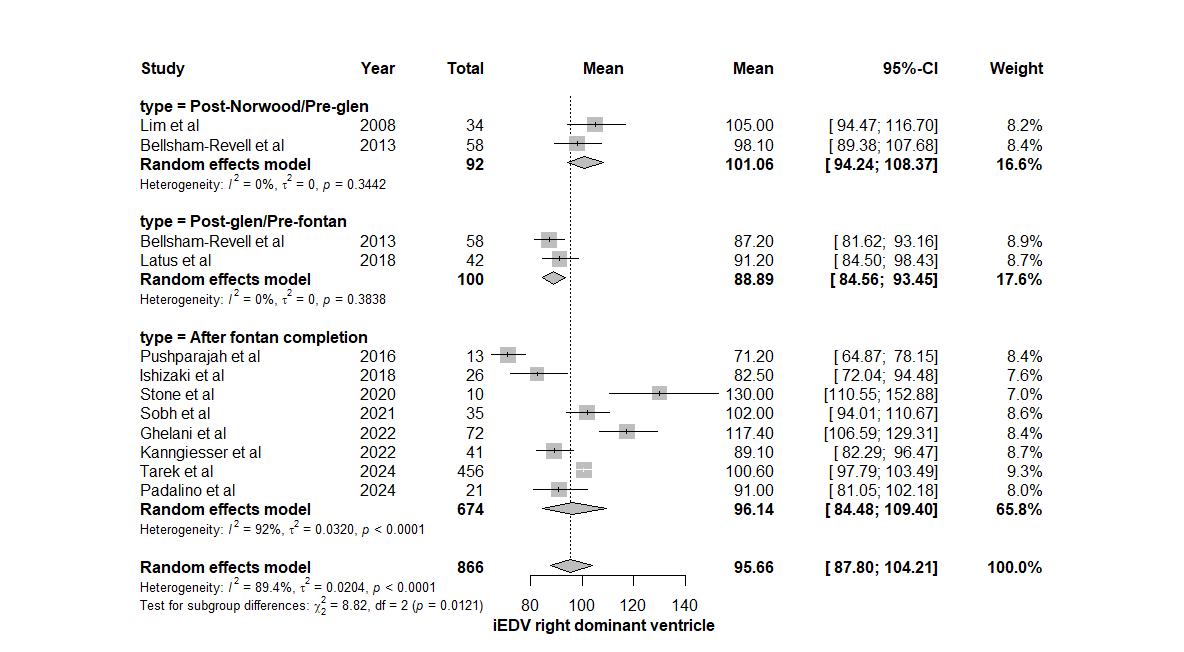
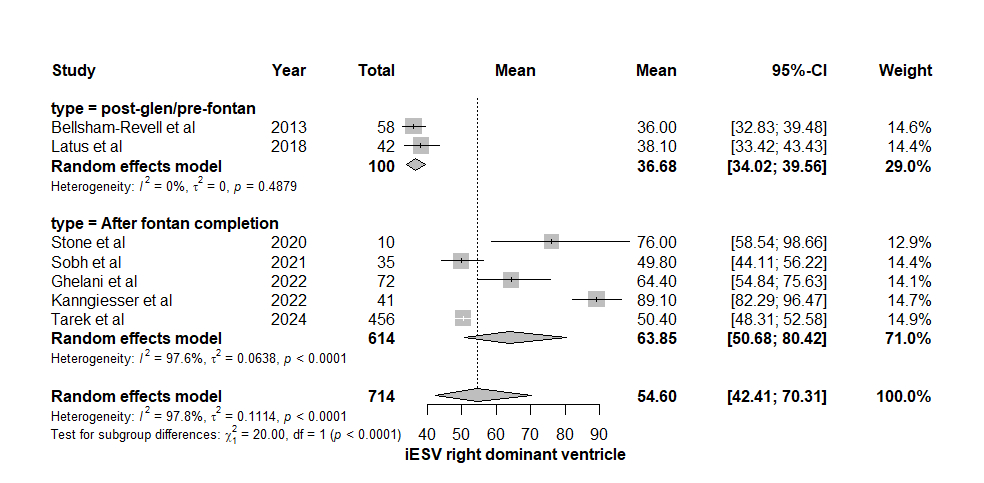
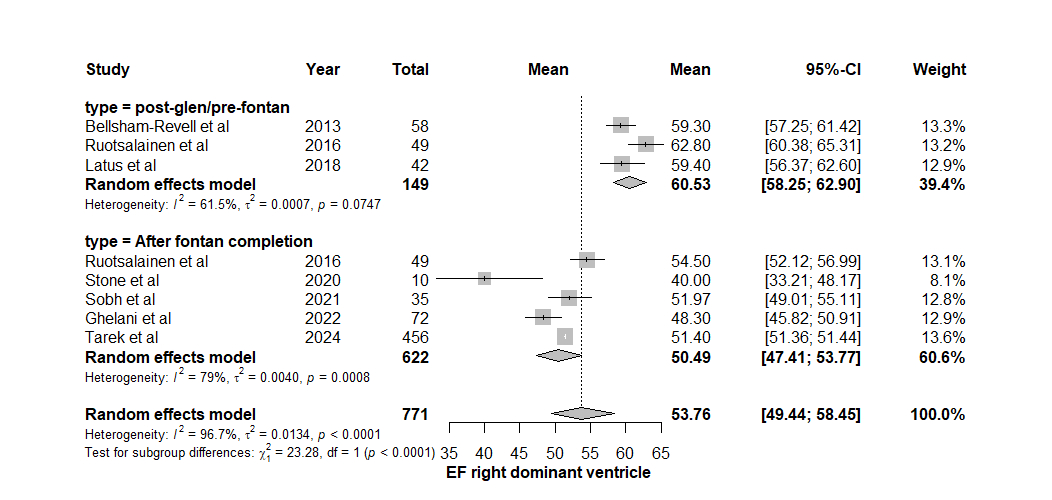
We included 23 studies with a total of 2318 patients in our meta-analysis. Twelve (37%; 858/2318) and five (30%; 717/2318) studies reported data on right and left ventricular (LV) cohorts, respectively. Twelve studies also consisted of a mixed ventricular cohort (33%; 765/2318). The timing between Fontan and CMR was between 10 and 15 years. From Norwood to Fontan completion in right ventricular (RV) patients, iEDV reduced and further increased (101.03 ml/m2 vs 88.89 ml/m2 vs 96.14 ml/m2; p=0.01) (Figure 1). Post-glenn and Fontan completion outcomes for the RV FSV cohort continue as follows: increased iESV (36.68 ml/m2 vs 63.85 ml/m2; p<0.05) (Figure 2), reduced ejection fraction (EF) (60.53% vs 50.49%; p<0.05) (Figure 3), maintained stroke volume (51.90 ml/m2 vs 51.14 ml/m2; p=0.63), and reduced cardiac index (4.65 L/min/m2 vs 4.21 L/min/m2; p=0.02). In the mixed cohort, the reduction in iEDV (101.34ml/m2 vs 86.89ml/m2; p=0.15) and iESV (52.05ml/m2 vs 37.53ml/m2; p=0.16) observed post-glenn and after Fontan were not significant. The LV cohort only had post-Fontan data, and our pooled mean iEDV was 88.63 ml/m2 (95% CI: 83.28-94.32), mean iESV of 42.33 ml/m2 (95% CI: 37.81-47.38), and mean EF of 51.44% (95% CI: 47.72-55.44).

Conclusion
In our systematic review and meta-analysis examining ventricular volumetric changes in FSV patients, RV FSV patients developed ventricular dysfunction with increased volume over time.
  • Danso, Kwadwo  ( UICOM Peoria , Peoria , Illinois , United States )
  • Bogarapu, Soujanya  ( UICOM Peoria , Peoria , Illinois , United States )
  • Author Disclosures:
    Kwadwo Danso: DO NOT have relevant financial relationships | Soujanya Bogarapu: No Answer
Meeting Info:

Scientific Sessions 2025

2025

New Orleans, Louisiana

Session Info:

Unmasking Congenital Complexity: Advancing the Role of Cardiac Imaging

Monday, 11/10/2025 , 01:45PM - 02:45PM

Moderated Digital Poster Session

More abstracts on this topic:
A Growing Burden of Electronic Medical Record Messages in ACHD Care

Dailey Schwartz Andrew, Alegria Jorge

4D Flow MRI Allows for Enhanced Characterization of Aortic Regurgitation

Avgousti Harris, Johnson Ethan, Berhane Haben, Thomas James, Allen Bradley, Markl Michael, Appadurai Vinesh

More abstracts from these authors:
You have to be authorized to contact abstract author. Please, Login
Not Available