
Logo

American Heart Association

  17
  0


Final ID: 4338173

Chronic Stress and Mortality Among Adults with Abnormal Ankle-Brachial Index in Rural South Africa: A Longitudinal Analysis of the HAALSA Cohort

Abstract Body (Do not enter title and authors here): Background: Individuals with an abnormal ankle brachial index (ABI) are at risk for peripheral artery disease (PAD), a condition linked to elevated psychological stress and mortality. Despite this risk, limited research examines the stress-mortality relationship among those with abnormal ABI. We estimated the association between chronic stress and all-cause mortality among those with abnormal ABI in a sample of older adults from rural South Africa, a population with high exposure to lifecourse stressors (e.g., Apartheid and HIV epidemic).

Hypothesis: High chronic stress among those with abnormal ABI is associated with an increased risk of all-cause mortality.

Methods: We used data from the population-representative Health and Aging in Africa: Longitudinal Studies in South Africa (HAALSA) cohort and an underlying annual census, the Agincourt Health and socio-Demographic Surveillance System. We identified participants with abnormal ABI (ABI≤1.00), who were then classified as having hemodynamic (ABI≤0.90) or borderline PAD (ABI≤1.00 & >0.90). Chronic stress was estimated via a biomarker-based allostatic load (AL) score (range: 0-5) and dichotomized as low (0-2 points) vs. high (3-5 points). Biomarkers comprising the score were HDL cholesterol, C-reactive protein, blood glucose, waist-to-hip ratio, and resting heart rate. We fit extended Cox Proportional Hazards models estimated at 1-month intervals to test the association between AL and all-cause mortality. Models were covariate-adjusted and inverse probability weighted to account for differential attrition.

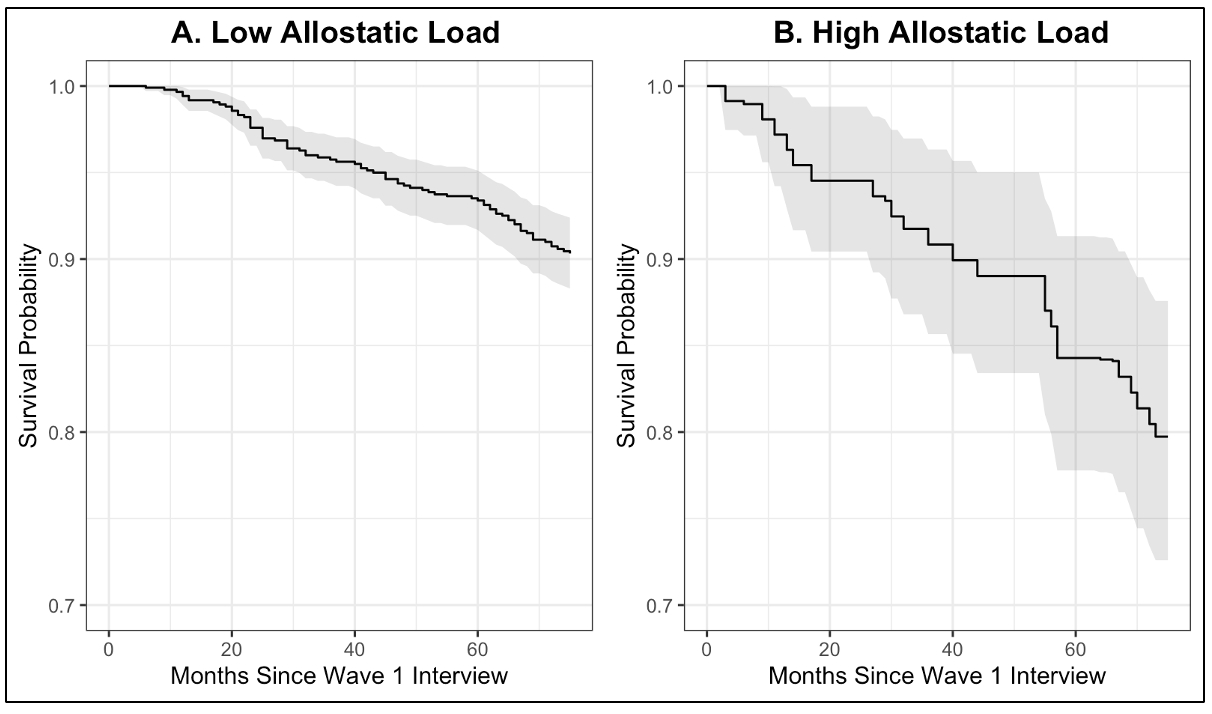
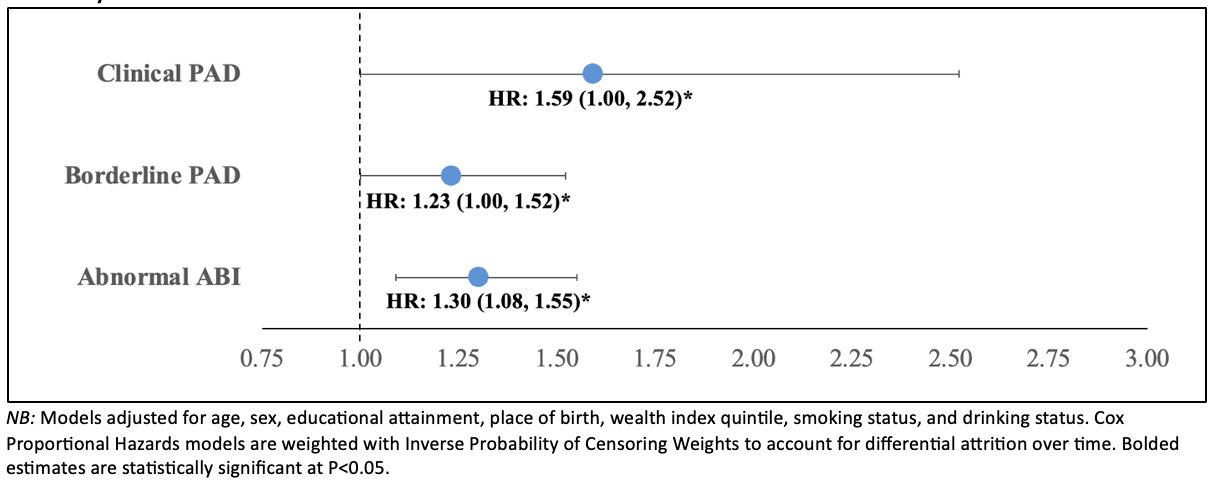
Results: We identified n=953 HAALSA participants with abnormal ABI (hemodynamic PAD: n=113; borderline PAD: n=840). For those with abnormal ABI, each 1-point increase in AL was associated with a 34% increase in the hazard of all-cause mortality (HR: 1.34, 95% CI: 1.11-1.60). Those with high AL exhibited double the hazard of all-cause mortality compared to those with low AL (HR: 1.99, 95% CI: 1.22-3.25). A larger effect was observed for hemodynamic PAD, where high AL was associated with 3.4-times the hazard of death compared to low AL (HR: 3.44, 95% CI: 1.09-10.91).

Conclusion: AL was strongly associated with the risk of death in an aging population with abnormal ABI in rural South Africa, highlighting the importance of stress as a potential modifiable risk factor. Stress should be measured to identify individuals at heightened risk for premature mortality and explored as an intervention target for this group.
  • Beidelman, Erika  ( Indiana University , Bloomington , Indiana , United States )
  • Rosenberg, Molly  ( Indiana University , Bloomington , Indiana , United States )
  • Ludema, Christina  ( Indiana University , Bloomington , Indiana , United States )
  • Mall, Sumaya  ( University of the Witwatersrand , Johannesburg , South Africa )
  • Kalbaugh, Corey  ( Indiana University , Bloomington , Indiana , United States )
  • Author Disclosures:
    Erika Beidelman: DO NOT have relevant financial relationships | Molly Rosenberg: DO NOT have relevant financial relationships | Christina Ludema: No Answer | Sumaya Mall: No Answer | Corey Kalbaugh: DO NOT have relevant financial relationships
Meeting Info:

Scientific Sessions 2025

2025

New Orleans, Louisiana

Session Info:
More abstracts on this topic:
Accessibility of Vascular Surgeons in Communities at High Risk for Peripheral Artery Disease

Quinn Patrick, Armstrong Molly, Campbell Drayson, Corriere Matthew

A Body Shape Index at Age 25-64 Predicts Mortality and CHD Hospitalization

Shafran Itamar, Krakauer Nir, Krakauer Jesse, Cohen Gali, Gerber Yariv

You have to be authorized to contact abstract author. Please, Login
Not Available