
Logo

American Heart Association

  18
  0


Final ID: MP806

Iron Deficiency And Quality Of Life In Patients With Chronic Heart Failure Treated With Liposomal Bivalent Stabilized Iron Sulfate

Abstract Body (Do not enter title and authors here): INTRODUCTION. Iron deficiency (ID), affecting up to 50% of Chronic Heart Failure (CHF) patients, is associated with higher mortality, worse symptoms, poorer quality of life and impaired exercise capacity.
Chronic inflammation in CHF promotes functional ID through elevated hepcidin levels, impairing iron availability and worsening anemia.
The stabilized bivalent liposomal iron (SBLI) bypasses the absorption channel blocked by hepcidin and is directly absorbed by enterocyte cells, allowing immediate and high bioavailability.
In previous trials, oral iron therapy has never demonstrated, unlike intravenous administration, an improvement in functional capacity and quality of life in these patients.
The aim of our study was to evaluate the efficacy of SBLI in increasing the availability of circulating iron, in patients with CHF, as well as its effects on quality of life.
METHODS. 59 patients (mean age 68±12 years) with CHF and reduced or mildly reduced ejection fraction and confirmed ID were enrolled in the study. ID was defined as ferritin levels <100 μg/L or ferritin levels of 100 to 299 μg/L along with Transferrin Saturation (TSAT)<20%.
Patients were randomized in a double-blind manner to receive SBLI (30 mg twice daily for 1 month, then once daily for an additional 2 months) or placebo. Kansas City Cardiomyopathy Questionnaire (KCCQ) scores were acquired at baseline and after three months of therapy.
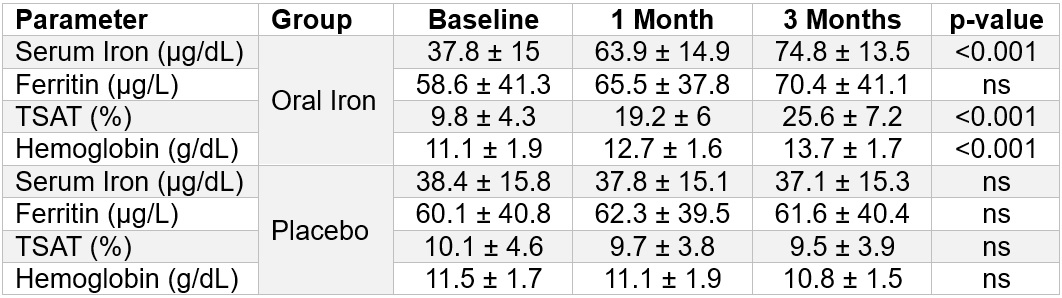
RESULTS. Baseline characteristics and blood parameters were similar in both groups and all patients were on optimal medical therapy. Blood parameters are reported in Table 1.
KCCQ Overall Summary Score significantly improved, in the treatment arm, from 48.9±18.50 to 62.1±13.8 (p<0.001), but not in the placebo arm (from 48.1±16.9 to 50.2±12.2, p=0.06).
CONCLUSIONS. The positive impact of oral SBLI on iron balance and quality of life underscores its potential as a therapeutic intervention for CHF patients with ID.
Its ability to bypass the hepcidin-mediated absorption block allows for a more effective increase in iron balance compared to other formulations. It increases iron bioavailability instead than quick iron storage, avoiding elevated risk of oxidative stress, membrane damage and ferroptotic cell death. It also represents an excellent therapeutic choice in terms of cost-effectiveness.
This clinical trial is the first to show that oral SBLI therapy improves quality of life in CHF patients as well as iron bioavailability. Future research can validate these findings.
  • Tagliamonte, Ercole  ( Umberto I Hospital , Nocera Inferiore , Italy )
  • Civale, Alessandra  ( P.O. A. Tortora , Pagani , Italy )
  • Marotta, Luigi  ( Umberto I Hospital , Nocera Inferiore , Italy )
  • Esposito, Gennaro  ( Umberto I Hospital , Nocera Inferiore , Italy )
  • Miele, Tiziana  ( Umberto I Hospital , Nocera Inferiore , Italy )
  • D'andrea, Antonello  ( Umberto I Hospital , Nocera Inferiore , Italy )
  • Author Disclosures:
    Ercole Tagliamonte: DO NOT have relevant financial relationships | Alessandra Civale: DO NOT have relevant financial relationships | Luigi Marotta: No Answer | Gennaro Esposito: No Answer | Tiziana Miele: No Answer | Antonello D'Andrea: No Answer
Meeting Info:

Scientific Sessions 2025

2025

New Orleans, Louisiana

Session Info:

Iron Deficiency and Volume Overload: Tackling Symptom Burden in Heart Failure

Saturday, 11/08/2025 , 12:15PM - 01:30PM

Moderated Digital Poster Session

More abstracts on this topic:
Aggressive Risk factor REduction STudy for Atrial Fibrillation (ARREST-AF) implications for ablation outcomes: A Randomized Clinical Trial

Pathak Rajeev, Mahajan Rajiv, Abhayaratna Walter, Kalman Jonathan, Sanders Prashanthan, Elliott Adrian, Lau Dennis, Middeldorp Melissa, Linz Dominik, Fitzgerald John, Ariyaratnam Jonathan, Malik Varun, Noubiap Jean Jacques

A novel LMNA mutant (R225X) leads to cardiac conduction disorders

Li Tingting, Chelu Mihail, Wang Xiaolei, Song Jia, Li Luge, Gutierrez Yaqueline, Shinohara Anna, Whitfield William, Adeleye Adeniyi, Li Na

You have to be authorized to contact abstract author. Please, Login
Not Available