
Logo

American Heart Association

  16
  0


Final ID: MP2529

Functionally Bicuspid Quadricuspid Aortic Valve with Mixed Valve Disease and Ascending Aortic Aneurysm

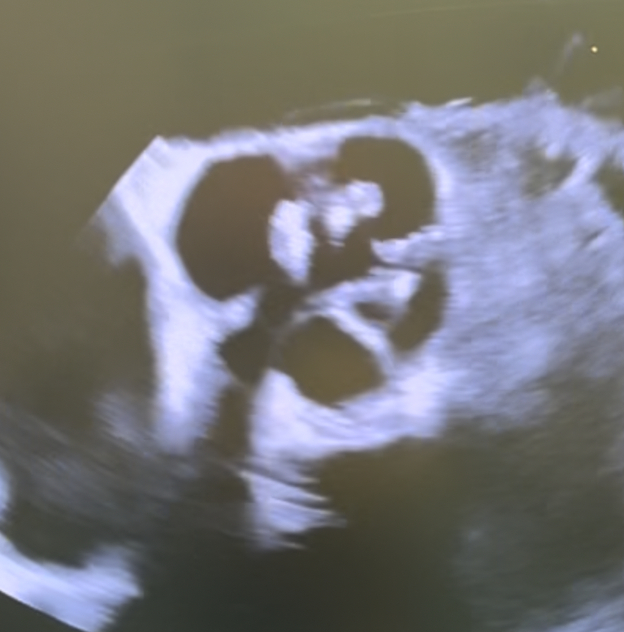
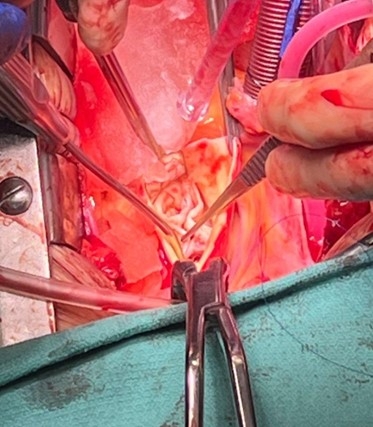
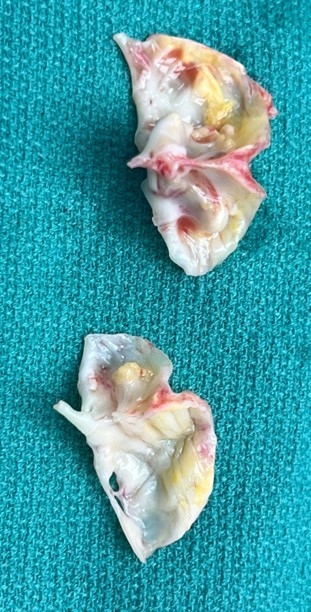
Abstract Body (Do not enter title and authors here): Description of Case: A 58-year-old man presented with progressive fatigue and dyspnea. Echocardiography showed mixed valve disease with severe aortic stenosis (AS), severe aortic regurgitation (AR), left ventricular hypertrophy, and preserved ejection fraction. Coronary angiography was normal. Chest computed tomography angiography revealed a quadricuspid aortic valve (QAV) with severe calcification and aneurysmal dilation of the ascending aorta to 47 mm. At the time of the operation, the quadricuspid valve was functionally bicuspid, with two raphes. An additional cusp was present between the right and left coronary cusps (Nakamura Type 1) with 2 equal larger cusps and 2 unequal smaller cusps (Hurwitz and Roberts Type F). The right and supernumerary cusps, and the left and non coronary cusps, were fused respectively. All cusps were significantly thickened and calcified. The degenerated valve was excised and replaced with a size 27 bioprosthetic valve. The ascending aorta was resected and replaced with a straight graft. Postoperative echocardiography confirmed a low mean gradient and normal function, and the patient had an uncomplicated recovery.
Discussion: QAV is a rare congenital anomaly found in less than 0.05% of the general population and less than 1.5% of patients undergoing aortic valve surgery. Anatomic QAV with functionally bicuspid morphology and ascending aortic dilation (> 45 mm) is rarer still, with unclear etiology and surgical implications. The most common valvular dysfunction with QAV is AR, with pure AS and mixed valve disease occurring in only 0.7% and 8.4% of QAV cases, respectively. Although AR is typically managed with surgical repair, QAV-related AR often requires valvular replacement, either immediately or after initial repair attempts. The functional bicuspid nature of the QAV in this case may help explain the presence of severe AS and ascending aortic dilation, conditions that are less common in QAV but more prevalent in bicuspid aortic valves (BAVs). This case emphasizes the complexity of managing QAV, particularly when severe AS and calcification preclude valve repair. The concomitant ascending aortic aneurysm necessitated combined surgical intervention, highlighting the need for comprehensive preoperative planning. The case suggests that the association between QAV and ascending aortic aneurysms is understudied, especially in the setting of functionally BAVs.
  • Meldrum, Danika  ( University of Michigan , Brighton , Michigan , United States )
  • Hamilton, Barbara  ( University of Michigan , Brighton , Michigan , United States )
  • Author Disclosures:
    Danika Meldrum: DO NOT have relevant financial relationships | Barbara Hamilton: DO NOT have relevant financial relationships
Meeting Info:

Scientific Sessions 2025

2025

New Orleans, Louisiana

More abstracts on this topic:
More abstracts from these authors:
Case Presentation: LIfetime Management in 65-79 Year Olds

Hamilton Barbara, Scrimgeour Laura, Bromberger Bianca

Case Presentation: Acute Coronary Syndrome in a Patient with h/o TAVR

Wang Hanghang, Hamilton Barbara

You have to be authorized to contact abstract author. Please, Login
Not Available