
Logo

American Heart Association

  141
  0


Final ID: Mo2137

Bundle Payment Reimbursements and Atrial Fibrillation Ablation Outcomes: Analysis of Real-World Data

Abstract Body (Do not enter title and authors here): Background: Bundled payments represent a shift in reimbursement models, promoting value-based care by providing providers a predetermined payment per episode of care rather than fee-for-service. This model incentivizes optimizing patient care while reducing spending on unnecessary tests, treatments, and days hospitalized. Atrial fibrillation (AF) ablation procedures transitioned to bundled payment reimbursements starting January 1, 2022.
Research Question: What impact has value-based care made on patient care treatments and outcomes?
Methods: This retrospective study utilized the TriNetX Global Research Network to review and compare patient outcomes for AF ablation patients (CPT code 93656) the year leading up to (Jan 1 – Dec 30, 2021) and year subsequent (Jan 1 – Dec 30, 2022) initiation of bundle payments. Propensity score matching was applied to balance cohorts based on demographic characteristics and comorbidities. One-year post-ablation complication rates were analyzed.
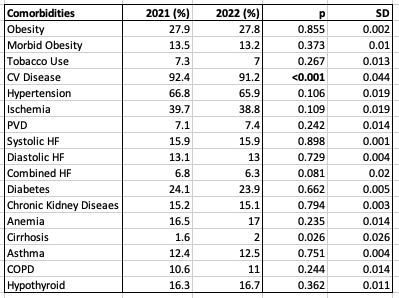
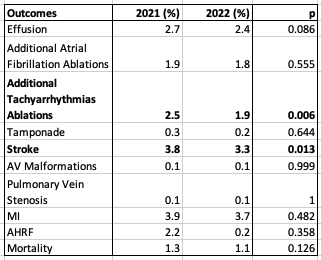
Results: Propensity score matching of the pre-bundle (N = 14,690) and post-bundle cohorts (N = 16,734) resulted in 14,687 patients from 91 U.S. healthcare organizations. The post-bundle cohort suffered a lower prevalence of circulatory system diseases (ICD-10 code I00-I99) compared to the pre-bundle cohort (91.2% vs 92.4%, p<0.001). The post-bundle cohort was less likely to undergo ablations for subsequent tachyarrhythmias (1.9% vs 2.5%, p=0.006) and lower stroke rates one-year post-ablation (3.3% vs 3.8%, p=0.013).
Conclusion: The transition to bundle payment reimbursements for AF ablation procedures was associated with a significant reduction in post-ablation stroke rates and a reduced likelihood of undergoing additional ablations for tachyarrhythmias. Future studies should focus on financial analyses of the AF ablation bundles to further optimize care under this reimbursement model.
  • Howie, Cole  ( University of Iowa , Iowa City , Iowa , United States )
  • Byer, Stefano  ( University of Iowa , Iowa City , Iowa , United States )
  • Cochran, Ryan  ( University of Iowa , Iowa City , Iowa , United States )
  • Xdominicx, Xpaarix  ( University of Iowa , Iowa City , Iowa , United States )
  • Author Disclosures:
    Cole Howie: DO NOT have relevant financial relationships | Stefano Byer: DO NOT have relevant financial relationships | Ryan Cochran: No Answer | xPaarix xDominicx: DO NOT have relevant financial relationships
Meeting Info:

Scientific Sessions 2024

2024

Chicago, Illinois

Session Info:

Optimizing Outcomes in Atrial Fibrillation - Where Do We Go from Here?

Monday, 11/18/2024 , 01:30PM - 02:30PM

Abstract Poster Session

More abstracts on this topic:
CAR-T-associated Cardiovascular Events are Associated with Increased Resource Utilization

Song Justin, Eradat Herbert, Schiller Gary, Devos Sven, Timmerman John, Stein-merlob Ashley, Neilan Tomas, Larson Sarah, Young Patricia, Mahmood Syed, Yang Eric, Vuong Jacqueline, Mead Monica, Gornbein Jeffrey, Rothberg Michael, Pan Chelsea, Dhaliwal Jasmeet, Boiarsky Jonathan, Gaut Daria

Artificial-Intelligence Based Tracking of Atrial Fibrillation Waves that Exit Pulmonary Veins Predicts Response to Ablation

Anbazhakan Suhaas, Abad Juan Ricardo Carlos, Ruiperez-campillo Samuel, Rodrigo Miguel, Narayan Sanjiv

More abstracts from these authors:
Device Extraction Improves Survival in ESRD Patients with CIED Infections

Byer Stefano, Alzahrani Ashraf, Farjo Peter, Powers Edward, Xdominicx Xpaarix

Implanted Vagus Nerve Stimulators Show Reduced Risk of Developing Atrial Fibrillation and Supraventricular Tachycardia

Williams Ryan, Howie Cole, Farjo Peter, Dominic Paari

You have to be authorized to contact abstract author. Please, Login
Not Available