
Duration of Cardiopulmonary Resuscitation Enhances Prognostic Stratification in Cardiogenic Out-of-Hospital Cardiac Arrest
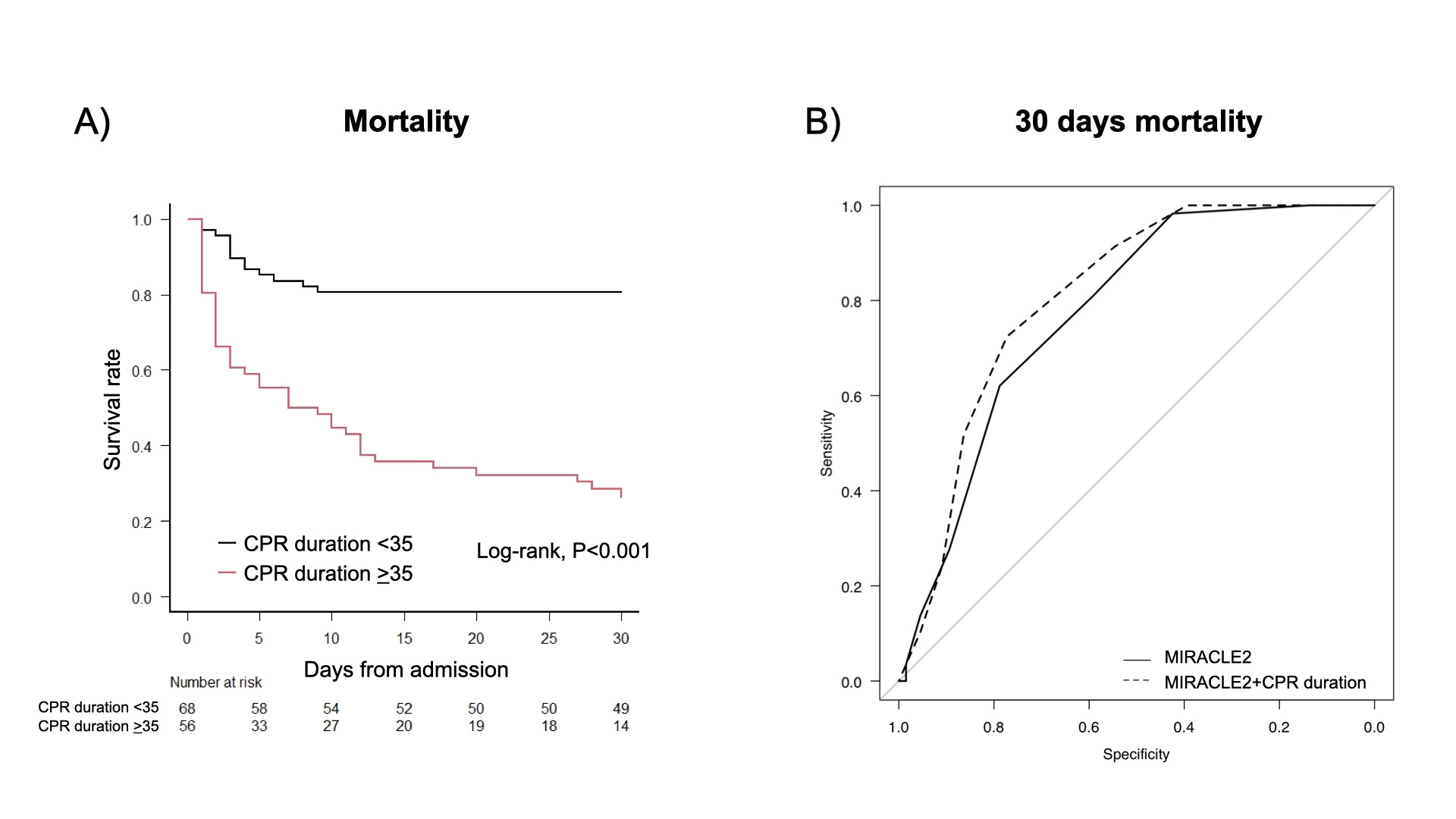
Abstract Body (Do not enter title and authors here): Background: Despite advances in treatment strategies for out-of-hospital cardiac arrest (OHCA), prognosis remains poor. The MIRACLE2 score is an established prognostic predictor, but does not consider the duration of cardiopulmonary resuscitation (CPR), a critical determinant of outcomes. Stratifying risk at admission is crucial for guiding subsequent management decisions. Aims: To evaluate the prognostic value of CPR duration in patients with cardiogenic OHCA and assess its additive predictive utility beyond the MIRACLE2 score. Methods: We conducted a single-center, observational study (COEDO-CPA registry) of cardiogenic OHCA patients from 2018 to 2024. Receiver operating characteristic (ROC) analysis identified the optimal CPR duration cut-off for predicting 30-day mortality. We compared the predictive performance of MIRACLE2 score alone versus combined with CPR duration. Results: A total of 124 consecutive cardiogenic OHCA patients was ultimately analyzed, with an average age of 62.6 years; 87% were male, and the average MIRACLE2 score was 3.0. ROC analysis identified 35 minutes as the optimal CPR duration cut-off for 30-day mortality. Kaplan-Meier analysis revealed significantly higher mortality in patients with CPR duration >35 minutes (Log-rank p<0.001, Figure A). Multivariable Cox regression model showed CPR duration >35 minutes independently predicted mortality after adjusting for MIRACLE2 score (HR: 3.41, 95% CI: 1.82-6.39). Additionally, compared to MIRACLE2 score alone, combining MIRACLE2 score with CPR duration >35 minutes improved prediction of 30-day mortality (AUC: 0.81 vs. 0.78, p=0.005, Figure B). Conclusion: In cardiogenic OHCA patients, CPR duration >35 minutes independently stratified mortality risk and enhanced the accuracy of existing prognostic models like MIRACLE2 score. Incorporating CPR duration could improve risk assessment and guide management decisions in this high-risk population.
Numaga, Miki
(
Saitama Medical Center
, Saitamacity , Japan )
Abe, Takuro
(
Saitama Medical Center
, Saitamacity , Japan )
Miyoshi, Kotaro
(
Saitama Medical Center
, Saitamacity , Japan )
Yoneyama, Fumika
(
Saitama Medical Center
, Saitamacity , Japan )
Kitagawa, Kai
(
Saitama Medical Center
, Saitamacity , Japan )
Hashimoto, Junki
(
Saitama Medical Center
, Saitamacity , Japan )
Ogata, Madoka
(
Saitama Medical Center
, Saitamacity , Japan )
Okuda, Nozomiko
(
Saitama Medical Center
, Saitamacity , Japan )
Kawahara, Yuki
(
Saitama Medical Center
, Saitamacity , Japan )
Tani, Akihiro
(
Saitama Medical Center
, Saitamacity , Japan )
Ando, Toshiyuki
(
Saitama Medical Center
, Saitamacity , Japan )
Komiyama, Hideori
(
Saitama Medical Center
, Saitamacity , Japan )
Ishihara, Shiro
(
Saitama Medical Center
, Saitamacity , Japan )
Jujo, Kentaro
(
Saitama Medical Center
, Saitamacity , Japan )
Author Disclosures:
Miki Numaga:DO NOT have relevant financial relationships
| Akihiro Tani:DO NOT have relevant financial relationships
| Toshiyuki Ando:No Answer
| Hideori Komiyama:No Answer
| Shiro Ishihara:DO NOT have relevant financial relationships
| Kentaro Jujo:DO NOT have relevant financial relationships
| Takuro Abe:DO NOT have relevant financial relationships
| KOTARO MIYOSHI:DO NOT have relevant financial relationships
| Fumika Yoneyama:DO NOT have relevant financial relationships
| Kai Kitagawa:No Answer
| Junki Hashimoto:No Answer
| Madoka Ogata:No Answer
| Nozomiko Okuda:No Answer
| Yuki Kawahara:No Answer